
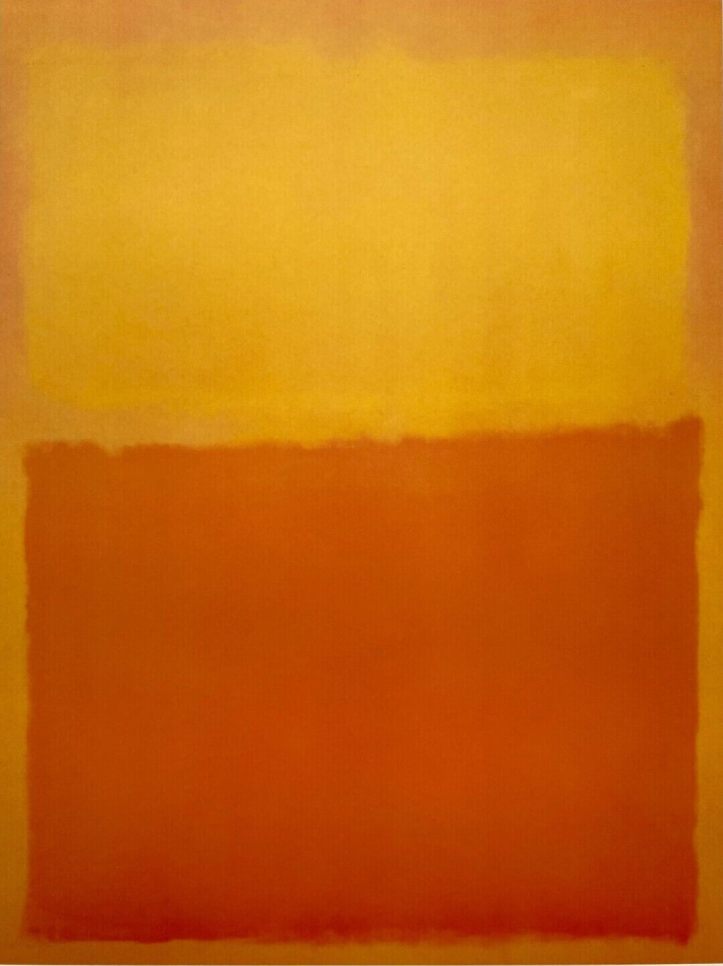
Okay, we bought a book last week called Abstract Expressionism by David Anfam. Since we’re now really getting into our art stuff, we’re reading that for review next week—be prepared for us to pontificate at you over the matter.
In the work a certain Mark Rothko (1903-1970) features heavily. An American abstract painter, who was born in the western region of Russia, and from a family of intellectuals. As he was Jewish, he faced a lot of persecution in his youth and this influenced the themes across his career.
THUS! We’re here to explore his work, with nods to the pieces we like best and an overview of Rothko’s brilliant career.
Emotions and Colours in Mark Rothko’s Whirly World
“I’m interested only in expressing basic human emotions—tragedy, ecstasy, doom, and so on.”
Rothko believed he could best convey human emotions, and drama, through abstract images. If you’re not into this type of art, it may just look like a mishmash of stuff jammed together that takes a minute to thrash out.
But his approach shows how much thought goes into it.
Now, we love this type of thing. Minimalistic yet eye-catching, which artists such as Georgia O’Keefe also mastered. Wavy lines and mergers of colour combinations.
The difference here is Rothko pretty abandoned naming most of his pieces. The likes of the below are nameless—just abstractions. Each one being whatever you want it to be. A sunset? Desert mirage?

It was in the 1940s when he really settled into his stride, introducing a new compositional format. He never did accept perfection with that, continuing to develop it until up until his death in 1970.
And in the 1950s, this became his “classic” era of most famous pieces. The National Gallery of Art (Washington, D.C.) described it like this:
“His classic paintings of the 1950s are characterized by expanding dimensions and an increasingly simplified use of form, brilliant hues, and broad, thin washes of color. In his large, floating rectangles of color, which seem to engulf the spectator, he explored with a rare mastery of nuance the expressive potential of color contrasts and modulations.”
But other than his brief commentary that his work covered “ecstasy” and “tragedy”, he didn’t comment much on his pieces.

The above has us thinking of many things. It feels oddly familiar, but we’re not sure why. It could just be a bit of sushi, or is it representing a nuclear explosion?
It’s intriguing work and it all hails from Rothko’s difficult, stressful life, times, and the world he was trying to make sense of.
The Life and Times of Mark Rothko
Still being quite new to a deeper art exploration, we hadn’t heard of Rothko until recently. For us, this art thing is a new creative discovery process. Like when we got into classical music back in 2011—we’re still learning about that all now.
Rothko was famous in his era, as pre-eminent as Jackson Pollock and Willem de Kooning.
The Rothko family arrived in the US as migrants in late 1913. Mark Rothko attended Yale University from 1921 and then Parsons School of Design in 1925. He was heavily influenced by Arshile Gorky (1904-1948), who also turned his personal suffering (during the Armenian genocide of 1915-1917) into creative expression.
Once Rothko settled into his work he (as mentioned at the start of this piece) was interested in covering “basic” human emotions (doom, ecstasy, tragedy), but those are pretty complicated feelings right there. He lived through a period of incredible tumult—two world wars, the nuclear bomb etc.
Rothko said he felt he was successful in his work, as some people were known to break down and cry when observing his paintings. There seems to have been a wry, macabre sense of satisfaction in that! Mission accomplished, as it were.
But from his earlier life experiences, he suffered with severe anxiety issues. He self-medicated in a lot of alcohol and cigarettes to alleviate those issues. Despite doctor’s orders, he continued drinking, didn’t exercise, and ate unhealthily. Naturally, that diet just made him more anxiety-ridden (as if you eat crap, you’ll feel like crap). Unfortunately, it reached such a painful peak for the artist he ended his life.
In the final few months of his life he’d been painting a Black on Grays series, such as below, perhaps indicating he wasn’t in the best of mental health.
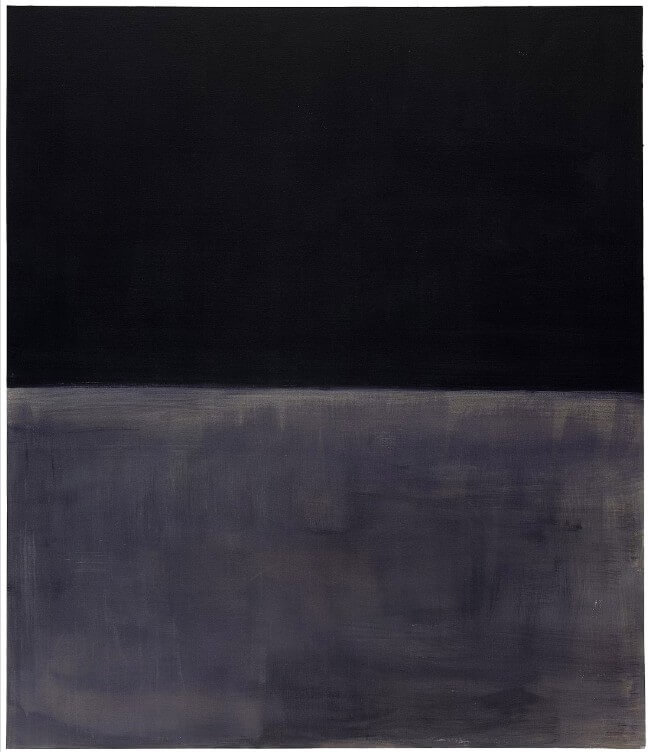
The colour scheme matching his state of mind may be a little too reductionistic as a thought process. Maybe he was just experimenting with these colours and it was just a coincidence.
But we have seen some artists reflect their poor state of mind in their work. Genius/madman Caravaggio was in such a paranoid state near the end of his life (at 38), he painted himself getting beheaded over and over.
Whatever was going on for Rothko, by February 1970 at age 66 he’d had enough.
Other than his brief commentary that his work covered “ecstasy” and “tragedy”, he didn’t comment much on his pieces. It’s all left open to interpretation, as one of the things about abstract art… well, for some people it’ll look like total bollocks.
To others, it’ll open a world of thought. Some of that may open a world of pretentious bollocks, too, but ditching the whole ego thing—these are beautiful paintings. For us, they stir up all manners of thoughts. Maybe it’s because we’re ASD, but the whole abstract shindig just does it for us.

All killer, no filler.
LikeLiked by 1 person
Rather!
LikeLiked by 1 person