
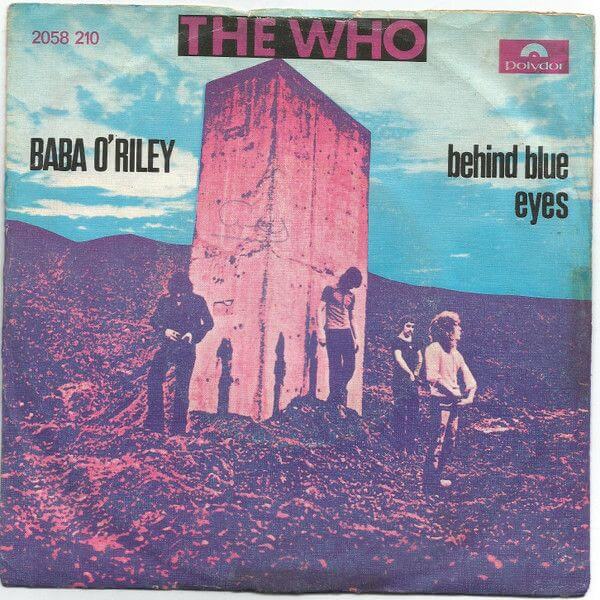
Baba O’Riley is simultaneously one of The Who’s best and weirdest songs. Written and created by Pete Townshend, it showed his growing confidence in creating new types of music for the band.
It remains a fan favourite, too, and one of the band’s core live set numbers (often closing out gigs in euphoric fashion). But its history is just as intriguing, as songwriter Pete Townshend had a troubled time bringing it into existence.
Meher Baba and Marimba Loops in Baba O’Riley
After the colossal success of Pete Townshend’s rock opera Tommy (1969), The Who had launched to superstardom. They toured the world extensively, particularly in America, and released the iconic Live at Leeds album in 1970.
Whilst all that played out, and the band lapped up the plaudits, Townshend had a creative problem—what to do after Tommy.
The idea he came up with was called Lifehouse, based on his experiences performing Tommy live. The vibrations he saw from how loud the band played led him to think the audience could:
“Dance themselves into oblivion.”
Channelling philosopher Inayat Khan (1882-1927) and Townshend’s great spiritual guru Meher Baba (1894-1969), The Who’s figurehead viewed Lifehouse as a chance to reflect the individual experiences of audience members. He turned to new synthesiser technology to achieve this sound and began plotting out the new rock opera.
His ideas became so advanced and forward-thinking, he confused the hell out of the other band members. Under creative and commercial pressure to deliver a new album, Townshend promptly had a nervous breakdown.
Realising no one understood the Lifehouse project except himself, he abandoned the project for the good of his mental health.
Reverting to a traditional rock album, he picked a few tracks he’d written for Lifehouse and dumped them into what became Who’s Next (1971).
The album opens with Baba O’Riley, with its hypnotic electronic rhythm. That’s called an ostinato, a looping musical note at the same pitch. Townshend initially wanted to enter Meher Baba’s life details into a synthesiser and see what this data would produce. When that didn’t work, he used a Lowrey Deluxe TBO-1 and a marimba African beat style repeat function to generate the pulsating noise.
Indian composer Terry Riley is famous for this approach, with his surname being added into Baba O’Riley’s title as a tribute.
The band initially had a 30 minute take of the song, before whittling it down to five minutes.
The Who’s drummer (Mr. Keith Moon) apparently suggested the violin closing section, where the looping noise swells up and reaches its peak. Dave Arbus of the band East of Eden performed the violin solo.
We must note, this is also a classic example of Moon’s drumming prowess, showing great restraint when necessary, between landing two absolutely awesome drum fills across the song.
However, and despite opening Who’s Next, they didn’t release the song as a single.
That was likely as it was considered too long, an issue bands faced with radio time. It was only when Queen launched Bohemian Rhapsody in 1975 that longer songs became more socially acceptable (ahem) as singles.
The Lyrical Structure of Baba O’Riley
The song’s lyrics are the early sections of the story Lifehouse would have been. But in the context of the rest of Who’s Next that don’t have any relevance.
Out here in the fields,
I fight for my meals,
I get my back into my living.I don’t need to fight,
To prove I’m right,
No I don’t need to be forgiven.Don’t cry,
Don’t raise your eye,
It’s only teenage wasteland.Sally take my hand,
We’ll travel south cross land,
Put out the fire,
And don’t look past my shoulder.The exodus is here,
The happy ones are near,
Let’s get together, before we get much older.Teenage wasteland,
It’s only teenage wasteland,
Teenage wasteland,
Oh yeah, teenage wasteland,
They’re all wasted!
Townshend has said he’s surprised people find the song “uplifting”. Although it’s not that surprising to us, it’s an upbeat sort of song.
But he’s said the closing lyrics are specifically about the notorious mud bath the iconic Woodstock 1969 music festival turned into.
It was that and the Isle of Wight festival the band attended in 1969. Townshend hated the whole Woodstock experience and was also alarmed by the sheer number of teenagers who had bad episodes after taking acid—”they’re all wasted”. Some were left with brain damage.
Away from that, the festivals also resulted in a colossal amount of mess and devastation left at the site (500,000 people attended Woodstock without proper toilet facilities etc.). Townshend was left baffled by the mess.
But the song is about the “absolute desolation of teenagers at these festivals in the hippy era of LSD dropping etc.
Worth remembering, as over the last 50 years Woodstock has gained a reputation as the peak moment of hippy, counterculture perfection. There was some of that, but also a lot of mud and some very out of it young people. The Band’s drummer Levon Helm described it as a “warzone”.
Notable Live Performances of Baba O’Riley
The song has been a mainstay in The Who’s live act since 1971. There are plenty of live recordings to pick from, but we particularly like the above one from Wembley in 2019.
Roger and Pete were 74 and 75, respectively, in the above clip. And still giving it plenty of welly!
Baba O’Riley did pose something of a problem for the band regarding the violin solo. They didn’t always have a violinist on hand travelling with them to perform that one segment, when the rest of their songs don’t use violin.
To get around that, singer Roger Daltrey would riff on a harmonica. As seen here at a 1974 gig in Chorlton.
There are so many live versions to choose from across YouTube it’s difficult to pick a total favourite. But the above two get the vibe across, with the second showing original drummer Moon in action.
On a final note, that 1974 gig was to promote the band’s ambitious Quadrophenia album. That launched in 1973, with Townshend able to get his ideas across clearly for that mod-era based rock opera.
