
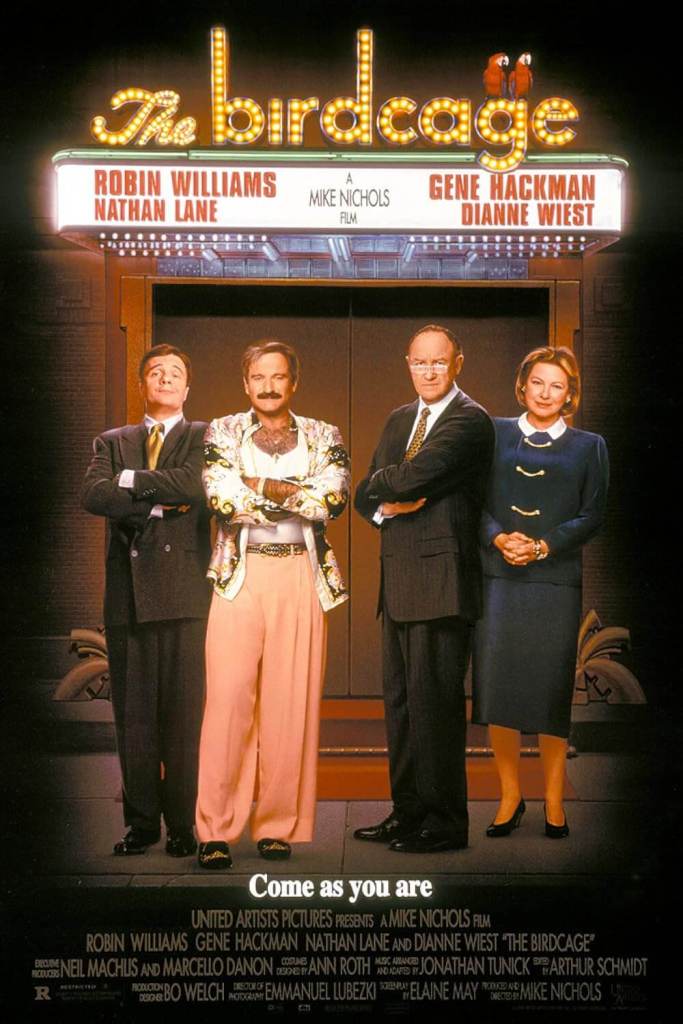
The Birdcage is one of Robin Williams’ lesser-known films, buried beneath all the other massive hit movies he was in during the 1990s. But it’s a lot of fun, ridiculously camp, and very progressive in its themes.
Directed by Mike Nichols, the cast also included Gene Hackman, Nathan Lane, Hank Azaria, Calista Flockhart, and Christine Baranski. There was a lot going on in the story, which has all made it an LGBTQ+ cult classic with a lot to sing and dance about.
A Camp Clash of Ideologies in The Birdcage
Robin Williams was at the peak of his career in 1996 and for him to take on the role of Armand Goldman, one very gay man indeed, is a tribute to his fearlessness.
Back when performing as a gay man would’ve been seen as PROBABLY BEING GAY HIMSELF OMG THE HORROR. And yet most of the lead male actors here were straight guys playing the campest fiends known to history. However, Nathan Lane is openly gay (he told his mother when he was 21 and she said to him, “I’d rather you were dead.” To which he responded, “I knew you’d understand.”).
With a big budget to play with, it remains one of the few major studio released films to feature LGBTQ characters right at the forefront of it all.
The plot follows the life of Armand Goldman (Williams), an openly gay drag club owner in South Beach, Florida. His partner is the flamboyant Albert (Lane), the star attraction at The Birdcage club.
Living above the club they own, they share their flat with ridiculously buff housekeeper Agador Spartacus (Hank Azaria).
It emerges Armand has a 20-year-old son from a drunken one-night-stand, who one day returns home to announce he’s engaged to a woman called Barbara Keeley (Calista Flockheart of later Ally McBeal fame). Flockheart is supposed to be playing a 19-year-old, but was actually 30 at the time of the shoot.
The twist is Barbara’s parents are ultra-Conservative, hate gays, and work for the government. Her father is Senator Kevin Keeley (Gene Hackman).
This setup, given the political state in North America and here in the UK, is astonishing to behold. We do wish we could state it reflected a different time and place, but all these terrible themes have come back to haunt society. For no reason other than mindless bigotry.
To try and help his son, Armand agrees to meet the Keeley family. But convinces Albert and Spartacus to put on a macho, alpha male front over a dinner party. This in the hope the Senator won’t have a problem with Val marrying Barbara.
Thus, Armand tries to teach Albert how to be MANLY.
The setup there is for comedy hijinks as a bunch of very gay men, particularly in the form of Albert, have to try and restrain themselves. The theme, then, is the infiltration of Conservative values into a progressive space, followed by confusion, a clash of ideals, and a happy ending.
That young couple? They get married! The two families put aside their differences for the good of their children. Also, the Senator ends up having to get into drag at one point, too, which he’s seen as enjoying as he bops along to We Are Family.
It’s a feelgood film, then, which marked a change from Hollywood’s other films about gay people. Think of Tom Hanks in Philadelphia (1993) and as important as that film is, it covers a harrowing topic.
The Birdcage does the total opposite and it’s lots of upbeat fun. And what’s impressive is it showing a thriving, loving family at the heart of the plot.
Its wider premise is daft, appropriately tongue-in-cheek, and you can tell the cast was having a blast.
Plus, it all shines through lovingly in a cult classic film with a lot of great humour going for it. Terrific performances, too, with Robin Williams showcasing those effortless comedic flourishes that marked him out as a true star.
The Production of The Birdcage
This was a big production with a $31 million budget. Thanks to the star power of Robin Williams, it was also a hit and made $185.3 million worldwide.
Being young at the time, we had no idea this film existed until recently (it was covered on the brilliant You Are Good podcast). 30 years ago it may have been a hit, but we feel it’s fallen into obscurity a bit since then.
Williams had so many massive films coming out at that time, it’s lost amongst all the others. He was also intended for the role of Albert, but shifted his focus away from the flamboyant nature of that role (wanting a change from that side of his acting repertoire).
Elaine May wrote the screenplay, adapting it from the 1978 French film La Cage aux Folles. That film was adapted from a 1973 play of the same name by French actor, director, and screenwriter Jean Poiret.
Director Mike Nichols allowed Robin Williams and Nathan Lane to improvise throughout the shoot, preferring to film everything like a play. Most of the filming took place in LA, not in Florida, although exterior shots were filmed of the iconic Art Deco District, Miami Beach, and Ocean Drive.
Again, it was a commercial hit.
It also received notable critical acclaim, with one Oscar nomination (Best Art Direction), although it got loads at the American Comedy Awards (winning a batch, too).

Absolutely iconic.
LikeLiked by 1 person
Glad you like! I never saw it until recently. Not sure why, it wasn’t covered really in the UK back in t’ day.
LikeLiked by 1 person
Oh wow! I consider it a classic and feel that it’s pretty well-loved here in the states. Just re-watched it again recently.
LikeLiked by 1 person
Good! Well, it demands more respect in the UK then. Really, I follow various film podcasts here and I’ve not heard it mentioned or seen it reviewed.
My recommendation for you is Withnail & I (if you haven’t seen it). Very British, very funny.
LikeLiked by 1 person