
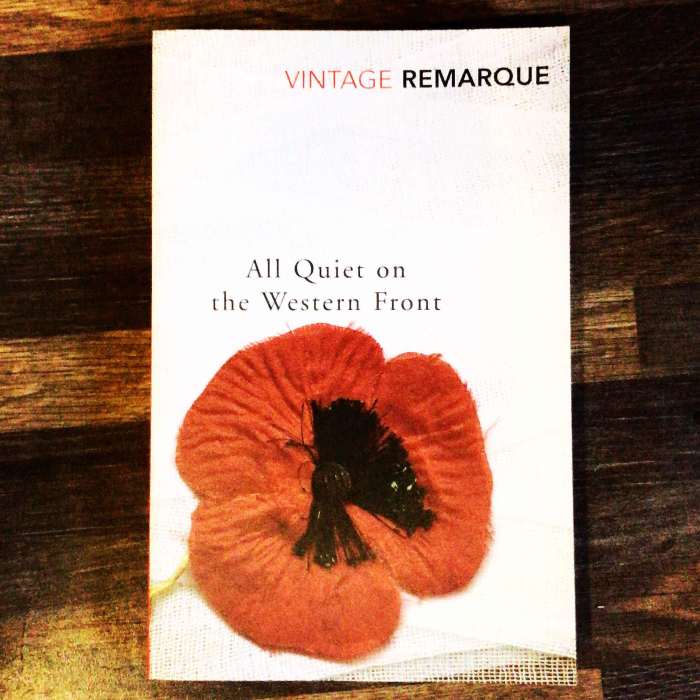
One of the most powerful anti-war statements in literature, All Quiet on the Western Front was first run between November and December 1928 in the German newspaper Vossische Zeitung.
The book publication followed in January 1929 as (Im Westen nichts Neues—”Nothing New in the West”) and author Erich Maria Remarque (1898-1970) followed it with a 1930 sequel called The Road Block.
But it’s the first work that continues to inspire. It was a huge hit and sold over 2.5 million prints in 22 languages within two years of launching. However, it also caused controversy in Nazi Germany and was subjected to book burning purges.
Here’s the story of a remarkable book and its impact on the world.
Remarque’s All Quiet on the Western Front As a Powerful Anti-War Statement
“This book is intended neither as an accusation nor as a confession, but simply as an attempt to give an account of a generation that was destroyed by war – even those of it who survived the shelling.”
Paul Bäumer is the young protagonist of the work, a German soldier who signs on with his friends and is sent to the Western Front of WWI.
Following his idyllic life in a quiet rural German village, he believed it his heroic duty to attend the war and fight for his country.
But the trenches of World War I turn into a living hell (and see the excellent documentary They Shall Not Grow Old for further insights into that) of British bombardments, rats, and freezing conditions.
“I am young, I am twenty years old; yet I know nothing of life but despair, death, fear, and fatuous superficiality cast over an abyss of sorrow. I see how peoples are set against one another, and in silence, unknowingly, foolishly, obediently, innocently slay one another.”
Whilst engaging in regular battles, interspersed with a lot of hunger and muddy conditions of the trenches, Bäumer makes some new friends.
It’s that comradeship that becomes the tragic heart of the story.
One soldier in particular, Stanislaus “Kat” Katczinsky, becomes a close friend of Bäumer’s and the absurdity of their brutal situation doesn’t seem too lost on them.
Whilst trying to cling to some sort of a normal life, the war constantly reminds them it isn’t a possibility. For example, there’s a famous section where Bäumer is stuck in a ditch with a French enemy soldier.
After mortally wounding the man, he’s gradually consumed by sorrow.
“But now, for the first time, I see you are a man like me. I thought of your hand-grenades, of your bayonet, of your rifle; now I see your wife and your face and our fellowship. Forgive me, comrade. We always see it too late. Why do they never tell us that you are poor devils like us, that your mothers are just as anxious as ours, and that we have the same fear of death, and the same dying and the same agony–Forgive me, comrade; how could you be my enemy?”
Bäumer sees his friends die, engages in bloody battles, and the monotony.
The boredom of war, as a lot of the time there’s nothing going on at all. But even then, the lingering sense of death pervades over all.
All of which keeps the story away from any chest beating bravado. It’s not a story of heroism, more a tale of lives wasted. Particularly when Kat is hit by debris in the closing sections of the work, with Bäumer attempting to wrest contact details from his friend so they can catch up after the war.
By the time Kat is dragged back to the infirmary, he’s dead. A shocked Bäumer seems barely able to process the news.
The pacifistic leaning of the work couldn’t be more devastating at times. Remarque steers all of this through the book, mixing the brutality of warfare alongside the nature of the human suffering within.
“How senseless is everything that can ever be written, done, or thought, when such things are possible. It must be all lies and of no account when the culture of a thousand years could not prevent this stream of blood being poured out, these torture-chambers in their hundreds of thousands. A hospital alone shows what war is.”
And whilst a heartbreaking book, it’s also an exceptional one.
It has its place in history as a literary classic with good reason. It’s one of the very best war books thanks to its candid, youthful sense of honest. And how it depicts the devastation on young men lost in senseless battle.
Let it be timeless, then, and read by future generations the world over.
All Quiet on the Western Front’s Banning and Book Burning
Nazi book burnings were run by the German Student Union to try and wipe out texts considered to be liberal, Jewish, communist, socialist, anarchist, or pacifist.
This, once again, highlights how stupid the current mood (as of 2024) is to try and suggest the Nazi party was left-wing.
Previously, we’ve had a Daily Mail reader online try to argue at us the Nazis were left-wing as the party was anti-smoking and pro-animal rights. Selective argument, there!
Anyway, as All Quiet on the Western Front remains so openly anti-war, the Nazis took an extreme dislike to that. And onto the cultural genocide bonfire it went.
Hitler took a particular dislike to this work, whilst venerating Ernst Jünger’s Storm of Steel (1920). And so Remarque’s work was burned as a “degenerate book” in 1933.
In addition, screenings of the 1930 film adaptation met with similar resistance. Nazi protests had mob attacks on cinemas, and audience members, who went to see the film.
We’d like to say things have moved on a great deal since 1930.
But history is repeating all over again circa 2024, with select governments also maintaining this stance towards progressive culture (not naming any names—you already know who they are).
All Quiet on the Western Front’s Various Film Adaptations
Remarque’s book has been the subject of many big screen adaptations. The first arrived only a year after the publication of his book, which is great to think he got to see his work at cinemas.
The 1930 Production
In 1930, the Lewis Milestone directed feature film hit the big screen. It’s an impressive piece of work and won the 1930 Oscar for Best Picture.
This is arguably the most famous adaptation (even over the 2022 one that streamed on Netflix) down to its legendary status.
It was a landmark and ambitious piece of cinema for its era. Directed by Lewis Milestone, writing duties for the script went to Maxwell Anderson, George Abbott, Del Andrews, and C. Gardner Sullivan.
The budget was $1.2 million and it launched in the US on April 21st, 1930. It won Outstanding Production and Best Director at the Oscars.
Interestingly, it’ll also be entering the public domain from January 1st 2026 once the copyright expires, which should help bring this production to a wider audience.
The 1979 US TV Production
In November 1979 there was a television version, which was also a US production.
It was an epic anti-war film and starred Richard Thomas (of The Waltons fame), Ernest Borgnine, Donald Pleasence, and Sir Ian Holm.
Adapted by Paul Monash and directed by Delbert Mann, it stayed faithful to the book. And a lot of effort went in from the crew to make it authentic to the time period.
The effort paid off as it won two Golden Globe Awards and an Emmy. These days, you can pick this version up on Blu-ray.
The 2022 Production
Directed by Edward Berger, this 2022 production launched on Netflix and starred Felix Kammerer, Albrecht Schuch, and Daniel Brühl.
It was a big hit critically, bagging 14 nominations at the 76th British Academy Film Awards and nine Oscar nods. It won four of the latter, including Best International Feature.
We did find this version very dramatic, but very gory. Excessively gory at times, in fact, to the point it was quite repulsive for the sake of it.
Other aspects of the film seemed to lose their way from Remarque’s original book, but it’s down to personal opinion whether you like the differences or not. But, overall, a fine effort of a film.
