
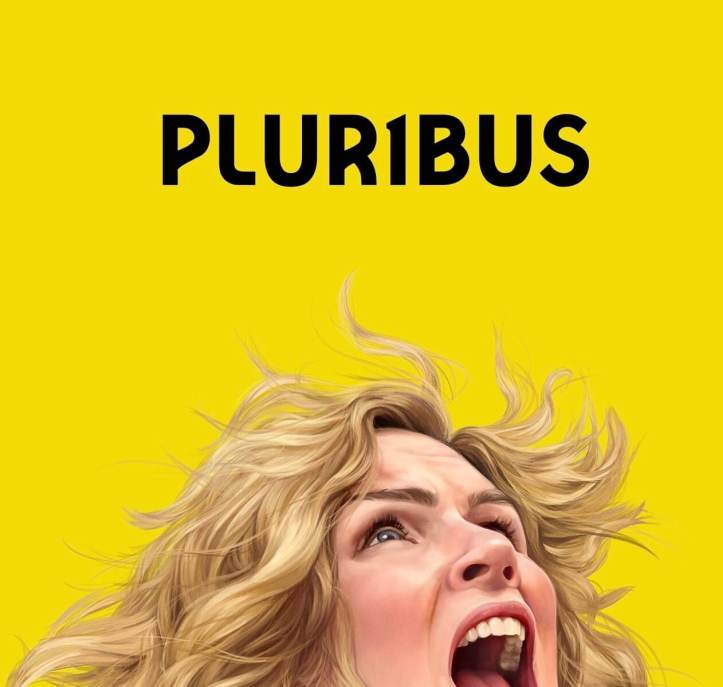
From Vince Gilligan, the creator of the legendary Breaking Bad, here’s the sci-fi dark humour drama thing Pluribus. Launching in November 2025, it stars the brilliant Rhea Seehorn in the lead role of post-apocalyptic survivor Carol Sturka.
Whilst Breaking Bad was a cultural phenomenon, Pluribus’s unusual science fiction hive mind premise is unlikely to lead to the same global response. However, at its peaks it has the trademark moments of Gilligan brilliance and offers intriguing, amusing philosophical considerations.
Nope! Pluribus Delivers the Oddball Philosophical Goods
Away from its high concept sci-fi themes, our main love for Pluribus is in the form of Carol Sturka. We just love her personality, which is acerbic, cynical, cranky, stubborn, and sardonic.
She has this way of abruptly saying “Nope!” to dismiss situations, which we’re going to adopt and plague society with going forward.
She can often be rude, casually bickers with anyone, has caustic putdowns, and rarely hides her feelings. It’s also implied, and then later revealed outright, that she’s had a drinking problem across her adult life.
She’s also uncertain about her career. She’s a successful fantasy romance (romantasy) author with a loyal fanbase, with whom she’s genuinely terrific with. Meanwhile, Sturka lives with her wife Helen in Albuquerque, New Mexico (Vince Gilligan’s favourite location). Her wife is her manager.
We’ve seen some other people online complain that Sturka is “unlikeable”. We guess that’s there opinion! She’s a prickly character, sure, but we spent the entire running time worshipping the ground she walks on (brought so excellently to life by Rhea Seehorn).
Anyway, the show really kicks off at a point when Carol is contemplating working on a more serious novel. Then… it happens.
e pluribus unum: Post-Apocalyptic Shenanigans
The show offers a post-apocalypse concept where instead of zombies, or whatever, everyone is really nice to each other.
Basically, an extra-terrestrial virus creates a Joining of human minds into one (all seven billion survivors of a viral RNA genome sequence event). Carol’s wife dies in the process, along with 800 million others, but what’s left is a collective minded human society who can all communicate as one.
This is all explained after an hour of mayhem to Carol Sturka, who has hit the drinks cabinet in an attempt to process the otherworldly happenings.
Only 13 people are immune to the Joining, one of which is Carol Sturka. As she deals with grief and the total overhaul of civilisation, she struggles with rage and drinking to excess.
The collective is called the Others (all seven billion people). They send a Polish member called Zosia (played by the terrific Karolina Wydra) to be Carol’s guide and chaperone.
Carol is informed by Zosia the Others don’t want to harm her, just want to make her happy, but ultimately want Struka to become one of them in an assimilation process.
That is something she’s vehemently against, which leads to all manner of hijinks during the nine episode season one run.
What Works (and what doesn’t) in Vince Gilligan’s Pluribus
Pluribus has been very well received by critics. You can only watch it on AppleTV, but it’s well worth your consideration… if it sounds intriguing.
And that’s the big if. Should this sort of sci-fi malarkey not be your type of thing, the show won’t hit in the same way as Breaking Bad did. Even though that show was very dark, it somehow managed to have a broad societal appeal and had everyone watching it. Pluribus is grounded in a totally different concept, so we’re not sure if it’ll have the same appeal.
However, there’s no denying its peaks are fantastic. Vince Gilligan’s writing is often brilliant, using familiar clever tactics as seen in Breaking Bad and Better Call Saul. All the hallmarks are there.
And Rhea Seehorn is just fantastic in this, totally embodying Carol Sturka and making her into a legend. But the entire cast is terrific, particularly Karolina Wydra as the ingratiating Zosia.
It all looks great, the production values are top notice, and the soundtrack/score is pitch perfect. It includes compositions by Dave Porter, complemented by pieces from other artists (such as Akusmi with his piece Cogito below).
We did have some issues with the show, though, not least some lulls across the nine episode run.
And at its worst, the concept feels a bit silly, and occasionally lapses into prolonged periods of nothing. It’s one of Gilligan’s trademarks, to have drawn out scenes of not much happening to set up a later big event, but in Pluribus it often doesn’t lead to much. Or feels corny (such as with the Grenade episode).
We feel like two episodes could have been cut from the season run with little difference to the narrative.
Full marks for originality here with Vince Gilligan, but we suppose the biggest issue is it’s not going to appeal to quite a lot of people. Our sister (Miss Wapojf) is one of them, who called it a day after two episodes (although she didn’t like Breaking Bad either, so she just clearly detests Vince Gilligan’s work).
An audacious project, then, and a solid 4/5 from us.
But what’ll keep us watching, rewatching, and coming back for season 2 is our Team Carol Sturka Status. We’re ready to “Nope!” our way through 2026 and that’s all down to some mighty fine dark comedic writing.
The Production of Pluribus
There’s an official cast and crew podcast of the show to go with the series’ launch. Vince Gilligan, Rhea Seehorn and others are on hand to provide lots of intriguing insights from the shoot.
Filming for season one of Breaking Bad began in Albuquerque back in 2007. Much of the show’s cast now live there, Gilligan loves the place, so he wanted to shoot everything there again.
The shoot ran from February to September 2024, with each episode (according to one source) having a $15 million budget. Just as well AppleTV has reported record-breaking viewing figures across the first two episodes of the show. Heck, we subscribed to the streaming service for a month just so we could watch it.
Gilligan got the idea for the show years ago. He used to write for the X-Files in the 1990s.
That’s when he saw Bryan Cranston in action, who had a one off appearance in an episode. Cranston impressed Gilligan so much he kept him in mind for a future show, which ended up being Breaking Bad.
For his latest, he once again has crafted a compelling anti-hero/flawed protagonist character (even if Walter White did end up being the outright antagonist).
