
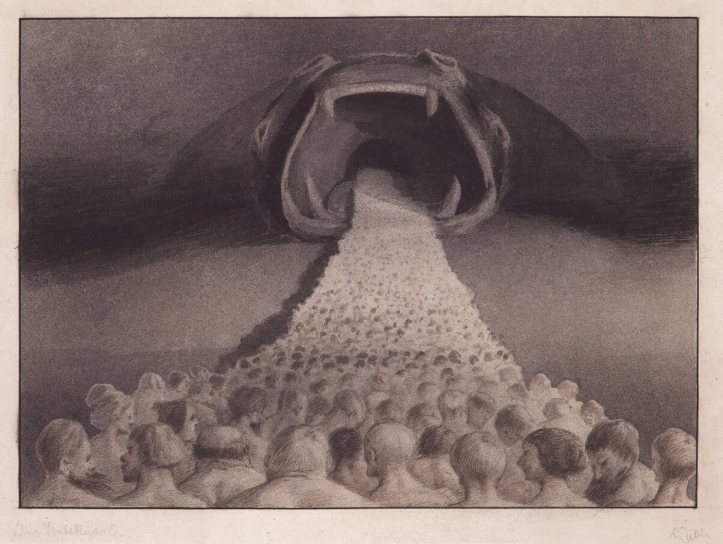
A BLEAK TOPIC TODAY! Don’t worry, though, there’s an upbeat post tomorrow.
Some artists have an uncanny ability to make paintings hellish disturbing. You think of Goya’s Saturn Devouring His Son and you’re along the right lines.
Then there’s the case of Austrain artist Alfred Kubin (1877-1959). Very big on Expressionism and Symbolism, tragic early life experiences shape the disturbed, bleak, fearful, terrifying nature of his artistic work. That’s what we’re exploring across his largely black and white hellscapes.
The Gloriously Disturbed Artwork of Alfred Kubin
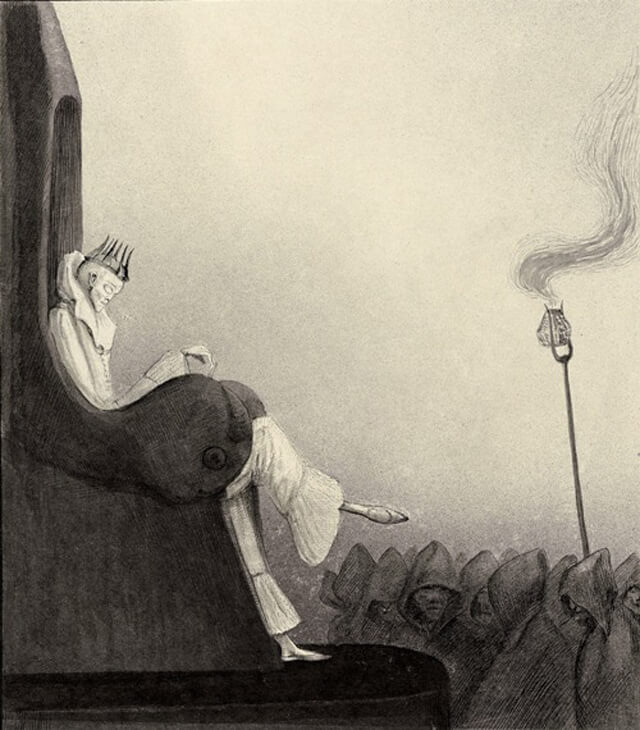
Kubin’s life was dominated by the death of his mother, which occurred in May 1887 when he was 10. She died of tuberculosis, which was deeply traumatic for the young Kubin.
Her death massively influenced the morbid themes he’d explore creatively for the next 70 years, including the one and only novel he wrote called The Other Side (1909). This book influenced Franz Kafka and other writers such as author and WWI memoirist Ernst Jünger. Written after the death of his father, a brief excerpt below highlights where Kubin’s frame of mind was often at:
“I had a black coffee and came to the conclusion I was fit for neither life nor suicide. ‘I’ll just vegetate somewhere between the two, waiting for the final blow like an ox at the slaughterhouse. It won’t be long coming.”
Suffering from anxiety and severe depression, in 1896 he attempted suicide at the site of his mother’s grave. His rusty pistol didn’t fire, so he decided to try and impress his strict gather. Kubin went into the Austrian army, which resulted in a nervous breakdown after 18 days.
A very personal demise was on his mind, but his creative efforts hadn’t shaped his deathly obsession. A few more disastrous life experiences would occur before helping him shape imagery like The Hour of Death.
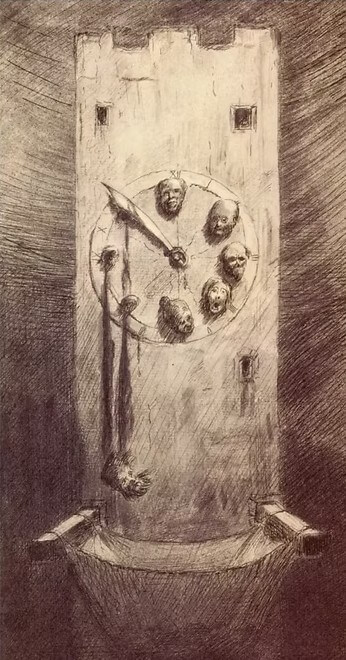
His father sent him off to a private art academy after that, realising his son’s efforts were better suited in creative environments. He went to study at Munich Academy of Art in 1899. He later noted:
“Here a new art was thrown open to me, which offered free play for the imaginative expression of every conceivable world of feeling. Before putting the engravings away, I swore that I would dedicate my life to the creation of similar works.”
He was inspired by Edvard Munch, Odilon Redon, and Max Klinger. It was the latter’s work that inspired in Kubin:
“A torrent of black-and-white images.”
With further inspiration from philosophical geniuses Schopenhauer and Nietzsche, Kubin was all set to start scaring the living bejeezus out of everyone with stuff like this.
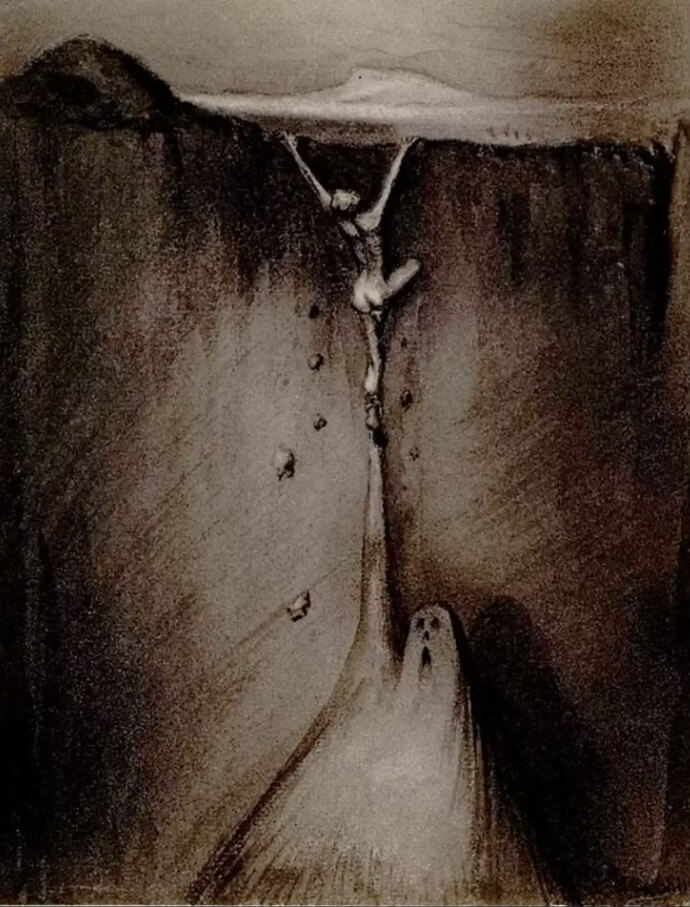
Kubin was stunningly prolific, creating over 3,400 pieces across his life.
He perfectly fits the concept of a tortured artistic genius withdrawn from society. From 1906 onward, he had an isolated existence living in a 12th century estate in Zwickledt, Austria. When the Nazis annexed the country in March 1938, his work was declared Entartete Kunst (meaning “degenerate art”) by the Nazi Party.
It’s interesting Hitler, Goebbels and his cronies looked at this stuff and got upset. Given a lot of these images would be fitting symbolism for what the political party would go on to do.
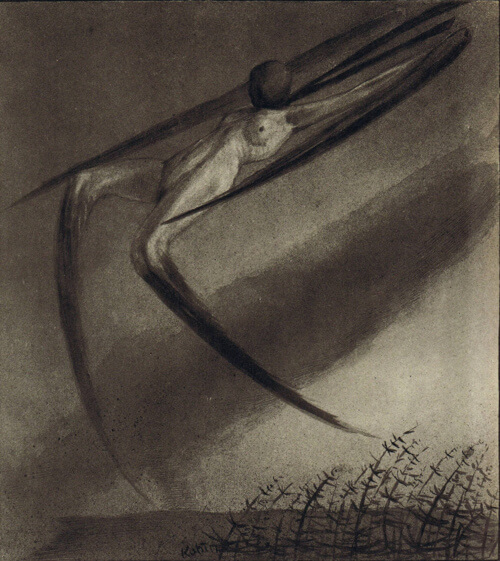
He was successful during his lifetime, winning various awards and holding exhibitions across Europe.
But his work circa 1900 certainly shows a tormented mind, one entirely preoccupied with death. Despite his early life issues, Kubin lived through two World Wars and right up to the age of 82. But this excerpt from his one and only book again hints at how he muddled through it all with poor mental health:
“When it comes down to it, no one can deny their own temperament, it will always determine everything you do. In mine, a decidedly melancholy one, pleasure and misery lie quite close together. I have always been subject to the most abrupt changes of mood. This particular disposition, a psychological legacy from my mother, has been the source of both great joy and bitter torment.”
