
Japanese woodblock printmaking is dominated by Hokusai’s Great Wave Off Kanagawa (1831). That work has became an international phenomenon… with good reason.
But there were many more great Japanese artists of that era. One of whom was Hiroshi Yoshida (1876-1950) who is rightfully regarded as one of the very best artists of the shin-hanga style (woodblocks and prints).
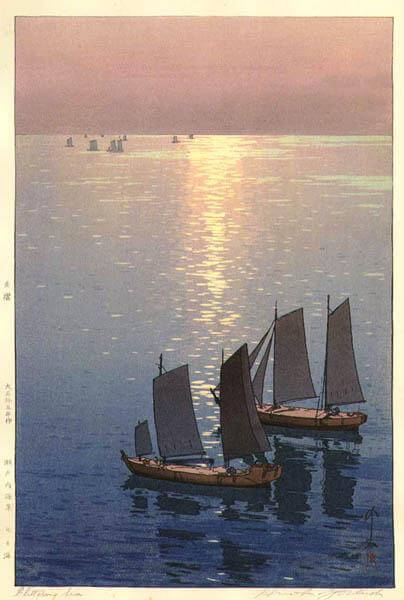
Just take a look at Sailing Boats (1921) up above there.
We feel he’s been pushed out of the limelight a bit by the ubiquitous nature of The Great Wave, so we’re here to take a look a tour through his brilliant canon.
The Striking Simplicity of Hiroshi Yoshida’s Traditional Japanese Themes
Japanese art tends to verge towards themes of nature, daily life, and often quite mundane situations. In such scenarios the Japanese find great delights (see The Beauty of Everyday Things by Yanagi Sōetsu).
Hiroshi Yoshida was no different. Searching through his work we found the familiar results of:
- Landscapes (fukei-ga)
- Famous places (meishō)
- Beautiful women (bijin-ga)
- Kabuki actors (yakusha-e)
- Birds and flowers (kachō-e)
There’s a great deal of stark simplicity in his style, which we don’t mean in a negative way. That’s the whole point of it.
Glittering Sea (1926) below shows a cut back scene. Just some boats, a stretch of ocean, and lots of water. Sparkling serenity!
His artistic vision was carried out on woodblock prints. That’s a meticulous process, one in use as far back as Chinese antiquity.
Below it’s demonstrated by printmaker Ayomi Yoshida who’s, yes, the granddaughter of the man in question here.
We’ve got a few more details on Ayomi’s work further below in this feature. But you can also follow the above link to find some of her rather excellent recent pieces.
Hiroshi Yoshida also worked across marble sculptures, stained glass windows, and prints on silk. But it’s his shin-hanga work that stands out.
A lot of his pieces portray peaceful settings.
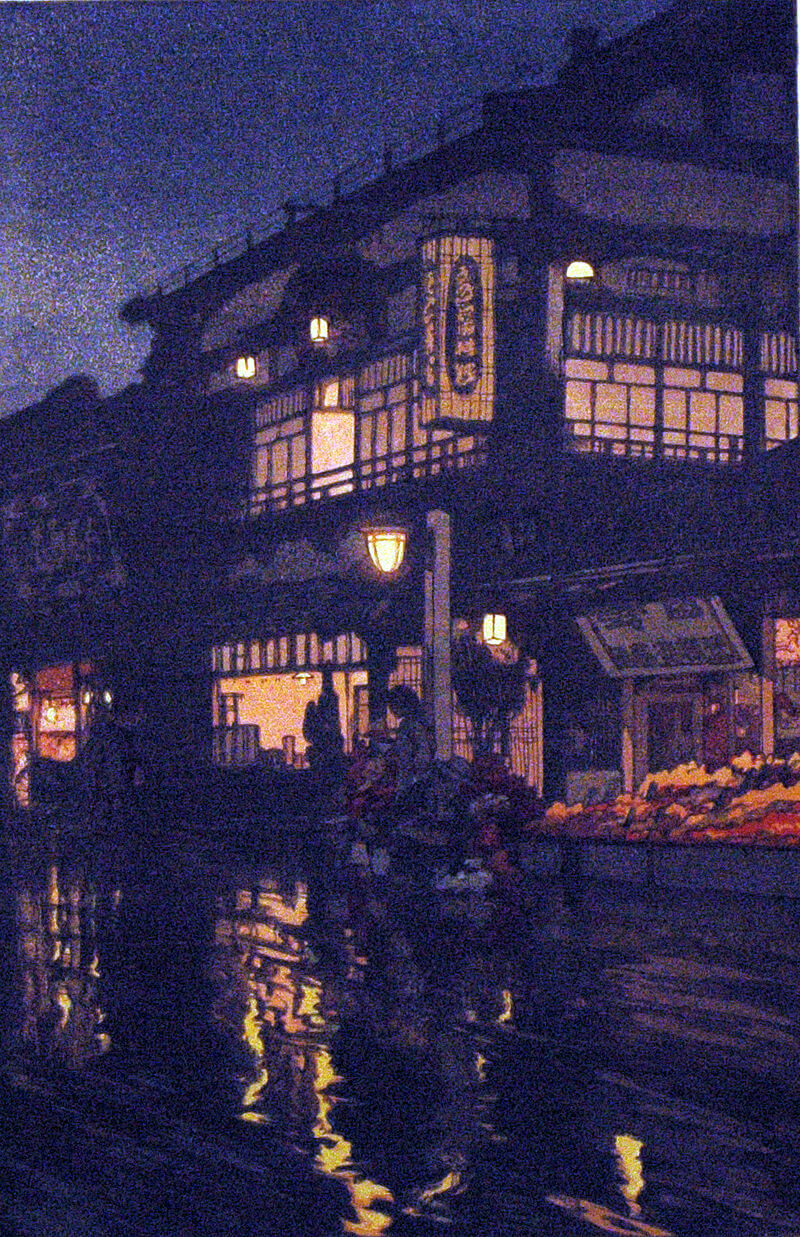
Sometimes they’re even borderline indistinct. With Kagurazaka Street after a Night Rain (1927), we can’t think of another artist who ever blurred up a piece so much to hide a lot of what’s going on. But it’s very evocative of night-time scenes anywhere around the world.
He was trained in the Western style of oil painting, but adapted it to the Japanese style for the Mieji period (1868-1912).
It’s worth noting his style was greatly influenced by extensive travels. He didn’t just stay put in Nippon and paint the local scenery, in fact his first trip to the US took place in 1899. During his visit he became aware westerners had a craving for ukiyo-e Japanese woodblock art.
This visit, along with his further studies, pushed him back towards traditional Japanese paintings.
Hokusai had died in 1849 at the age of 88, so wasn’t of his generation. But will have been a considerable influence on a young Yoshida.
The result was his woodblock career officially began in 1920. That was when he was hired by a publisher. From 1925 onward he had his own studio, where he hired a team of carvers and printers to work for him.
Shortly after this he took trips to Afghanistan, India, Pakistan, and Singapore. Before settling back into Japanese life in the 1930s.
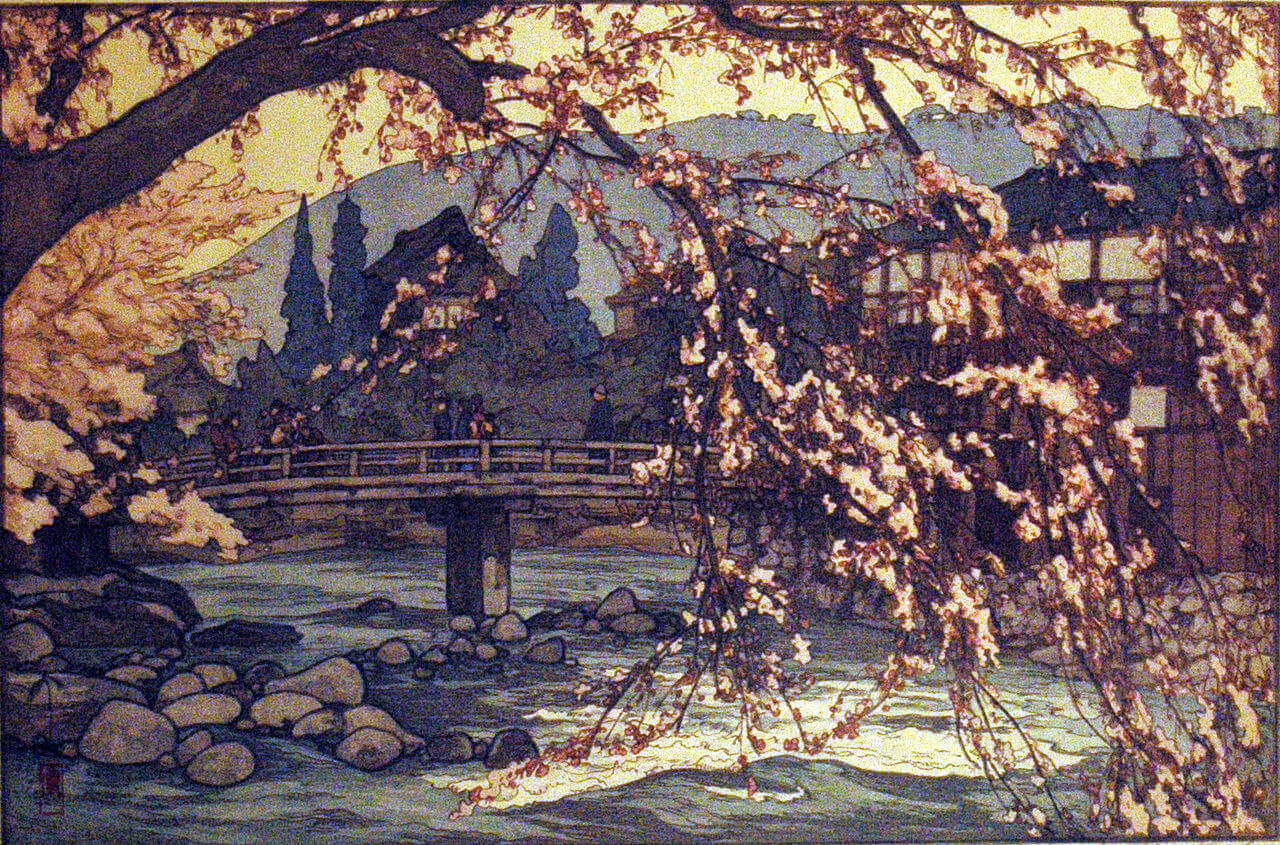
His Japanese roots are very clear indeed, as you can see in this Spring in a Hot Spring (1940). Again, all idyllic and peaceful. The trees in the foreground almost obscuring everything behind it so the locals on the bridge have a bit of privacy.
Calm. Serenity. Cup of tea, please, for a Japanese tea ceremony.
Or there’s the rolling expanses of clouds in View from Komagatake (1928), again highlighting Yoshida’s search for a spot of tranquillity.
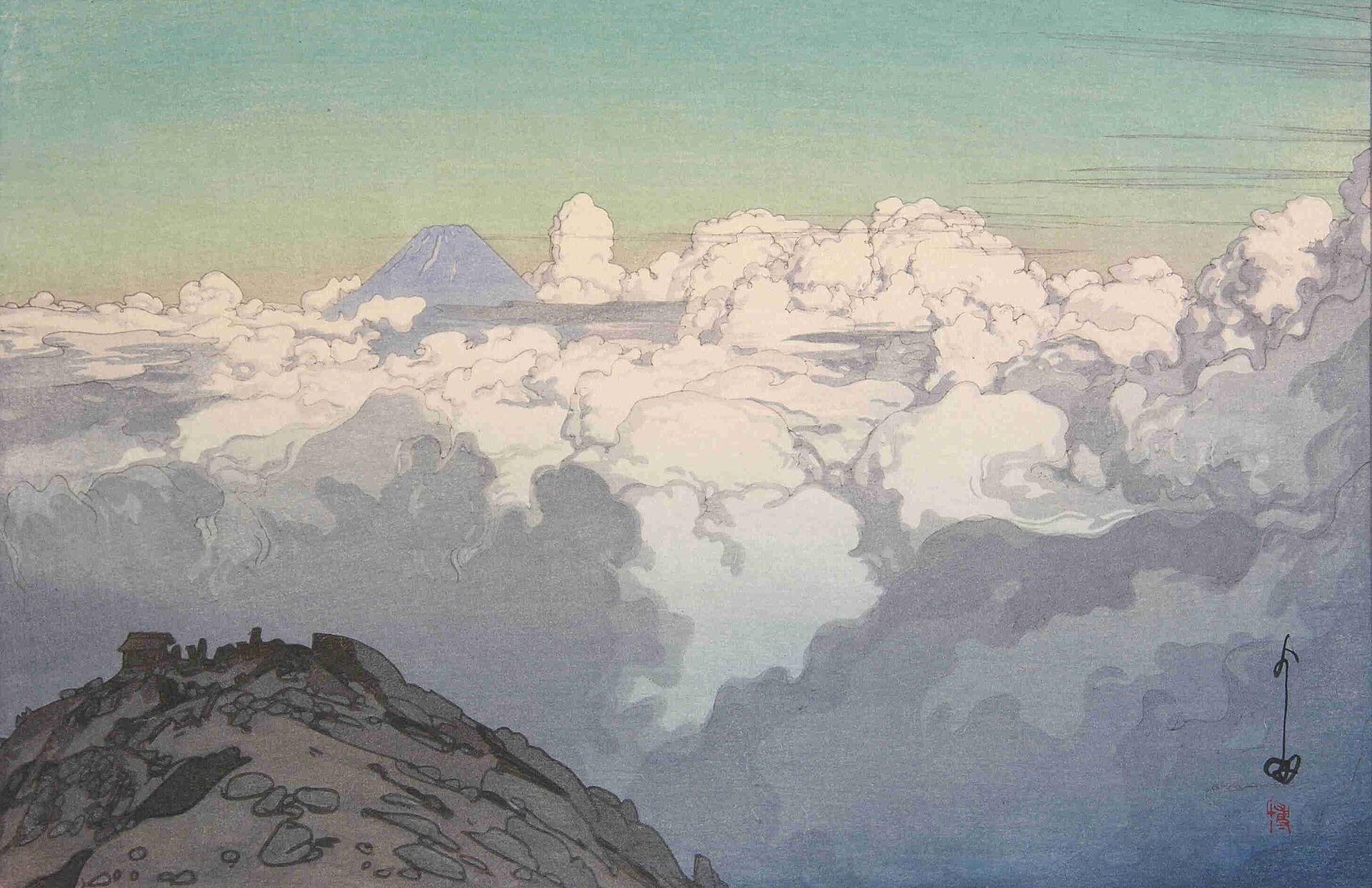
He created a grand total of 259 woodblock prints across his career.
During a trip to the city of Nagaoka he got ill and, unfortunately, didn’t recover from that. The sketches he took formed his final work—The Sea of Western Izu and The Mountains of Izu.
The body of work he’s left behind is well worth delving into.
We’ve barely scratched at the surface of his canon here. For example, he completed prints of the Grand Canyon and the Sphinx that are stunning and every bit as lost in a sense of solitude.
Thusly, we encourage you to take a tour of Google and check out his full canon. This was a woodblock master. But it’s an artistic legacy that runs in his family.
Hiroshi Yoshida and a Long Family Lineage of Artistic Values
The Yoshida family is very artistic! They span four generations of female and male artists. Look at this for a family tree:
- Kasaburo Yoshida (1861–1894).
- Kasaburo’s wife Rui was an artist.
- Their daughter Fujio Yoshida (1887–1987) was also an artist.
- Hiroshi Yoshida (1876–1950) the adopted son Kasaburo and Rui, he also married Fujio.
- Tōshi Yoshida (1911–1995), who was Hiroshi Yoshida’s son.
- His wife Kiso Yoshida (1919–2005) was also artist!
- Hodaka Yoshida (1926–1995) was also Hiroshi Yoshida’s son and, yes, had a penchant for art.
- And, you better believe it, Hodaka’s wife Chizuko Yoshida (1924–2017) was an artist as well.
It doesn’t end there, either! The daughter of Hodaka and Chizuko, Ayomi Yoshida (born in 1958), is an artist, too.
Truly, this one runs in the family. And she’s very bloody good indeed. Behold!
Ayomi Yoshida specialised in room-sized art installations and woodchip blocks. She’s had exhibitions in Japan and the US and continues to work to this day.
Long may that continue!

beautiful delicate art. Love it.
LikeLiked by 1 person
CORRECT! This stuff makes me happy.
LikeLiked by 1 person
It is beautiful.
LikeLiked by 1 person