
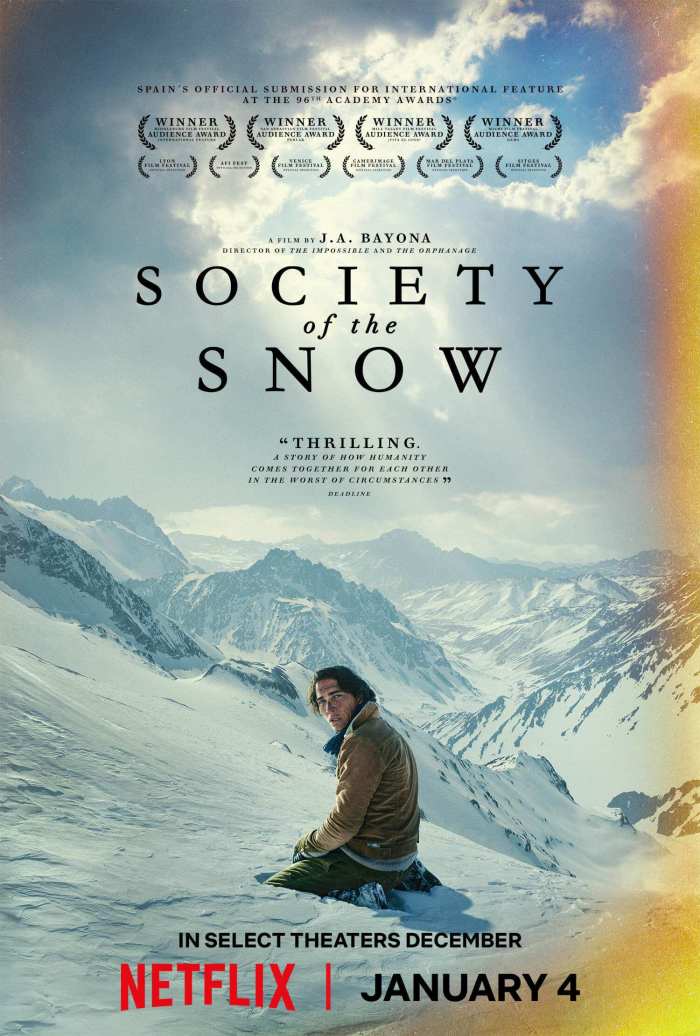
Newly launched on Netflix and in select cinemas, this is Society of the Snow. It’s the second major film adaptation of the remarkable 1972 Andes flight disaster, following three decades on from 1993’s Alive.
It’s also the first major film production about the disaster since the 2008 documentary Stranded: I’ve come from a plane that crashed on the mountains.
The difference between Society of the Snow and Alive is the former has Spanish speaking actors cast from South America. And it’s a major attempt to thoroughly document the real extent of this most horrendous ordeal.
Brutal Depictions of Extreme Survival in Society of the Snow
Directed by J. A. Bayona, La sociedad de la nieve is adapted from Pablo Vierci’s eponymous book, which features extensive interviews with the survivors.
The Andes Plane crash may be over 50 years ago, but the enduring appeal of this survival story continues. From the 20th century, outside of the two World Wars and the Chernobyl Disaster, we struggle to think of a story quite as brutal.
And so, yes, this is a tough film to watch. The story is harrowing, but ultimately uplifting and inspiring.
It’s notorious for the “cannibalism” element, but to focus purely on that is to downplay the incredible bravery of those involved in this event.
As the survivors have pointed out before, cannibalism has a lot of negative connotations. Generally, the killing of someone to eat. The appropriate term for the Andes crash is anthropophagy, which is the eating of human flesh.
Although a central component to their survival, much more was involved than to get themselves out of the mountain range.
The story begins in October 1972, with the chartered flight Fairchild FH-227D leaving Montevideo, Uruguay, with a course set for Santiago, Chile. The occupants, mainly young university students, are heading over for an amateur rugby match.
Following a mistake by the pilots, the plane crashes violently into the Andes mountain range (and be warned, the depiction of this is terrifying).
And so begins a two-month, remorseless ordeal.
One of the survivors, Nando Parrado, was on set to oversee this production. He just turned 74, but had to “celebrate” his 21st birthday out on the Andes mountain range in late 1972. Parrado’s guidance with the production makes Society of the Snow the most accurate movie depiction of the event (other than the Stranded documentary).
And to be clear, the survivors and their families provided consent for the production.
Bayona had the blessings of the families involved. Many of the family members, such as Numa Turcatti’s brother, provided recent interviews for the first time to English audiences (at least, the first ones we’ve ever seen with them). This was to promote the film.
After the crash, things get horrendous fast.
Interestingly, and here’s a spoiler, much of the narrative is driven by 25-year-old Numa Turcatti (played by Enzo Vogrincic Roldán in his screen debut). Turcatti was the last person to die during the disaster, making it a poignant decision to have his narrative leading the film.
From accounts of the ordeal, such as Parrado’s Miracle in the Andes (2006), the others thought very highly of Turcatti.
He was instrumental in leading escape attempts from the crash site, although it quickly became apparent to the survivors they were stranded in one of the most inhospitable environments imaginable.
After the rescue attempt to find them is abandoned (they find out from a radio they have), the survivors turn to the dead bodies of the crash victims for sustenance.
Whilst this keeps them alive, they subsequently endure an avalanche, freezing temperatures, and one last ditch effort to leave the mountain range.
This final trek is depicted impressively. Roberto Canessa (Matias Recalt) and Parrado (Agustin Pardella) scale vast mountain ranges in a seemingly suicidal attempt to find civilization.
And it’s that final section that makes an otherwise harrowing story so uplifting. The fact those two young men made it out of there against all the odds. And then immediately forced to answer press questions.
The real life Parrado, after the disaster, was informed the men shouldn’t have survived more than 36 hours. But they somehow lasted 72 days.
The director doesn’t hold back and is faithful to real life events. Having read multiple books on this, we can confirm it’s all real. For example, it intelligently depicts, and explains, the need for the eating of human flesh. There’s no sensationalism.
That’s set alongside the daily extent of the bravery and resourcefulness of the survivors out on the mountain. The level of resilience these young men displayed was truly special.
It’s a tough watch, but handled with excellent accomplishment. The avalanche scene, for example, is stunning in its unflinching realism.
Committing yourself to the two and a half hour onslaught is an emotional time of it, but it’s a crucial survival story for the ages.
The survivors deserve every credit for showcasing such unprecedented inner strength. To take on the many impossible challenges they faced and emerge alive, which is captured by some excellent performances from the young cast.
As the best films do, it puts you into that situation.
And Bayona captures, we’d say for the first time on screen, one of the main elements of the disaster—the freezing cold. The crushing nature of the cold, especially at night when temperatures would plummet to -20 degrees. Often shifting from tolerable daytime temperatures to sub-zero in a matter of minutes.
You do get that sense of it. The impossibility of the situation.
To go with the sweeping and impressive cinematography, there’s a fantastic score. It was by American composer Michael Giacchino.
As Roberto Canessa has noted in recent interviews, he feels the Andes Plane crash has universal appeal as everyone has their own Andes experience. Some traumatic event to overcome.
“We all have our own personal mountain range. And there are many people who are climbing the mountain right now. We must tell them not to be discouraged, to keep going” — Survivor Roberto Canessa, @SCMPNews
Link to the interview: https://t.co/UAHVEcyOjE#LaSociedaddelaNieve… pic.twitter.com/8Voc5s7TVU
— JA Bayona (@FilmBayona) January 4, 2024
Canessa’s excellent autobiography is another great component to this story. It’s I Had to Survive: How a Plane Crash in the Andes Inspired My Calling to Save Lives (2017) and it’s a brilliant work and a tribute to a man who went on to have an esteemed medical career.
Such an impressive feat is important to lose yourself in.
For a new generation to discover this story now, Society of the Snow is a fine film with a compassionate edge, and one that should provide viewers with personal revelations.
People look at the story, surviving against the most impossible odds, and see hope. A reason to battle on and overcome the odds stacked against them.
It’s not easy viewing, but its closing moments highlight how determination can drag you out of even the worst of times.
Society of the Snow’s Meticulous Production
The film launched in Uruguay on December 13th, 2023 and has since had a worldwide release. You can see it in some cinemas, but it’s there on Netflix as well.
It’s had widespread critical acclaim for the realistic depiction of the disaster. It’s even the Spanish entry for the Best International Feature Film at 2024’s Oscars.
J. A. Bayona took the production very seriously. He was meticulous in his approach and, of course, had Nando Parrado on set as an advisor.
One of the survivors, Carlitos Páez, even has a brief role in the film where he plays his father Carlos Páez Vilaró.
In pursuit of paying full respects to the story, some of the shoot took place at the actual crash site in the Andes. Bayona told Games Radar in a January 2023 interview:
“I really wanted to tell the story in the most realistic and respectful way. To me, it was very important to capture the socio-political context of the time to understand how they behaved in the mountains—it’s a story that you cannot tell without the context. And to me, starting with a different language would have spoiled that approach from the very beginning.”
Question: What was it like filming at the site of the crash?
“It’s very difficult to access. We went there at the same time of year as when the plane crashed. You need three days to get used to the altitude, so it took us three days to get there. Most of the film was shot in a ski resort in Spain, so it gave me a good idea of what the place was like, and then we went two further times to shoot with the actors. We couldn’t bring any heavy stuff there, no cranes, no dollies. It was like shooting a documentary. We had to be very careful. It was a dangerous place—we had some avalanches during the shoot.”
Most of the shoot took place in Sierra Nevada at a Spanish resort, but other locations included Argentina, Chile, and Uruguay.
Three replicas of the partially destroyed Fairchild fuselage were recreated, one of which was used in a parking lot outside a film studio. Artificial snow was used throughout the shoot, although it’s very realistic and really puts a chill into you as a viewer.
On a final note, the survivor José Luis “Coche” Inciarte died in July 2023. But he was shown an earlier version of the film shortly before his death. Over 51 years after the disaster, which for us once again highlights how they all made the right decisions out on the mountain range.
The eating human flesh element may be controversial (as depicted extensively in the film in open discussions), but there’s no doubt it was the right choice. Although a very difficult one for them all to make.
The 14 remaining survivors, along with their families, saw the film in October 2023.
