
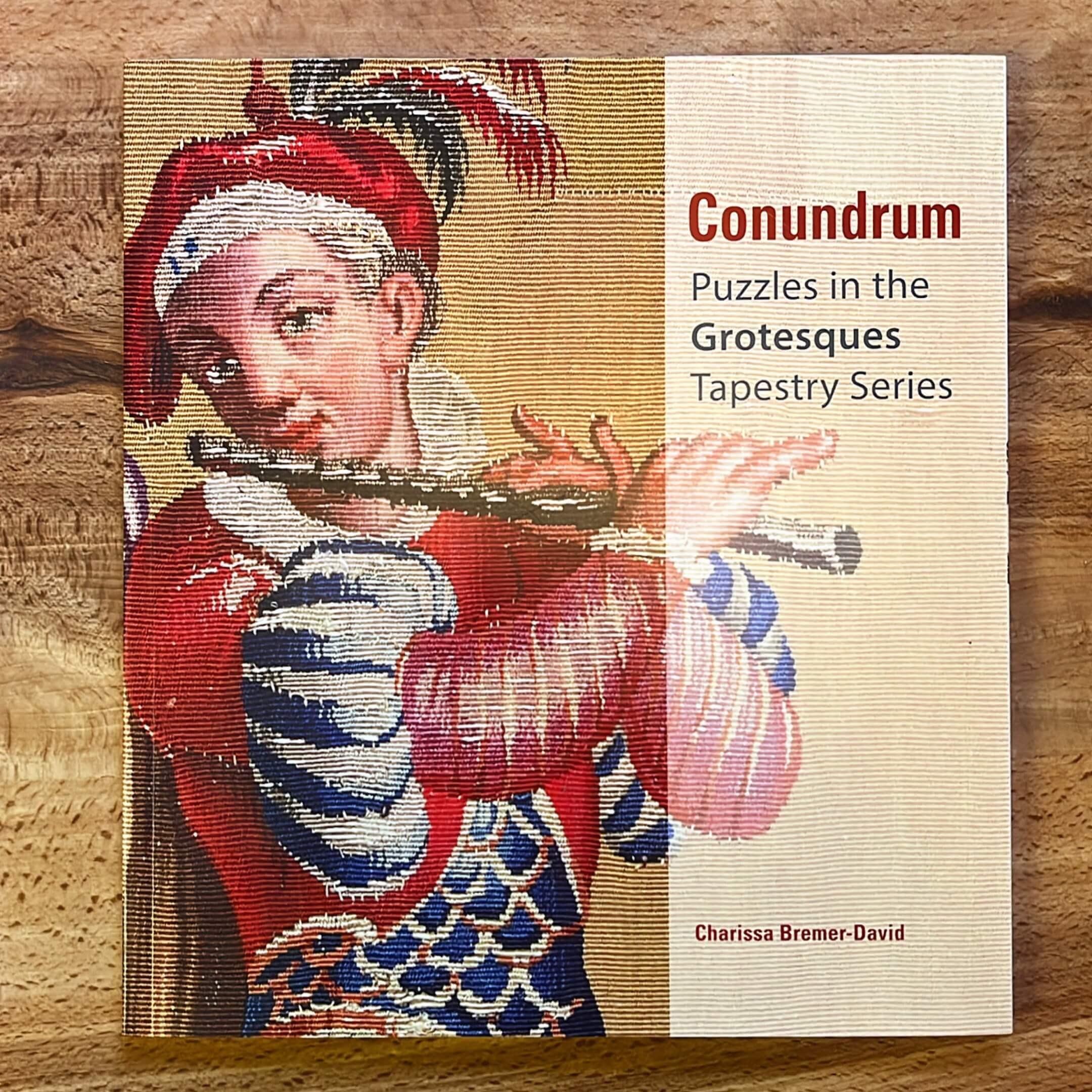
At the Getty Museum in Los Angeles there are four tapestries on display. They depict the Grotesques, artworks inspired by frescos (paintings on ceilings or walls) from ancient Roman culture.
But these four were created by the French Beauvais Manufactory historic tapestry factory between 1690 and 1730.
Charissa Bremer-David’s work in Conundrum: Puzzles in the Grotesques Tapestry Series (2015) is to take a closer look at the tapestries and try to uncover some meaning. As they’re packed with unusual wonders, offering no narrative structure—this has led to much debate from art historians about their meaning and purpose.
Puzzles in the Grotesques Tapestry Series by Charissa Bremer-David
Looking at these works is like taking on a Hieronymus Bosch painting. There’s so much going on it’s possible to stand and stare at one of these tapestries for hours.
Franco-Flemish painter Jean-Baptiste Monnoyer (1636-1699) was responsible for these works.
Conundrum: Puzzles in the Grotesques Tapestry Series covers all four of them, packed as they are with whimsical imagery that continues to baffler art fans. There’s no allegory at play here, no symbolism, no theological message. Just often quite joyful artistic imagery almost for the sake of it.
However, Charissa Bremer-David does reveal that Monnoyer handpicked various concepts and motifs to inspire his work. That included antique statuary, Renaissance prints, Mannerist tapestry, and Baroque art. He was also inspired by 17th century festivals, court shenanigans, theatre, and other happenings from his era.
This makes the Grotesque tapestries a unique insight into life at the time. Also, just on that name! Grotesque. It’s explained by Bremer-David thus.
“The meaning of grotesque as it was understood in the late seventeenth century differs from our current understanding of the word, which, with its modern association and conflation with the slang word gross, conveys an unpleasant sense of disgusting ugliness or crude coarseness. In the late 1600s grotesque had multiple subtle meanings, not all of which survive in today’s common usage. Originally derived from the word grotto, the adjective grotesque described unusual natural stone formations and rocky textures of the type encountered in caves and that were replicated in man-made environments, most often in garden settings.”
These tapestries were innovative in their style and feature many spectacular, intricately detailed takes on often luxurious settings. Such as here with The Offering to Bacchus (you can click on this image for a closer look).
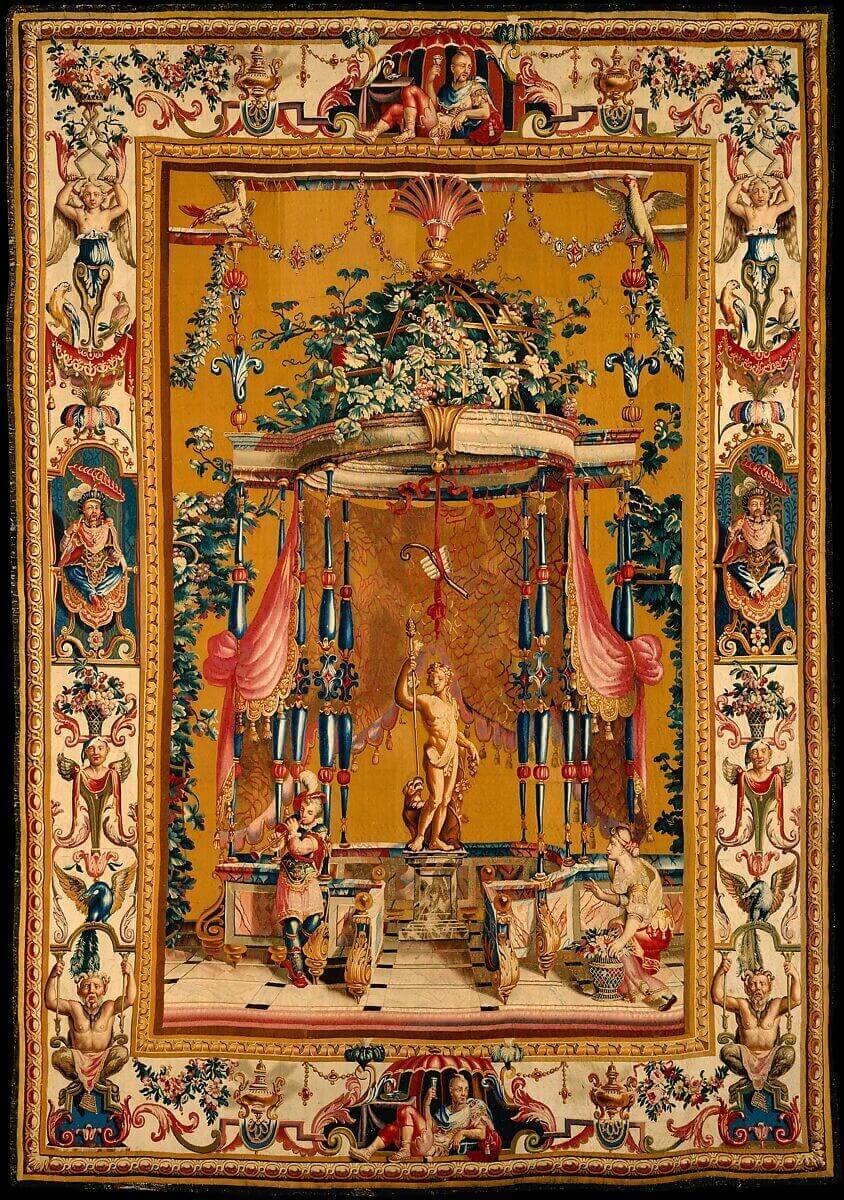
This sort of grandeur makes up the tapestries, with incredible and lavish use of orange, yellow, beige.
“The ingenious design of the Beauvais Grotesques tapestries manipulated space and colour in an innovative and intriguing manner. Visually, the Beauvais Grotesques were—and still are—arresting for their shallow foregrounds set simply and boldly against a flat, planar field of deep orange. The foreshortened, stagelike compositions were oddly pleasing to the eye, even though they lacked the traditional, illusionistic recession of pace from middle to background. The protagonists, both human and animal, were not monumental in scale but rather appropriately proportioned within their fictive arcades.”
Focussing in on various characters and you get some impressive, ultra-detailed work.
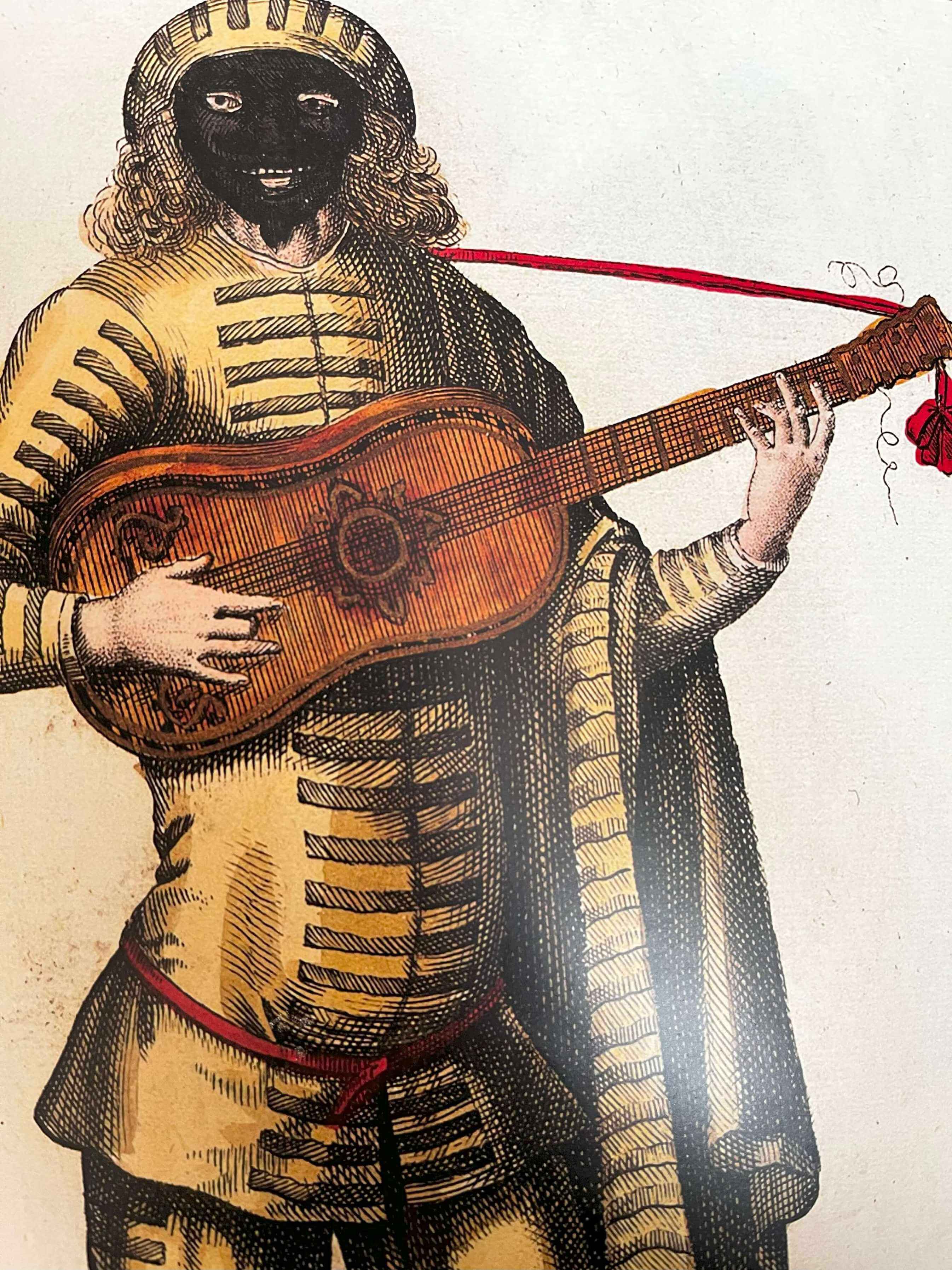
If you can imagine that dude playing Scarlatti’s Sonata E Minor K11 (L352) and you’ll be on your way to enjoying this artwork all the more.
Conundrum: Puzzles in the Grotesques Tapestry Series is a book we picked up from Waterstones (the UK’s leading book chain) as it was on sale for £5. It covers five chapters, most importantly across the tapestries:
- The Offering to Bacchus
- The Offering to Pan
- The Camel
- Musicians and Dancers
It’s a reminder of just how intricately detailed art history is, stretching back many thousands of years. The Grotesques are relatively modern artistic endeavours, nodding at a world of high culture and fine living amongst aristocrats.
The book is glossy and rather fantastic, with Charissa Bremer-David lending great insights and clear prose on each work. She also lays great praise (rightfully so) at the hands of the tapestry series’ creator.
“Jean-Baptiste Monnoyer practiced the time-honoured artistic tradition of aemulatio, by which diverse visual sources were given new meaning by juxtaposing them in dailogue. In its most expansive expression, aemulatio was more than emulation or imitation. In depicting the thematic program for this series, Monnoyer’s efforts revealed his nimble creativity and sophisticated powers of invention. His genius lay not just in borrowing or disguising well-known models and motifs, but also in playfully blending the learned with the lively, the lofty with the lighthearted.”
Great stuff, then, and a fine modern artbook worthy of any bookshelf.

A lovely post. I enjoyed this!
LikeLiked by 1 person
See, you learn stuff here on PM! Grotesque stuff isn’t always grotesque. 👍
LikeLiked by 1 person
I absolutely do! 😊
LikeLiked by 1 person