
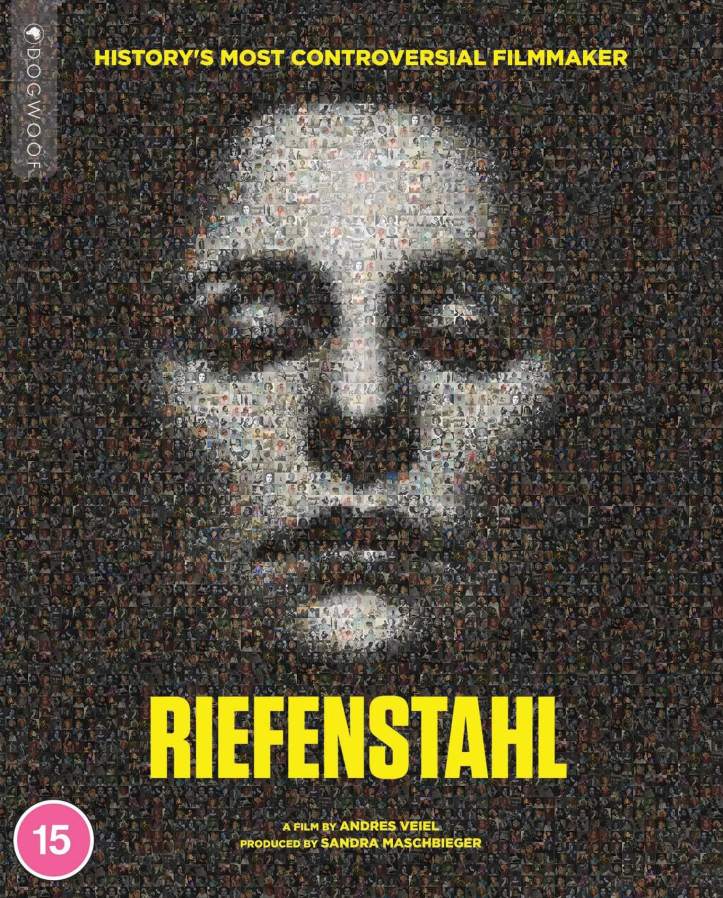
Riefenstahl is a 2024 documentary about the German filmmaker Leni Riefenstahl (1902-2003). She was famous for her technically impressive and groundbreaking directing techniques, but also for her involvement in 1930s/1940s Nazi propaganda films.
This excellent documentary, one of the best of 2024, was written and directed by Andres Veiel. It explores her artistic legacy and determination to absolve herself of post-war criticism.
A World of Denial in the Riefenstahl Documentary
The documentary plays out in two halves, with the first presenting Leni Riefenstahl’s defensive approach to her Nazi affiliation. She steadfastly denied she knew what the Nazi regime was doing, but the second half of the film gradually undermines her arguments with evidence.
Evidence that came to light for the first time thanks to the efforts of the film’s producer, Sandra Maischberger, who gained access to never before seen photographs and written records from the Riefenstahl estate.
Riefenstahl was on personal terms with Adolf Hitler and married an SA officer called Peter Jacob in March 1944.
One picture shows her, with arms outstretched, holding hands with Hitler in a warm handshake embrace as they both smile. It also emerges Joseph Goebbels tried to make advances on her and have her as his mistress.
Throughout the documentary, she can be seen in interviews downplaying her knowledge of the Nazi party’s ultimate goals and claimed she had no idea what was happening. She’s criticised for this claim across various interviews, from the 1970s through to the 1990s.
What’s clear from the interviews is how defensive she was. She actually starts ranting and gesticulating as Hitler did during his various 1930s talks (in rather disturbing effect).
As for her films, one of the most famous is The Blue Light (1932). For the time, this was a technically ambitious movie and featured an iconic scene at a waterfall. Riefensthal directed and starred in it as the lead.
These efforts brough her to the attention of Joseph Goebbels, who realised he could use her skills to promote party policy. What followed was her most influential project. That was Olympia (1938), a Nazi propaganda film of the 1936 Summer Olympics held in Berlin.
The director was given $7 million to work with. For the time it was a huge budget and went to groundbreaking directing techniques. She created many unique new styles that included smash cuts, extreme close-ups, and tracking shots on rails, all of which are still in use today.
This was all wrapped around Hitler’s ideals of racial supremacy and other bigotry, with Jews banned from entering the games. There are also many shots of Hitler looking on enthusiastically.
Another Nazi propaganda production was Lowlands, but the production of the shoot was difficult and continued through to 1944 (much to the ire of Goebbels). For this, she brought in 50 Roma internment camp victims as extras. Many of these were children.
There are pictures and behind the scenes footage of the children on set. It’s proven many of these young extras were later deported to Auschwitz and didn’t survive. However, Riefenstahl claimed she’d met all the extras after the war and they were “alive and well”.
Lowlands was heavily delayed and only launched in 1954 (one of the longest delayed productions in history).
After WWII she was borderline exonerated at the Nuremberg trials, but that didn’t stop the endless questions over the 55 years over her involvement with the Nazi party.
With the backlash against the Nazi regime, she spent 10 years working on her memoirs to make sure her legacy was considered correctly. For that, she spoke to Nazi architect Albert Speer for advice. He’d been released in 1966 from a 20-year jail sentence, having kept himself busy writing his own memoirs.
All of this is increasingly disturbing but makes for a fascinating, unsettling watch. Her continuous denial across interviews from the 1970s up until 1999 don’t match up with Sandra Maischberger’s new evidence and so we have an uncomfortable portrait of an undoubtedly gifted director and her alarming history.
Director Andres Veiel said of the production:
“In the last conversation Leni has on the phone in the movie, she says that it will take one or two generations for Germany to rediscover its role in terms of morality, virtue, and order … It was a darkly prophetic conversation.”
Meant in terms of the current western political situation. All of which makes for a vivid documentary, then, and a must watch for how a world of denial can unravel despite the most dedicated of efforts.
The Production of Riefenstahl
As we’ve mentioned in the review, author and journalist Sandra Maischberger was the producer for the project. You can see her insights above into how she gained access to new evidence from the Riefenstahl estate.
The documentary had a limited box office run and made $245,837. This is common for documentaries, which go on to recoup more money from streaming platforms and rentals.
Its first showing was at the 2024 Venice Film Festival and then ran in German cinemas from October of the same year.
Despite the importance of films like this, it’ll fall on deaf ears and it’s unlikely to have the impact it should in the public conscience. Nevertheless, it’s a fine work and will leave a profound effect on many who watch it.
