
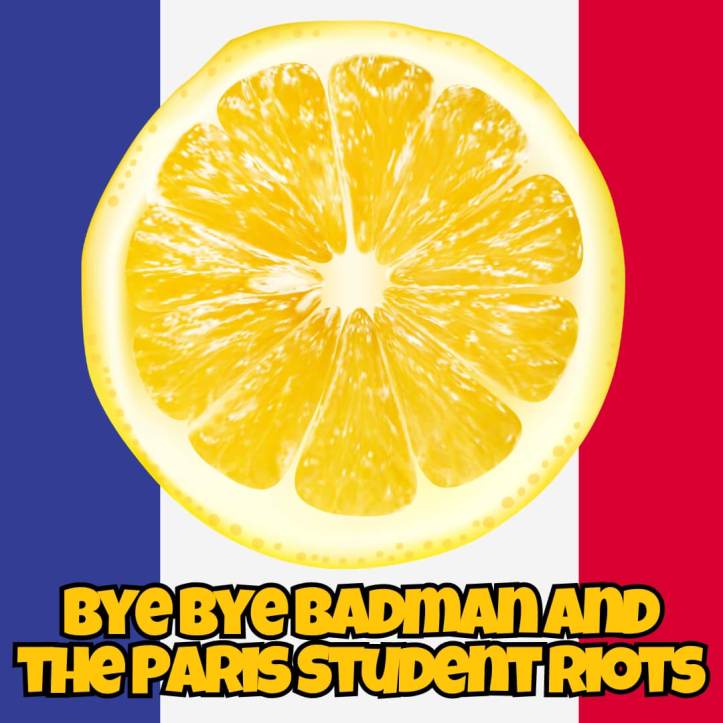
A big part of The Stone Roses’ 1989 debut album is its call for political revolution. Released on 2nd May 1989, it followed over a decade of Conservative Thatcherism that had laid waste to the country’s working classes.
Central to the album’s artwork and songs were the Paris student riots of May 1968.
During that civil unrest, students were pelted with CS gas by the French police. They sucked on lemons to prevent their eyes from watering, which 20 years later inspired songwriters John Squire and Ian Brown to pen Bye Bye Badman.
Civil Unrest and Lemons in Bye Bye Badman
John Squire is also an artist and did all the Jackson Pollock themed abstract pieces across the bands albums/singles. The Stone Roses has since become synonymous with the lemon symbol, which is featured on the cover of the debut album.
And, yes, the lemon is there as reference to the antics of Parisian students in the late ’60s. The result with Bye Bye Badman is a defiant anthem against government oppression, as seen in the lyrics.
Soak me to my skin,
Will you drown me in your sea?
Submission ends and I begin.Choke me, smoke the air,
In this citrus sucking sunshine,
I don’t care, you’re not all there.Every backbone and hearts you break,
Will still come back for more,
Submission ends it all.Here he comes,
Got no questions, got no love,
I’m throwing stones at you, man,
I want you black and blue and,
I’m gonna make you bleed,
Gonna bring you down to your knees,
Bye bye, badman, bye bye.
Some brilliant lyrics from Brown and Squire there, with further references to bad intentions, thrown stones, and French kisses later in the song.
On the eponymous debut album, Bye Bye Badman is followed by Elizabeth My Dear. This actively calls for the end of the UK monarchy system (some fans mistakenly think it’s a deeply patriotic song), highlighting again what Ian Brown, in particular, wanted in terms of a future United Kingdom.
All the band members had attended the anti-clause 28 marches in Manchester of May 1988. That was in response to the Conservative government’s Clause 28, which set out to essentially prohibit gay rights (blocking the “promotion of homosexuality”).
Peaceful left-wing demonstrations in Manchester ultimately helped to derail Clause 28, so you can see how the 1968 Paris riots helped inspire The Stone Roses’ political focus.
Bye Bye Badman and it features a complicated guitar loop from Squire, which led to the band rarely performing it live during their peak years of 1989 and 1990.
We did find one live example from a February 20th, 1989 gig in Sheffield. But the quality of the bootleg is too low to include here. Plus, during their reunion years they played it at every gig (see below in New York in 2016).
Bye Bye Badman highlights the Brown/Squire songwriting partnership at its best, plus Squire’s genius as a guitarist. The band specialised in taking political and often dark concepts, then wrapping them around catchy and upbeat songs. A constant act of defiance.
Other tracks, such as the inspiring Waterfall, cover similar ground. That appears to be about (as the lyrics are cryptic) escaping working class drudgery.
The debut album ends with the hedonistic rush of I Am the Resurrection, wrapping up an all-time great record with a demand for some sort of social revolution. And there was one of sorts, with Margaret Thatcher resigning in November 1990.
Ironically, just as The Stone Roses had peaked. As the anti-capitalist band then got stuck in a capitalistic court case of warring record labels battling for their services, blocking them from recording or playing live. Ho hum.
The Paris Student Riots (May ’68)
May ’68 (as it’s referred to historically) was France’s first major social upheaval since WWII. The student riots largely came about due to government repression and the low quality of university conditions.
What began as a small set of student demonstrations turned into a nationwide event.
As in February 1968, the French Communist Party and the French Section of the Workers’ International joined forces to try and topple President Charles de Gaulle. In March, various far-left groups met at the Paris University at Nanterre to discuss class discrimination across France and the upper class’s control over university funding.
Months of debates occurred and escalated once negotiations failed, with the French police (Compagnies Républicaines de Sécurité) occupying universities to maintain order. On 10th May at the Rive Gauche, a barricade erected by students was attacked by the police (resulting in hundreds of arrests and injuries).
It was allegedly a bunch of inciting agents within the student sect (i.e. police officers disguised as students) who had triggered a few petrol bombs. This gave the police an excuse to overreact and things got pretty heated.
The student revolt triggered the nation’s employees into action.
Worker strikes followed of some 10 million people and all the troubles led to de Gaulle fleeing the country to Germany. When he did return he called for a snap general election, forcing the rioting in the street to shift to campaigning for ballot box ticks. A full blown national crisis was eventually avoided with the Grenelle Agreements, seeing wage increases and better concessions for everyone. Including a:
- 35% increase to the minimum wage
- 10% wage increases overall
- Shorter working week
Workers were satisfied, so the alliance with students ended and things fizzled out. Especially as de Gaulle won the general election with a landslide victory, putting all those COMMIE BASTARDS (!!!!!!!!!!!!!!!!!!) in their, respective, places once and for all!
Although May ’68 ended up being something of a revolution that wasn’t, it’s still a great example of how justified civil unrest can result in a positive outcome for a country.
Not least as de Gaulle actually retired in 1969 anyway due to his position having been weakened. The education system was reformed by breaking it down into more manageable chunks, plus social values shifted regarding feminism and the challenging of authoritarian bodies.
The times, they do change and we’re now actively back voting in authoritarian regimes to take away all these hard fought rights. Thus, let us channel the spirit of it all going forward.
Bye Bye Badman, indeed.
