
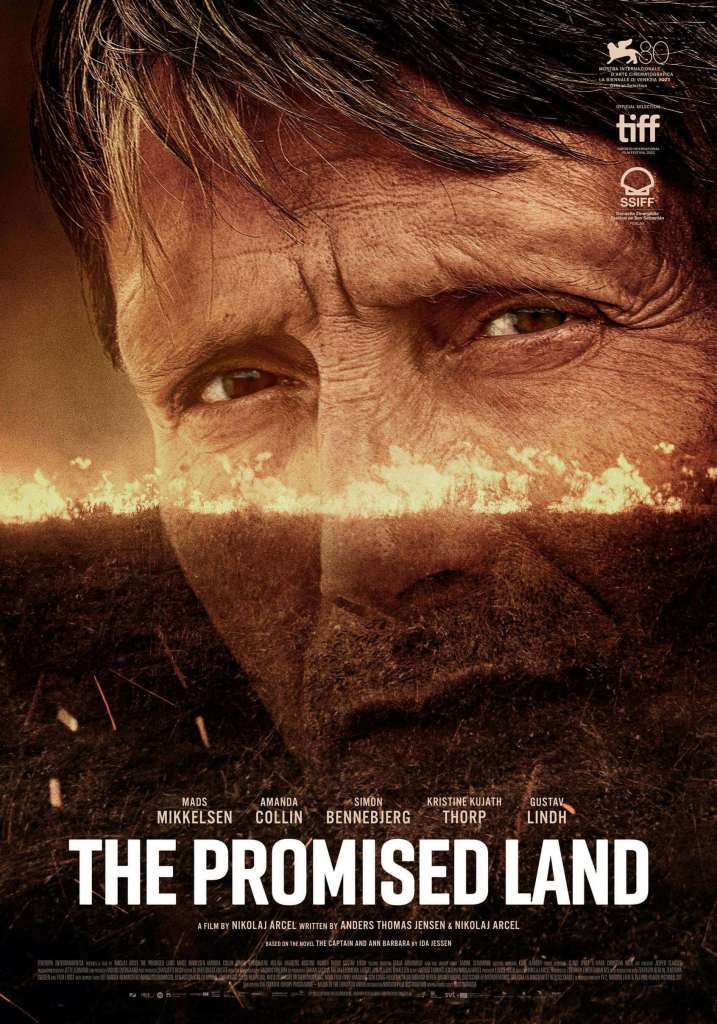
The Promised Land (“Bastarden” in Danish) is based on the true story of Captain Ludvig Kahlen (1700-1774), who retired from the German Army to develop a property across desolate Danish moorland.
This Danish-German production was directed by Nikolaj Arcel and takes Kahlen’s story very seriously, delivering the goods across an often brutal epic historical drama. And if Mads Mikkelsen is in a film, you know it’s going to be worth watching.
The Precariousness of Life in The Promised Land
Set in 1755, Captain Ludvig Kahlen (Mikkelsen) retires from his career in the army and requests permission from the Royal Danish Court to build a property on the Jutland moorland.
The request is granted, although the belief is it’s such a harsh environment Kahlen has no chance of succeeding. The end goal is he wants a noble title with a manor, so he can be financially secure, and his secret weapon for success is… potatoes!
Using the hardy vegetables, he hopes to grow crops and make his name.
Helping him along on the barren landscape are the serf workers Johannes Eriksen (Morten Hee Andersen) and his wife Ann Barbara (Amanda Collin). Plus, they enlist a precocious young gypsy girl called Anmai Mus (Melina Hagberg).
The troop face many problems on the harsh landscape, but their main threat to land cultivation comes from psychotic local magistrate and landowner Frederik Schinkel (Simon Bennebjerg).
Kahlen and Schinkel clash immediately, with the latter determined to make the former’s life a misery. For no real reason, of course, other than Schinkel being a complete overprivileged bastard.
As that psychodrama plays out, Kahlen must also try and cultivate the desolate landscape. He turns to increasingly risky means to achieve results.
You get a great sense of the precariousness of life several hundred years ago, where everything depended on crops growing. Scenes such as the morning frost threatening crops.
The Promised Land is methodical across its first two hours, but does rush through its final 30 minutes. That may have been for a variety of reasons (studio pressure to shorten the running time etc.), so maybe a director’s cut will emerge eventually. As there’s no reason this couldn’t be a full three hours or so.
We mention that as the ending does feel a bit rushed, with several key events unfolding at speed. And out of step with the rest of the film’s pacing. It doesn’t dent the film’s excellence, but we did feel it unusual.
But it is an excellent film. It’s brutal, with some particularly nasty scenes in it. But then that’s life for you, with Kahlen and Ann Barbara’s stories playing out to much chaos before, eventually, offering a message of hope at the end.
The Production of The Promised Land
A lot of great films came in 2023, it’s arguably the best year of films this decade. The Promised Land kind of got lost amongst big awards contenders like Zone of Interest and Anatomy of a Fall (basically, anything with Sandra Hüller in it).
Denmark selected The Promised Land as its entry into the 2024 Oscars (in Best International Feature Film), but it didn’t make the final cut. Critically acclaimed, then, but not a major commercial success (only making $2,246,680 at the box office).
The film was shot out in Germany, Sweden, and Czechia across September to November 2022.
It was adapted from the book The Captain and Ann Barbara (2020) by Ida Jessen, which was loosely based on Captain Ludvig Kahlen’s life. The real life Kahlen spent eight years attemtping to cultivate the land, but then gave up. Whereas in the film, he’s depicted as becoming highly successful (just after many trials and tribulations).
Also, the landscape is depicted as bleak during the story. But when filming, the cast and crew actually had a great time out there. It was treated as a camping trip with all the modern comforts Kahlen didn’t get to enjoy.
Interestingly, the focus of the shoot was influenced by David Lean’s classic Lawrence of Arabia (1962), with director Nikolaj Arcel noting:
“I remember once watching an interview with Steven Spielberg where he said that, when he saw Lawrence of Arabia for the first time, he thought, ‘I probably don’t need to do movies, because nobody can top this.’ I feel the same way. I watch Lawrence of Arabia once a year, and every time I watch it, I’m like, ‘Oh, my God!’ I mean, the complexity of the characters and the adventurous nature of the storytelling is just amazing. You’re gripped for 3-plus hours. That film means a lot to me, and we even tried to borrow from it a bit in terms of the way that we used our lenses and cameras, and the way we manipulated the lighting and the depth of field.”
The Promised Land isn’t as good as Lean’s film (not many are), but it’s definitely a more than worthy effort at epic historical stuff.
