The prestigious Cannes Film Festival has been a thing since August 1939, with the first event in 1946. It’s held in Cannes (believe it or not) over in France and is considered an intellectual version of the Oscars.
It’s an invitation-only event hosted at the Palais des Festivals et des Congrès.
Over the years, the event has become notorious for its absurd standing ovations at the end of films. Some have gone on for 22 minutes. That’s what we’re here to explore, why they go on for so long and if there’s any rhyme or reason to the clapping.
The Longest Ever Standing Ovations at Cannes Film Festival
Wikipedia even has a section dedicated to this (Longest standing ovations at Cannes) and that’s what we’re dealing with:
- Pans Labyrinth (2006): 22 minutes
- Fahrenheit 9/11 (2004): 20 minutes
- Sentimental Value (2025): 19 minutes
- Mud (2012): 18 minutes
- The Neon Demon (2016): 17 minutes
- Once Upon a Time in America (1984): 15 minutes
- The Paperboy (2012): 15 minutes
- Two Days, One Night (2014): 15 minutes
- Capernaum (2018): 15 minutes
- Happy as Lazzaro (2018): 15 minutes
To convey how stupid this is, here’s the 19 minute clapping run for Sentimental Value in 2025.
The list goes on some more, but the 10 minuters interested us. Almost as if there was some specific, unspoken rule for everyone to stop applauding at the 10 minute mark:
- The Beaver (2011)
- Rust and Bone (2012)
- Carol (2015)
- Macbeth (2015)
- Captain Fantastic (2016)
- BlacKkKlansman (2018)
- Arctic (2018)
- Close (2022)
- Nouvelle Vague (2025)
- It Was Just an Accident (2025)
- A Private Life (2025)
- Woman and Child (2025)
That’s 4 films from last year that hit the 10 minute mark. If you check the list, two others from 2025 (The History of Sound and Homebound) only reached 9 minutes. 4 more (Bono: Stories of Surrender, Pilion, The Phoenician Scheme, Fuori, and Resurrection) managed a mere 7 minutes.
Towards the lower rungs of the list, the likes of 2017’s Okja managed a pathetic 4 minutes of standing ovation.
These ovations are popular with journalists, who eagerly focus in on how long they last. The amount of clapping time gets reported every year, with everyone at the event aware it’ll get reported.
But can you imagine it? Standing there for over 20 minutes clapping away. For us, this is a pretentious and self-conscious effort from the audience to, basically, applaud themselves for being important enough to be there.
At Cannes, attendees watch the film at the 2,000 seater Grand Théâtre Lumière. And everyone there knows the clapping will be measured and reported.
The directors, plus the actors, are usually there at the screening and have to stand around awkwardly waiting for the endless clapping to stop. In 2024, the director of Bird (Andrea Arnold) actually brought an end to the clapping prematurely by announcing onstage:
“Thank you, this is really lovely, but I really want to go and party right now.”
As seen at the 6 minute 30 second mark below.
Whereas Nic Cage, there promoting his black satire film The Surfer, tried to manipulate the situation by whipping the audience up into a frenzy.
From what we can tell, there’s no rhyme or reason to any of this regarding film quality. The Neon Demon (an arthouse horror film) got 17 minutes of standing ovation in 2016, but then got a load of mixed media reviews afterward and it was a box office failure.
Cannes is a prestige event thing and it’s all rather smug.
We love film, and this sort of event serves its purpose as a marketing exercise, but cripes it’s insufferable as well. The egomania of it all from a huge chunk of the attendees is pretty insufferable. But for those there with honest intentions having to endure 10+ minutes of clapping, they have to endure and hope for the best.
The Longest Boo at Cannes Film Festival
Not every film is worthy of clapping at Cannes. In fact, some are poorly received and get either walkouts or booing.
One infamous example of this was Twin Peaks: Fire Walk With Me (1992) that received a lot of booing and heckling. The famous Taxi Driver (1976) also met with lots of boos. But also cheers.
This counter-applause thing happened again with Terence Malick’s inventive The Tree of Life (2011). Some people booed it, others applauded. We’re surprised this has never resulted in a full-scale riot there at Cannes (and we’re disappointed it hasn’t, but there’s still time!).
There’s even a May 2022 feature by IndieWire titled: 45 Great Films Booed at Cannes.
In some respects, getting booed is better for a film’s publicity than it receiving, say, a middling 7 minute standing ovation. That’s just very generic at Cannes, but if people are on their feet yelling abuse at the film for 10 minutes than that’s going to get a lot of column inches.
As with the clapping, the boos don’t reflect a film’s quality.
Taxi Driver was booed due to its, for the time, shockingly violent content. It was viewed as a debauched, violent, reprehensible piece of work. Until it launched fully at cinemas and became an instant classic that won Oscars.
When Did Applause and Standing Ovations Become a Thing?
Based on our research, the human habit of standing and clapping has been around since at least Ancient Greece. In 6th century BC, a law maker called Kleisthénes of Athens determined an audience must clap to show approval to a leader. This would save time over everyone individually showing approval.
In Ancient Rome, it was also used. There’s applause (applaudere in Latin), mainly brought on by clapping (and with some whooping etc.). But when an audience is especially chuffed, they go one further and STAND the hell up.
The Romans had standing ovations and ovations (ovatio, to rejoice) to celebrate Roman triumphs (triumphus), which were civil ceremonies put on for military success stories. Returning military commanders and their units could expecting rapturous applause for their deeds.
It’s a clear indicator of how Roman culture has stuck with us over thousands of years. With the terms used in English since around 1831.
Now it’s common to see standing ovations at sporting events, political venues, at the theatre, opera, random business events etc. It’s humans being humans, helping us have a shared experience.
We should note, as with Cannes, it’s used out of politeness.
If you go and watch a play and you think the play is rubbish, you’re unlikely to not clap at the end of the performance. Even though you’ve paid to see the production be rubbish, you’ll clap along heartily to fit in and show a bit of respect.
However, if you’re working in a bar/pub in England and drop some plates, you can guarantee a bunch of tabloid-reading geezers will go “WAHEY!” and start mock applauding someone dropping some plates.
There’s also the trope of The Slow Clap. This has been used in TV and film over the decades, such as in 1993’s Cool Runnings. It shows one person starting to clap slowly, then more people start clapping, and you end up with an uplifting scene and a smug cosy feeling that should make you feel wrong about yourself.
There’s also the sarcastic possibility of The Slow Clap. Like with the Joker from Batman: Dark Knight using clapping in a sadistic, mocking way.
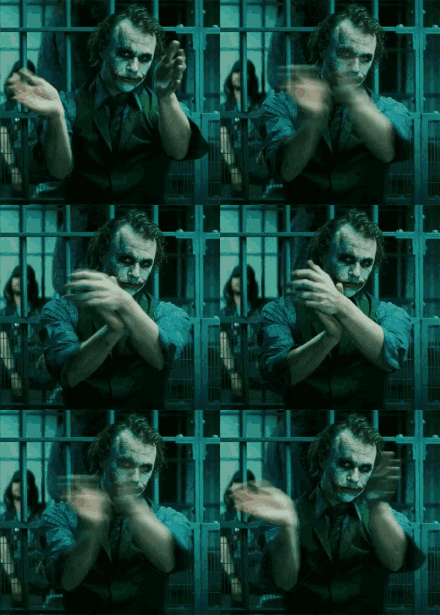
It extends online, as you can just type “slow clap” under someone’s comments on Reddit or wherever and it’d be mocking them for being a bit dense.
Think about it! If everyone at Cannes stood up and slow clapped… that’d be quite the marvel. That’d get you some serious column inches.
Thus, clapping is 98.7% (highly accurate mathematical formula alert) positive and 1.3% used for merciless mockery. Make of that what you will. 👏
