
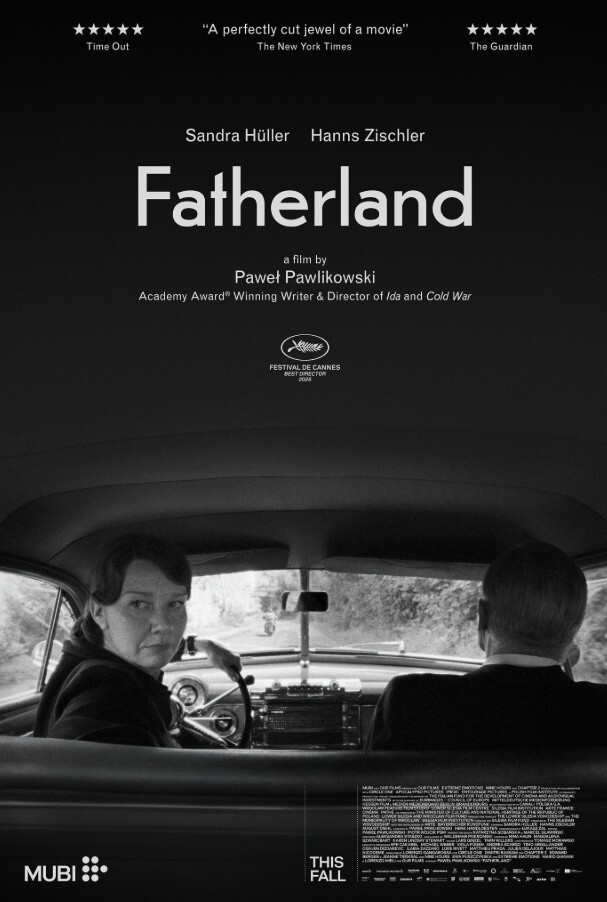
Due to capitalism issues, we’ve taken a few weeks off. Now we’re back with a review of Paweł Pawlikowski’s 2026 biographical film Fatherland, which stars Sandra Hüller and Hanns Zischler.
Set in the summer of 1949, it follows novelist Thomas Mann and his daughter Erika as they take a road trip across post-WWII Germany. A sense of national alienation and divided identity follows, themes that resonate in our chaotic modern political landscape, all of which make for an intriguing film that demands more than one viewing.
Losing Your Nation in Fatherland
Thomas Mann remains most famous for his works Buddenbrooks (1901), The Magic Mountain (1924), and Death in Venice (1912). He took a dramatic arc with his political views over his life, shifting from a Conservative nationalist during WWI into an anti-fascist polemicist before and after WWII, embracing socialism and rejecting the Nazi party.
Mann was on holiday in Switzerland when the Nazis rose to power in 1933 and he, wisely, chose not to return home. In 1936, the Nazi government revoked his German citizenship.
So, yes, just to clarify on this as the film is historically accurate. Mann did return to Germany in 1949 and many of the characters he knew are depicted here.
Fatherland portrays all of this in melancholic black and white. In mid-1949, we find a country in crisis and one struggling to recover and find its new political path. Mann is still in exile, but is invited to Frankfurt to receive a Goethe Prize in literature. He’s joined by his daughter Erika, who chooses to drive across the country as part of her father’s homecoming.
It’s a far from celebratory return, with the devastation of the war still more than apparent.
During the trip, her brother Klaus (also a writer) appears to commit suicide.
Erika and her father continue to attend events and mingle with luminaries, many of whom were in some way associated with the Nazi party. The narrative follows this structure, with Erika and Thomas increasingly ill at ease with the country they’ve returned to.
We watched the film at HOME independent cinema in Manchester and there was an audible gasp from cinemagoers with that slap. He deserved it, though.
The uneasy nature of Fatherland, playing out at a sedate pace, really ramps up the sense of alienation. Erika and her father are out of sorts back in Germany, each new road trip encounter enhancing the sense of national isolation.
It does remind us somewhat of The Zone of Interest’s (2023) tone, also starring Sandra Hüller and arguably the best WWII film we’ve ever seen.
A big difference, though, is Fatherland is so concise. It’s only 82 minutes. The film breezes into your life, set in black and white, considers the nature of a country in recovery, then leaves you with a family in emotional turmoil.
It’s received many 5/5 reviews for what it depicts, but it’s definitely a film we need to watch more than once. Very good indeed, with Sandra Hüller and Hanns Zischler on firm form. Paweł Pawlikowski’s direction is also beautiful, with some stunning shots faithfully recreating the sense of time and place.
Yet its time and place is what makes it such uneasy viewing. History appears to be repeating across the modern political world, which makes Fatherland feel undated and timely. Erika’s steely gaze of uncertainty haunts much of the film, a look of stoic personal bravery we feel many can take solace in.
The Production of Fatherland
Fatherland is out in cinemas now. Its €10 million budget has so far resulted in €6 million at the box office, so we expect it to be a commercial success (it’s still yet to roll out in some countries). Especially as the project is headed by Sandra Hüller, who has hit the big time in 2026. Alongside this, she was in the big Hollywood hit Project Hail Mary and the critical darling indie film Rose.
She also has a small part in Tom Cruise vehicle Digger, which we’ll cover soon enough. She’s almost certainly going to win an Oscar this year, we’d wager.
Director Paweł Pawlikowski’s inspiration for the project came from Thomas Mann’s very real return to Germany in 1949. However, Pawlikowski reimagines aspects of this historical event. Working with cinematographer Łukasz Żal, most of the shoot was chronological and took place in Poland (as this was cheaper). Sets were constructed in the street to match the surrounding buildings.
Costume designer Aleksandra Staszko has also faithfully recreated 1940s fashion for the film. This was more complex than you’d expect, as it required a specific emphasis between Eastern and Western German dress styles.
The shoot began in August of 2025 and completed in December, with a total of 38 days across those months used for filming.
Fatherland premiered at Cannes Film Festival in May 2026, launched in Germany from 3rd September, and hit UK cinemas this week. It’s been a huge critical darling and Pawlikowski won Best Director at Cannes.
Expect it (and Sandra Hüller) to win big at next year’s Oscars run.
