
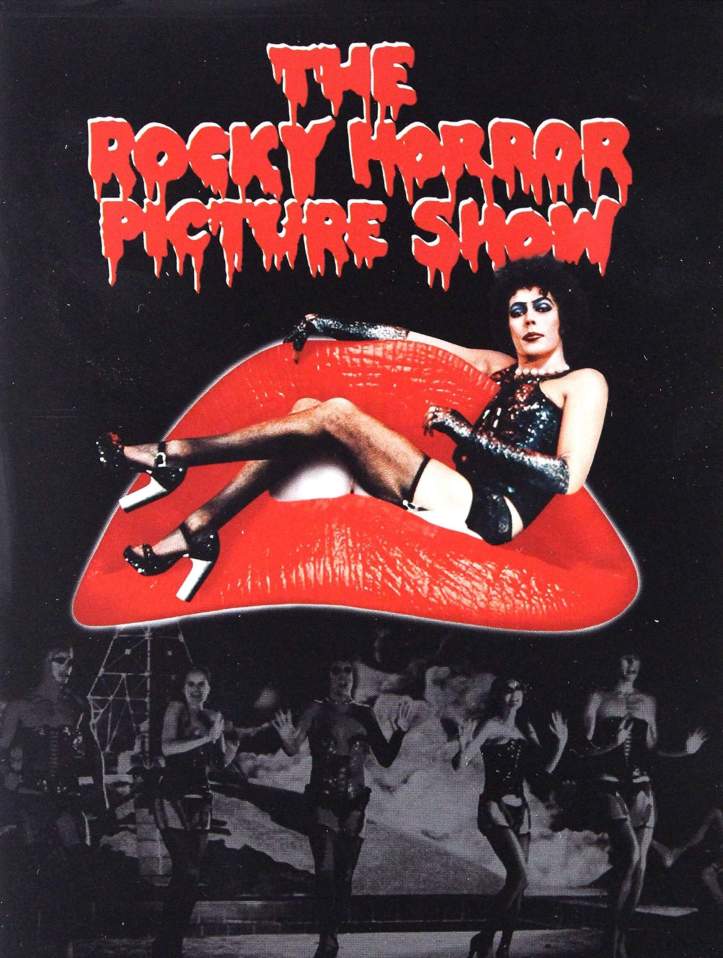
WELCOME TO HALLOWEEN, DARLINGS! And that means only one thing. It’s time for the Rocky Horror Picture Show! The midnight movie darling that was ignored by critics upon its 1975 release, became an overnight sensation, and is now the longest running theatrical release in history.
That’s right, it’s still in limited release across cinemas 51 years after it launched. Hell of an achievement for one very weird musical and its ever-pertinent LGTBQ+ edge to it all. Huzzah!
Let’s Do the Time Warp in The Rocky Horror Picture Show
The film was adapted directly from Richard O’Brien’s stage play. We watched it in full for the first time recently, having seen it out of order over various years. What struck is straight off is Jim Sharman’s direction is fast-paced and doesn’t hang about.
Viewers are launched straight into it all, moving quickly between catchy songs.
We meet Janet (Susan Sarandon) and her fiancé Brad (Barry Bostwick). They’re a very Conservative couple and, after just getting engaged, they plan to catch up with an old teacher friend.
On the journey, their car suffers a flat tyre. Brad and Janet go looking for a telephone to get help, discovering an old castle where a party is taking place. The creepy butler Riff Raff (Richard O’Brien) welcomes them into the building, where the maid Magenta (Patricia Quinn) join a group rendition of The Time Warp.
Feeling unsettled, Janet and Brad look to leave the property. They’re stopped by the flamboyant arrival of Dr. Frank-N-Furter (the one and only Tim Curry) who rapidly lands some revelations on the couple.
Dr. Frank-N-Furter is a mad scientist and introduces the couple to a blonde man called Rocky (Peter Hinwood), a being he’s invented to ogle. This introduction is interrupted when a different creation, Eddie (played by Meat Loaf), breaks out of a deep freeze and goes on a rampage.
The mad scientist has a simple solution to the carnage. A mercy killing!
What follows on from here is Brad and Janet are taken on a kind of progressive awakening. Dr. Frank-N-Furter tries it on with both of them, during which time Janet finds a newfound confidence in herself and realises she doesn’t just have to marry herself off at a young age.
The wider plot arc is Dr. Frank-N-Furter being an alien, with his mission being to return to his home planet. That leads to the iconic I’m Going Home song, one of the serious moments in The Rocky Horror Picture Show.
It’s a great fun film that holds up very well. There’s not really a lead character, if there is one it’s arguably Susan Sarandon’s Janet. But the most memorable of the lot is Tim Curry on incredible form, dominating his role with absolute confidence and turning himself into a star in the process.
We’re not musicals fans at all, but it delivers big time on its job. Plus, it’s so bizarre. There’s something about its madness that’s endlessly appealing.
Lots of catchy songs, at a hell of a rate, plus engaging characters around that. But it’s the LGBTQ+ edge and progressive themes (some of which are now dated and jarring at times) that have ensured the film’s long-term, iconic status.
Tonight, it’ll be played across many cinemas in America! We had a check and it’s even playing at our local cinema, 5:30pm at The Light Bolton of Greater Manchester. Get your tickets whilst you still can!
The Production of The Rocky Horror Picture Show
Richard O’Brien (who we knew as kids from hosting The Crystal Maze) came up with the concept in the early 1970s. He was living in London as an unemployed actor. A musician as well, he cobbled the songs together and wrote the script over one chilly winter.
A big fan of daft B movie horror films and sci-fi, he combined the two and hammed everything up with OTT dialogue and absurdist horror.
The emergence of glam rock between 1971 and 1975 helped him open up more, with bands like T. Rex (headed by Marc Bolan) providing him with confidence that his project could work. It turned into the stage play the Rocky Horror Show and it became a cult hit in London and moved between various theatres. It eventually found its home at the 500-seater King’s Road Theatre in August 1973 and had a six-year run there. It also shifted over to the US for its debut in LA from 1974.
Its stage success led to funding for the film.
Shot on set at Bray Studios, the other main location was the swanky Oakley Court in Maidenhead, Berkshire. The latter is a country house built in 1857 in the Victorian Gothic style of architecture. Due to that setting, Tim Curry decided to camp up Dr. Frank-N-Furter’s performance by speaking in RP (received pronunciation) posh accent.
Oakley Court is a cold place and, because the shot took place in autumn, young Susan Sarandon actually came down with pneumonia. Curry also noted shooting some scenes proved very unpleasant, such as a pool scene before I’m Going Home. It was supposed to be a luxurious, warm swimming pool, but it wasn’t… the water was freezing bloody cold.
It was the first film for many on set, too, and Tim Curry’s screen debut. He and Susan Sarandon, obviously, went on to some major things afterwards.
But it was a hell of a risky career move for Curry. Given how uptight society was in the early 1970s, the ’60s counterculture movements had managed to loosen up crusty Conservative mindsets slightly, but taking on a screen debut role as a mad scientist transvestite could have ended his reputation there and then.
When the film launched, it was generally ignored. Then something rather magical happened!
The Rise of The Rocky Horror Picture Show
The above is from July 1978 at the Village Theater in Dallas, other footage is then from 1979, with some people boasting of seeing the film over 200 times at the cinema. These midnight screenings in the US are what transformed The Rocky Horror Picture Show into a cultural phenomenon.
Without that, it would’ve been some obscure musical. The budget was a modest $1.4 million, with all the extra attention it’s since made over $170 million worldwide.
American film critic J. Hoberman claims to pinpoint the exact moment the film really took off. At one screening five months into its American run, audience members began shouting lines back at the screen. Apparently, the normally mild-mannered teacher Louis Farese Jr. yelled at Janet:
“Buy an umbrella, you cheap bitch!”
This soon exploded into counter point dialogue and an interactive film experience, with fans attending whilst dressed up as their favourite characters. A glorious thing indeed and the power of film, this curious musical getting quiet and introverted people out of their shells a bit. Letting them be themselves or a bit of an alter-ego.
In recent years, shortly before he died, Tim Curry was noted as celebrating the film’s influence:
“The message of the film, ‘Don’t dream it, be it’, is very important. One of the things that the movie does, I think, is give anyone permission to behave as badly as they really want, in whatever way and with whom. And I’m proud of that.”
And people are going to be out there tonight, and for many years to come, revelling in this daft B movie horror madness. We can dig that.
