
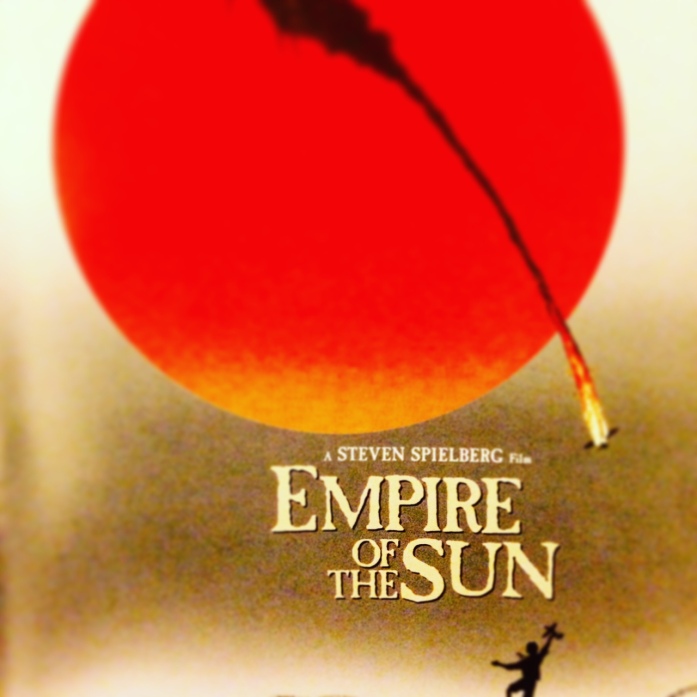
Our first experience of Steven Spielberg’s Empire of the Sun was in 2004. We were super young and at university, but picked the VHS copy out of our parent’s collection and were amazed by it all.
Launching on December 11th 1987, is arguably Speilberg’s most underrated film. Alongside a masterclass in direction, young lead actor Christian Bale was phenomenal. It’s made this an enduring classic, with lots of unique themes and a moving tribute to the struggles of millions during WWII.
A Steven Spielberg Masterpiece in Empire of the Sun
Author J.G. Ballard was growing up in Shanghai when WWII kicked off, causing chaos in the vicinity and his family’s internment in a Japanese POW camp. He adapted his experiences into the novel Empire of the Sun (1985) with central character Jim Graham based on himself.
Young Jim is stranded in Shanghai and ultimately left to fight for survival in a POW camp, where he comes across an assortment of individuals who, in their own way, shape the rapidly growing Jim’s personality.
It’s a coming of age story set in WWII, essentially, but it’s highly charged and emotional, which was perfect territory for Spielberg.
The plot allows the famed director to apply typically high artistic standards to his work, along with considering his popular themes of youth and wonder. Importantly, J.G. Ballard approved of the film adaptation, so that is rather excellent.
Young Jim’s Quest to Find His Mother
As with many Spielberg films, the characterisation focuses around family. There’s no cheesy dialogue here (helped by the fact it’s based on J.G. Ballard’s excellent novel, from which quite a lot of dialogue is taken verbatim) or lazy characterisation. It’s straight up compelling portrayals of real, desperate people.
For us, the mercurial Basie (John Malkovich on excellent, slippery form) makes the film. When we first meet him he’s wearing a hat and is looking ruggedly handsome. His greed leads to an early mishap, however, when Japanese soldiers floor him with bokken (wooden samurai sticks), finally revealing him to be distinctly human and, indeed, dramatically balding.
For the rest of the film Basie’s all over the place. Primarily concerned with his survival, Jim is kept in tow as he can perform oddjobs. As Jim idolises Basie, he doesn’t have many problems with risking his life for the American.
In the meantime, Basie’s endlessly conniving ways earn him numerous severe beatings in the POW camp, landing him in hospital for long periods of time.
There’s also Frank (Joe Pantoliano), Basie’s cohort, who is also rugged and handsome on his first appearance with a hat and stubble, but is soon revealed to be somewhat pathetic, balding, and merely a grown-up version of Jim – minus the intelligence.
Then there’s English actor Nigel Havers who plays the intellectual, pompous Dr. Rawlins. He becomes a father figure for Jim and there’s an extraordinary scene with Bale and Havers as the doctor attempts to calm young Jim whilst P-51 Mustangs blast past in the background, mere feet away.
We also have to mention Jim (performed brilliantly by Christian Bale). He’s a precocious little git, but generally is endearing in his naïve, childlike way.
There’s a sense of human frailty being exposed throughout the film. For instance, the tough-guy façade held by Basie and Frank is tested by the brutal situations the two face. Frank ultimately falters and becomes a feeble character, whilst Basie (through sheer bloody will) holds his nerve despite the teeth he loses in the process.
It’s beautifully shot, the gorgeous Welsh lullaby Suo Gan drifts subtly in and out, the performances are often remarkable, Malkovich is at his peak, and there are many iconic scenes on offer. But young Christian Bale put himself on the Hollywood map with his incredible performance.
And there some of Spielberg’s best moments here. Notably at the conclusion of the film when Jim is reunited with his mother (Emily Richard). This actress really gets across the sense of separation families went through during the destruction of WWII and Jim’s reactions are brilliantly observed.
Having read the book, we must note the film varies quite significantly at times. J. G. Ballard was full of praise for what Spielberg did, but felt it differed from his narrative.
The film certainly plays down some of the more traumatic themes, notably the mass starvation following the abandonment of the camp. In the novel this is very realistic, but Spielberg strayed away from being too graphic here. Something he addressed much more full on in Schindler’s List (1993).
Empire of the Sun may, then, not be Spielberg’s most famous film. But we put the argument in that it’s one of his most important and underrated.
The Production of Empire of the Sun
Filming began on March 1st 1987 on location in Shanghai, Spain, and also at Elstree Studios in the UK. This followed negotiations in 1985 with Shanghai Film Studios and China Film Co-Production Corporation to allow for shooting in Shanghai.
The shot lasted four months with a budget of $25 million, which was fairly low even for the time. With shooting happening just over 40 years since the end of WWII, it also made it the first US film shot in Shanghai since the 1940s. Spielberg used over 5,000 locals as extras in various scenes.
In 2023, Spielberg was asked about Empire of the Sun. It’s clearly a film he put a lot of passion into and also allowed for his other famous WWII projects that were to follow.
Christian Bale is now 51 and has become a Hollywood legend by starring in many iconic films (American Psycho, Batman etc.) He was quizzed in 2017 about his experiences on the set and gave this answer.
The film was a moderate commercial success, although a disappointment given it was a Spielberg film, bringing in $66.7 million at the global box office. That included only $22 million in America.
After its release on home video (VHS) and TV it went on to recoup significantly more.
It was also Oscar nominated across six areas, but didn’t win anything. All of which is a bit odd, as for us this is easily one of Spielberg’s best films. For some reason, it just didn’t resonate with global audiences at that time in late 1987.

I have read this book and seen the movie, it is up there among the best!
LikeLiked by 1 person
Both are fabulous, there’s no denying it!
LikeLike
I saw ‘Empire of the Sun’ on first release. It was a tremendous movie.
LikeLiked by 1 person
I only watched it for the first time in 2004, unfortunately, but grew pretty obsessed with it straight away! Love the book, too.
LikeLiked by 1 person