
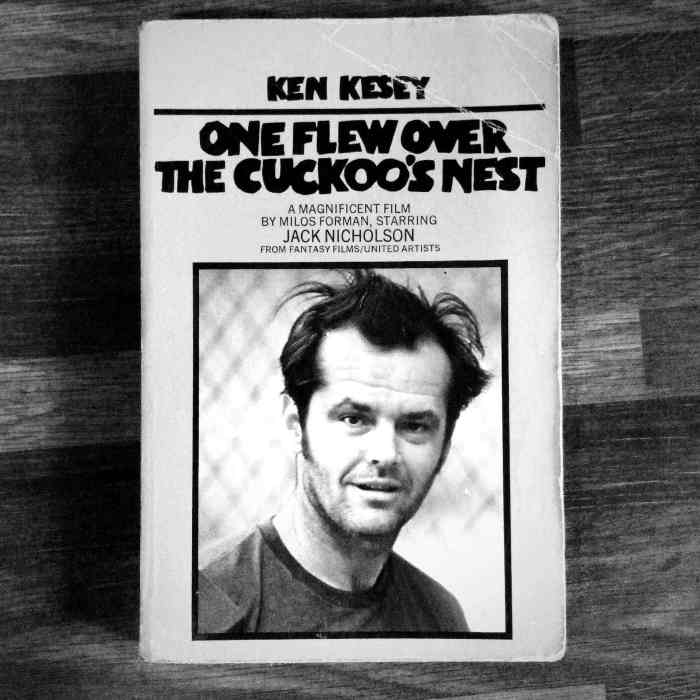
Ken Kesey’s debut novel One Flew Over the Cuckoo’s Nest is a modern classic. A book of incredible power and, undoubtedly, a timeless classic.
Whilst its 1975 film adaptation tends to dominate the limelight, there’s no denying the book is every bit as brilliant. A stunning piece of work from its author.
First published in 1962, it’s lost none of its importance or power. And we’re exploring some of its themes to see just how Kesey landed a masterpiece at his first time of asking.
Themes of Power, Individualism, and Sanity in Kesey’s One Flew Over the Cuckoo’s Nest
“All I know is this: nobody’s very big in the first place, and it looks to me like everybody spends their whole life tearing everybody else down.”
The book is set in an Oregon psychiatric hospital. A half-Native American patient called “Chief” Bromden narrates, although he’s styled himself as a deaf and mute occupant of his ward.
One day there’s a new patient called Randle Patrick “R. P. ” McMurphy, a red-haired, rebellious, extroverted character.
He’s come in faking insanity to try and skip time in a standard jail.
McMurphy immediately clashes with the monotonous nature of ward life, which is run with ruthless efficiency by the head administrative manager Nurse Ratched. She has total authority and doesn’t take kindly to anyone screwing with her routine.
That means Ratched and McMurphy immediately don’t see eye-to-eye, with the latter going well out of his way to wind her up at every given opportunity.
It leads to a battle of morals, power, and wills.
During which time McMurphy comes to question why his fellow inmates (some of whom could leave at any time) are there. As he notes:
“Never before did I realise that mental illness could have the aspect of power, power. Think of it: perhaps the more insane a man is, the more powerful he could become. Hitler an example. Fair makes the old brain reel, doesn’t it?”
That all leads to some fantastic monologues from McMurphy.
Flawed as a character he may be, but his ability to see through the bullshit and express himself clearly is enough for anyone to have a revelation.
“What do you think you are, for Chrissake, crazy or somethin’? Well you’re not! You’re not! You’re no crazier than the average asshole out walkin’ around on the streets and that’s it.”
The work builds to a crushing, yet inspiring, ending that’s become iconic. A more perfect ending we don’t think would be possible to conceive (we’re not including it here, for spoilers sake!).
It’s an amazing book. Make no mistake. Everybody should read it.
Interestingly, Anthony Burgess’ classic A Clockwork Orange launched in 1963. Although it’s set in a nightmarish dystopia, the themes of power struggles, establishment control, and mental illness are in keeping with Kesey’s counterculture stance.
Although we weren’t around at the time, it feels like this was the beginning of mental illness (and mental health) being a more open discussion point in society.
Again, this highlights the power of culture.
How one book from an inspired writer can lead discourse and inspire people to find inner strengths and resilience. That’s the powerful capacity of Kesey’s masterpiece.
A Note on the Book’s Nursery Rhyme
Vintery, mintery, cutery, corn,
Apple seed and apple thorn,
Wire, briar, limber lock,
Three geese in a flock,
One flew East,
One flew West,
And one flew over the cuckoo’s nest.
Just as a quick aside here, after electric shock treatment Chief Bromden remembers the above nursery rhyme. And how his grandmother sang it to him when he was younger.
After a bit of digging around, we found it’s a song from America.
Its first available recorded use in history dates from 1806 in Massachusetts and Connecticut. It’s not one we heard here in England when we were growing up in the ’80s and ’90s.
The first time we became aware of it is from the book, which briefly references the children’s folk rhyme in its front matter.
On One Flew Over the Cuckoo’s Nests Origins
Ken Kesey (1935-2001) grew up in Springfield, Oregon, and became a novelist, essayist, and counterculture figurehead during the Sixties.
In his most famous book, you can see that anti-establishment sense of vigour that went on to make the spirit of Woodstock ’69 (amongst many other key moments from the decade).
His idea for the work came from his Menlo Park Veterans’ Hospital night shift. He worked there for spells during 1959.
Kesey spoke with the patients and, as he was taking a lot of drugs at the time, during which time he came to think of the patients are perfectly sane.
Just not people who fit into society’s neat little brackets of social conventions.
After the book launched it was a big success in America. As it was published during a major Civil Rights Movement in the US, the timing couldn’t have been any more perfect as an attack on ultra-conservative authority.
Its first adaptation was as a stage play (and it still receives regular theatre runs across the world).
Then came the legendary 1975 film adaptation, cementing the work’s status as a timeless classic and a defining work of the 20th century.
We first read One Flew Over the Cuckoo’s Nest at the tail end of 2001, around about the time Kesey died (November 10th). The second time we read it, over a decade later, we realised just how much of a masterpiece the book is.
Tribute to the Legendary Film Adaptation of One Flew Over the Cuckoo’s Nest
Directed by Miloš Forman (1932-2018), the film adaptation of One Flew Over the Cuckoo’s Nest is a cinematic masterpiece.
Despite its status, Kesey never saw the film. He was involved in the production, but:
- Left after two weeks due to a dispute over his pay.
- Was unhappy Chief Bromden didn’t narrate the film.
- Remained unhappy with Jack Nicholson’s casting (Kesey wanted Gene Hackman for the role of McMurphy).
Despite his personal issues with the project, according to his wife he was, nevertheless, happy that the film adaptation went ahead.
It launched in 1975 and starred Jack Nicholson in, arguably, his most iconic movie role.
The film had a budget of around $4.4 million and went on to make $163.3 million at the box office. An impressive feat given the serious subject matter, although we’re sure Nicholson’s star power drew a lot of people to this one.
There are some differences to the novel, considering the book is narrated by Chief Bromden. That’s entirely absent from the film. Instead, we see things as they play out in real-time on screen. We should imagine this was done for accessibility purposes.
R. P. McMurphy is also a lot different in the film to the book, but Nicholson made the film his own with an outstanding performance. Kudos, too, for Louise Fletcher as the quietly monstrous Nurse Ratched.
The pair of them square off for cinema’s most memorable scenes.
It all makes for an excellent complement to the book, both as enjoyable as each other for different reasons, but with a message that’ll resonate for centuries to come.
