

As it turns out Wolfgang Amadeus Mozart (1756-1791), genius extraordinaire and iconic music man, had a puerile streak about 10 miles wide. What was going on there?
Well, before we go on let’s just say we’re huge fans of Mozart’s work. His canon is vast (over 600 pieces in just 35 years) and he was an absolute genius. This feature isn’t to undermine, or mock, that legacy.
But there was something odd about the man’s fixation on toilet humour. Mozart could create timeless masterpieces, but also took joy ranting about excrement. Well, the scholarly world isn’t happy about that and has debated its butt off about it! Let’s explore.
Mozart and Scatology: What Was Going On?
The beautiful piece above is Leck mich im Arsch (“Lick me in the arse”), a canon in B-flat major composition by Mozart. His intention for it was to be sung by six people as a party piece.
It’s likely he composed that one circa 1782 whilst in Vienna.
The very same composer of such a silly number also produced beautiful works such as Serenade For Winds; K 361; 3rd Movement (perhaps the “winds” bit had a different intention than we might think).
The issue people struggle with is how one man can be so erudite and sophisticated, whilst also plunging the depths of (what for some people) is crude and offensive behaviour.
This subject has been the centre of much debate for decades now. Entire books and psychological studies are out there with the sole attempt to understand what was up with Mozart.
To understand what everyone is so worked up about, you have to first turn to Mozart’s prolific letter writing habit. As with many people from his era, he wrote vast amounts of letters to family members and friends.
Here’s an example of one of his letters (written at the age of 19), dated Mannheim, 5th November, 1777.
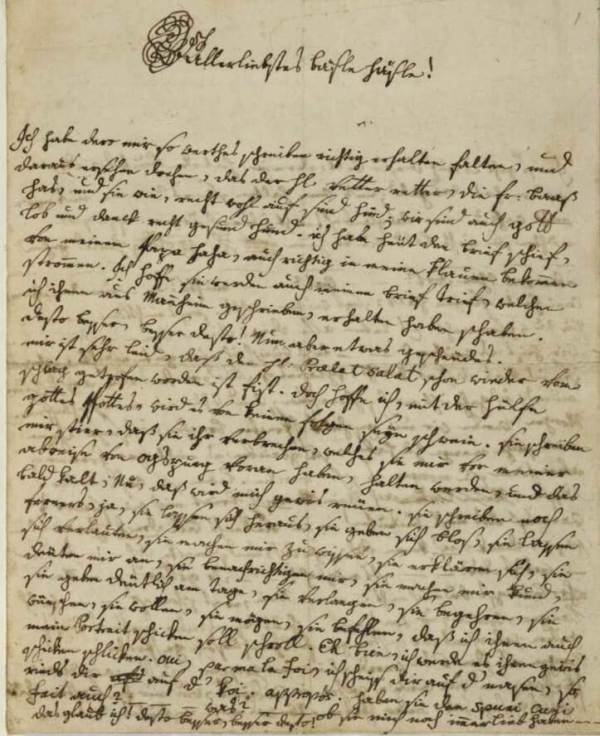
This was translated by author Robert Spaethling. He found it contained some absolute humdingers in baffling and crude behaviour. Including this bit:
“Tomorrow we’ll speak freak sensubly with each other. Things I must you tell a lot of, believe it you hardly can, but hear tomorrow it already will you, be well in the meantime. Oh my ass burns like fire! what on earth is the meaning of this!—maybe muck wants to come out? yes, yes, muck, I know you, see you, taste you—and—what’s this—is it possible? Ye Gods!—Oh ear of mine, are you deceiving me?—No, it’s true—what a long and melancholic sound!”
Amongst the ordinary stuff about what he’s been up to is that line:
“Oh my ass burns like fire! what on earth is the meaning of this!”
That’s where all the consternation begins as, oddly, a significant proportion of his letters contain blatant toilet humour and profanity. Not what the cultured world expects from a man of his creative genius.
With much stern expressions and tut-tutting, the intellectual world has gone about getting to the bottom of it all.
Benjamin Simkin, in a 1992 article for the National Center for Biotechnology Information (NCBI), headlines a piece Mozart’s scatological disorder. He begins:
“The surprising scatology found in Mozart’s letters has not yet been satisfactorily explained.”
Simkins highlights the 1938 publication of Mozart’s letters (earlier editions removed many of the crass remarks to protect the sensitivity of readers), in which an introduction from Emily Anderson states:
“It was not only when writing to his ‘Basle’ (little cousin) that Mozart indulged in this particular kind of coarseness, but … certainly his mother and very probably the whole family and indeed many of their Salzburg friends were given to these indelicate jests.”
Simkin compiled Mozart’s letters to determine how many times he used toilet humour with his nearest and dearest. The results are as follows:
- 20 times to his father Leopold.
- 6 to his wife Constanze.
- 6 to his cousin.
- 4 to his sister.
- 1 to his mother.
- A number of times to a selection of various acquaintances.
And then there are the recreational pieces such as Leck mich im Arsch, which continue to baffle people regarding his behaviour and intentions.
To note, there are some contemporary reports of Mozart’s personality. These were written by his family and friends, most of which highlight he was a cheerful person. But had a very childlike streaks. Interesting? Well, let’s take a closer look on that.
Mozart’s Signs, Symptoms, and Symphonies
The hypothesising for what was up with Mozart is still in operation—for decades it has raged on.
Simkins was convinced it was Tourette’s syndrome. It’s a claim influenced directly by Peter Shaffer’s play Amadeus (and later the 1984 film), which was developed based on Mozart’s letters.
Shaffer’s play was adapted into an Oscar-winning film in 1984. In that production, Mozart comes across as a happy-go-lucky, immature genius.
His brilliance as a musician is tempered by an irritating, intemperate personality.
Although his commitment to music is displayed as borderline infatuation, the film suggests he’s kind of lucked into his situation. Tom Hulce’s performance does develop into something more profound. Later in the film, as the composer becomes ill, Mozart shows far more dramatic and tragic (as the man’s story ultimately is) depth.
But Amadeus certainly didn’t impress the composer’s legion of fans. Was he really that annoying?
Again, we return to his many letters. From that, a myriad of other claims have emerged. For instance, some believe the composer had a hypomanic manifestation of a cyclothymic personality disorder (bipolar disorder).
Some suggest psychopathological tendencies. Obsessive-compulsive disorder has also been considered.
Regardless, it’s clear those researching Mozart’s condition consider his antics as:
“Coarse, immature characteristic[s] which Mozart retained in his adult life.”
The bickering in the medical field has raged for decades, with such great minds as Oliver Sacks stepping in to offer a considered opinion—he dismissed Simkin’s diagnosis.
Freud’s Look Into Mozart
Many other neurological experts have also waded into the Mozart mix, including the founding father of psychoanalytics.
Austrian writer Stefan Zweig (famous for works such as Twenty-Four Hours in the Life of a Woman) also studied Mozart’s letters and got in touch with Sigmund Freud.
He suggested the letters pinpointed infantilism and coprophilia (an abnormal interest in excrement), although Freud didn’t agree—allegedly.
Has anyone agreed on anything? No.
David Schroeder, however, took a lenient look at Mozart’s writings and has provided what’s possibly the most sensible analysis of the situation yet. He suggested the passage of time has:
“[Forced] us to misread his scatological letters even more drastically than his other letters. Very simply, these letters embarrass us, and we have tried to suppress them, trivialise them, or explain them out of the epistolary canon with pathological excuses.”
And that’s a sentiment we agree with. Frankly, we think that’s nailed it one really. All this obsession about understanding Mozart has clouded more clear cut answers.
However, it has been fun observing some of the dramatic overreactions to what the composer wrote hundreds of years ago.
Elsewhere we Have Margaret Thatcher’s Disdain For Mozart’s Crude Portrayal
Unfortunately, not many people have time for Schroeder’s appeal for calm and Mozart’s behaviour has upset a number of high profile figures.
Perhaps most famously of all, the Iron Lady that was Margaret Thatcher (a great admirer of Mozart’s work) was enormously displeased at the idea the composer had an immature streak.
The former English Prime Minister saw Peter Shaffer’s play Amadeus in London. Its director, Peter Hall, later recalled in a preface to the published screenplay:
“She was not pleased. In her best headmistress style, she gave me a severe wigging for putting on a play that depicted Mozart as a scatological imp with a love of four-letter words. It was inconceivable, she said, that a man who wrote such exquisite and elegant music could be so foul-mouthed. I said that Mozart’s letters proved he was just that: he had an extraordinarily infantile sense of humour … ‘I don’t think you heard what I said’, replied the Prime Minister. ‘He couldn’t have been like that.’ I offered (and sent) a copy of Mozart’s letters to Number Ten the next day; I was even thanked by the appropriate Private Secretary. But it was useless: the Prime Minister said I was wrong, so wrong I was.”
Not wishing to get too political, but that’s from a woman who also claimed people in poverty have a “personality defect”.
Contemplating silly humour was never going to be a strong point of someone with such an austere Conservative bent.
The Mozart Mystery: Childish or With a Sense of Fun?
We’re not sure what some scholars expect from Mozart. Considering he’s deified, perhaps they believe he awoke at 5am each morning, headed to his bedroom window, and stared forlornly into the middle-distance in deep contemplation about the nature of being.
Dropping to his knees, Mozart must surely have let rip with an existential roar of anguish before heading off to make profound music.
That’s how great artists function, right? With a constant sense of sophistication and dramatic heft; a sole focus on profundity…
Or, perhaps, give the guy a break.
Whilst his letters are puerile (to quite an unusual streak, not in the silly Monty Python sense—just flat out childish) he did have two children and perhaps this brought out his silly side.
In addition, the vast gulf of time between our era and Mozart’s makes it difficult to determine what social attitudes were to this sort of thing. Was it common to make crude jokes? Probably.
In Medieval times the Royal court in London was home to professional flatulists (see Jack Hartnell’s Medieval Bodies). In the 18th century, although a more advanced world, there’s no reason why puerility wasn’t commonplace.
Unfortunately, all we have with Mozart are a batch of letters and descriptions of his behaviour. No recorded footage, no possibility of judging his body language, or having a first-hand account of who he really was.
In this respect, it’s a tad difficult to judge the man considering this may very well have been a minor part of his personality—he composed over 600 works in his lifetime and this suggests he spent most of his time hard at work creating serious music.
We can all be thankful for that, at least.
