
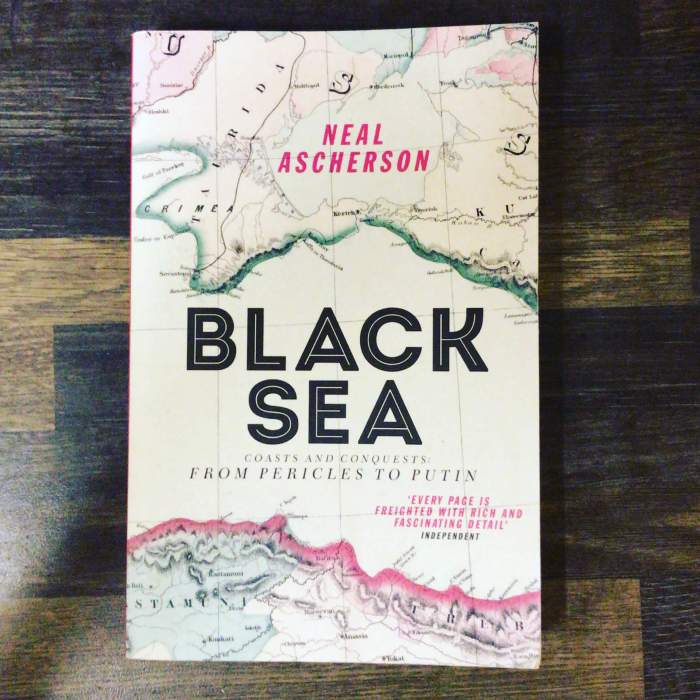
If you want a tribute to an ocean and its various shores then Black Sea: Coasts and Conquests: From Pericles to Putin is for you. It’s by Scottish journalist and writer Neal Ascherson and originally published in 1995.
It’s an intriguing read and a homage to Eurasian history. We suppose its unique take is to present an all-encompassing look at this region, from its beginnings (as a startup) to how it’s now functioning as a billion dollar conglomerate… are we getting confused with big business capitalism or something?
Anyway, Ascherson is on hand to dish the dirt about the Freeks, Scythians, Samatians, Huns, and many more. As the synopsis notes, it’s the place where barbarism was born.
The Black Sea Offers Mysteries and
Okay, so the Black Sea isn’t black. Let’s be clear on that. What it is? The marginal Mediterranean sea of the Atlantic Ocean with Bulgaria, Georgia, Romania, Turkey, Russia, and Ukraine bounded by its area.
Refer to the 2022 River documentary here, but the likes of the Danube, Dnieper, and Don supply the Black Sea. This means its drainage efforts pack out 24 nations across Europe.
The Black Sea covers 436,400 km2 (168,500 square miles) and reaches a lowest depth of some 7,257 feet. That’s pretty deep.
But the work is much more than an endless series of facts about the area. It’s an examination of the ethnic and social ecological history of many groups of people spread out across a vast geographical region.
Our edition of the work was updated in 2015 and includes a foreword from Ascherson:
“In the years since this book was published, the world has learned to worry about the Black Sea region. For the first decade and a half after the collapse of the Soviet Union in 1991, the new outlines remained stable. Most governments around the Sea were engaged in domestic struggles to establish their own authority and subdue economic chaos. But in the early 21st century, and almost without warning, Black Sea frontiers began to buckle as a fresh age of political earthquakes began.”
This highlights the work is much more than an ecological insight to the area. Instead, it’s heavily steeped in examining the political issues of the area. As now the Black Sea is even more resonant due to Putin’s disgusting antics.
But there is also analysis of what makes the Black Sea such a striking region:
“On the atlas, the Black Sea appears as a kidney-shaped pond, connected to the outer oceans by the thread-like channel of the Bosporus and the Dardanelles. And yet it is a sea, not a fresh-water lake: a salt-water mass some 630 miles across from east to west and 330 miles from north to south – except at its ‘waist’, where the projecting peninsula of Crimea reduces the north-south distance between the Crimean shore and Turkey to only 144 miles. The Black Sea is deep, reaching down to more than 2200 metres in places. But there is a large, shallow shelf in its north-western corner, off the stretch of coast which reaches round from the Danube delta in Romania in the west to Crimea in the north. This shelf, less than a hundred metres deep, has been the breeding-ground for many of the Black Sea’s fish species.”
The work is divided across three parts:
- The Making of the Black Sea (discussions on the geography, geology, and climate of the area and its history relating to Greek cities).
- The Ottoman Empire and the Black Sea (covering the 14th century to the 20th).
- The Black Sea Today (the environmental issues the region faced in the 1980s and 1990s).
The final section considers the collapse of the Soviet Union and what may lay ahead.
This makes Ascherson’s work makes an interesting accompaniment to Chernobyl: History of a Tragedy (2018) as a sweeping insight into a hectic region of Earth and its longstanding political issues.
It’s an interesting read and one we enjoyed pouring over, not least with looking back at how the world was in the region in different eras.
Essentially, it’s about the encounters between Europe and Asia to the backdrop of a beautiful part of the world. One ruined somewhat by the constant differences of human behaviour and the disputes that brings with it. Conflict, death, war and the usual human stuff.
What we did note online is how such bickering is represented in the feedback to the work. There are some negative responses to it online.
There’s one amusingly turgid reader response to the book we want to flag up from Waterstones in “I really wouldn’t if I were you”:
“The whole book is written in an elliptical and pompous style which makes it hard to work out what exactly the author means, not helped by an incomprehensible chapter structure. It uses analogies which would be inappropriate in any book, but especially one marketed as area history.
An example from p.57: ‘It was once the ranked, slow marching foot army of King Darius of Persia which was outmanoeuvred by the Scythians. Now it is the New York Police Department forming up against the homeless dossers on the pavements around Tompkins Square Park… Tomorrow it will be the turn of customs officers and frontier guards of the European Union to be outwitted and hunted by ten million illegal, inaccessible, fast-moving, aporoi immigrants.'”
And that warrants a 1/5 review. We mean, really, the worst book we can think of we’ve ever read we wouldn’t give 1/5. But there you go, internet era mania.
To note, in 1995 the Black Sea book actually won the Saltire Award for Literature and Los Angeles Times Book Award for History (1995 and 1996, respectively). It’s not too bad, then, and in fact we recommend it for history buffs looking for some oceanic insights.

Looks fascinating – I’d not run across this one before. What I find particularly interesting about the Black Sea is the way water has ebbed and flowed in and around it in response to the various glaciations, etc, followed by its role in the rise (fall etc) of the early civilisations – so I’m gonna have to check this book out.
LikeLiked by 1 person
It seems quite revered as a book, just divisive. Some of the 1/5 reviews are ridiculous. I’m sure you’ve had randoms do the same with your books as well.
Well worth a check this, though! The updated 2015 edition is the one to aim for.
LikeLiked by 1 person