
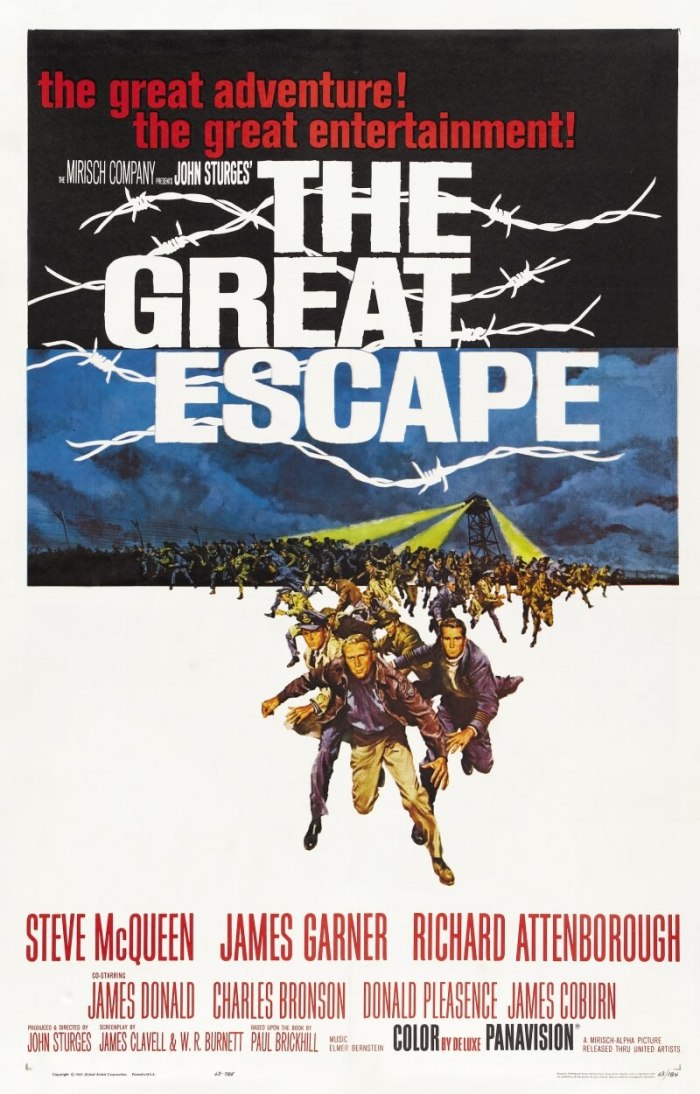
Here in England we must note The Great Escape (1963) has this weird status as a Christmas film. Sit back with the family, relax, and watch some British POWs stick it to those Nazi bastards!
Despite what us Brits want to make of it, we feel it’s a distinctly Hollywood classic. American director John Sturges (1910-1992) headed the project and it starred a swashbuckling Steve McQueen in his early 30s.
Officially it fits the genres of epic war suspense adventure films. Certainly fits the bill! And is something of an enduring classic.
Defiance and Derring-Do Galore in The Great Escape
The film was adapted from Paul Brickhill’s eponymous book, which was first published in 1950. However, it’s worth noting even with the book it’s a loose retelling of the true story.
There was a mass escape from a Nazi POW camp called Stalag Luft III during WWII by British Commonwealth prisoners (March 1944).
But for commercial appeal, screenplay writers James Clavell (of Shōgun the novel fame) and W. R. Burnett took artistic liberties.
That included the depiction of American POWs in the story, which was a chance to get the uber cool Steve McQueen onto the set (a similar thing later happened with the film adaptation for Empire of the Sun in 1987, with an enormously increased US presence in the movie).
Anyway, The Great Escape opens in 1942.
The Third Reich shifts Allied prisoners of war (POWs) to a fancy new camp, with nasty old Colonel von Luger (Hannes Messemer) heading up operations.
Group Captain Ramsey (James Donald) is warned that escape attempts will result in execution by shooting.
USAAF Captain Virgil Hilts (Steve McQueen) is legendary for his escape attempts. He spots one such opportunity but deliberately gets caught before revealing the weakness in the Nazi security.
Hilts goes off to “the cooler” (solitary confinement) for his swagger.
Flight Lieutenant Bob Hendley (James Garner) is also around, looking handsome, and supporting McQueen with his American accent.
After Hilts is detained, Squadron Leader Roger Bartlett (Richard Attenborough) establishes a formal escape committee.
The British (tally, bally ho!) plan a system of tunnels to dig their way out of the camp. The tunnels are named Tom, Dick, and Harry. Everyone groups together and adds their ideas, eventually cobbling together an extensive escape plan based on the few materials they have.
However, a bungled escape attempt at Tom leads to the death of one of the POWs (shot by the Nazi guards).
Despite this setback, the Harry tunnel becomes the main focus for escape.
On the big night in question, everyone makes a break for it. But the find they’re 20 feet short of the trees, which was intended for security cover. The Nazis spot them and are able to detain the unfortunates left behind, but several make a total break for it.
The rest of The Great Escape follows the attempts by Captain Hilts, Flight Lieutenant Hendley, and Squadron Leader Bartlett on their various trials and tribulations.
Ultimately, none of the escape attempts go particularly well. The Brits have their cover blown and it’s game over.
Flight Lieutenant Hendley is able to commandeer a Luftwaffe aircraft and nearly escapes to Switzerland, before the plane’s engine gives out. He’s soon recaptured by the Nazis.
Meanwhile, The King of Cool is off doing his own thing as the angry Germans chase after him in the name of stopping the plucky American.
Famously, McQueen did his own stunts in films. And he was arguably at his most spectacular best in the motorcycle chase scene. It’s even him in some scenes where Nazi officers are chasing his character Hilts. He was so skilled on a motorcycle director John Sturges used him essentially as a stunt driver.
However, there was one he didn’t do. Stunt double Bud Ekins took over for the famous, daring leap over some barbed wire.
McQueen wanted to do the jump and was well up for it, but his plans were curtailed by red tape (insurance concerns).
Comedian Eddie Izzard had a skit about the end of the film in his 1998 show Dress to Kill.
Izzard noted all the logistics and the planning that went ahead and the Brits were rounded up and shot in the head. Meanwhile, McQueen is off being super cool, gets caught, and gets away with another spell in solitary confinement.
And that leads to the film’s iconic closing sequence, with McQueen heard playing ball in his cell to help pass the time.
The film is about as Golden Years Hollywood as it gets, with some famous name actors giving it some serious welly.
We can understand why it’s got the reputation it has. In England, the effects of WWII were felt through the 1950s and into the 1960s and even longer. A rousing feel good, underdog story like this reflects the British spirit and all that. Stiff upper lip, old bean!
And for the Americans, well they’ve got the coolest bloke in history doing his thing, sticking it to the goddamn Nazis, and almost pulling it off against all the odds.
Certainly not the most realistic World War II film around.
But arguably the most uplifting amongst its various tragedies, highlighting the indelible nature of a fighting spirit and its benefits when one is in a tricky situation. What what!
The Production of The Great Escape
The Great Escape quickly became a legendary piece of cinema. In England, the likes of Michael Palin playfully spoofed it in the 1977 Ripping Yarns episode Escape From Stalag Luft 112B.
Director John Sturges, we’re sure, had no idea it’d become so iconic. But everything about it is memorable—right down to The Great Escape main theme.
The budget for this one was $3.8 million, with a box office return of $11.7 million. Not a huge hit, then, but over time its reputation grew.
These days, it’s always got a run on British TV at Christmas. For some reason. As the film is about as un-Christmassy as it gets. Nazis, war, death, executions, baseball… and yet it was a staple on TV for decades (this is how we got to watch the film years ago, eventually giving in and watching it one Christmas).
Contemporary reviews from 1963 weren’t overflowing with praise, with one SEDITIOUS British journalist (who shall remain NAMELESS here to protect his reputation) calling the film:
“Pretty good but overlong”
A statement enough these days in nationalistic Britain to warrant national riots. Indeed. BOO! HISS!
Whereas in subsequent years, especially in England, the film has gained a reputation as a cinematic classic of plucky underdog qualities. Us Brits just love a good they gave it their best but failed kind of story.
Keeping in mind this was filmed less than 20 years after the war had ended, many of the actors involved had fought in the conflict.
Steve McQueen was one. He got permission from his mother to enlist in 1947 (he wasn’t even 18 at the time) and joined the US Marine Corps. He was honourably discharged from service in 1950.
There aren’t many interviews with him, but this is a good one providing some rare insight into his processes (later, he was phenomenal in 1973’s Papillon).
Richard Attenborough was another. He served in the Royal Air Force during WWII and even suffered permanent hearing loss as part of his duties.
Screenplay writer James Clavell had also fought in WWII and was taken POW by the Japanese, which left him with severe PTSD for the rest of his life.
Most of the film was shot on location in Munich, with complete sets for the Nazi barracks constructed in full (a lovely reminder of the Nazi regime from the 1940s for locals).
The local town used for various outdoor shots was Füssen, Bavaria.
For the sake of posterity, we’ll end by showing the real Harry tunnel from the real Great Escape. Although the film was a very fictionalised account, as you can see the POWs did miss the tree cover by a margin.

Although it’s not mentioned in the film, many Germans assisted the POWs in their escape attempt. Citizens across the country mailed them realistic forgeries of documentation aimed at getting the prisoners over the border.
Several of the guards at the camp were also (secretly, of course) anti-Nazi. They provided the POWs with help and items.
That would’ve been a great inclusion for The Great Escape, so it’s a shame that side was left out.
As we feel terribly sorry for the Germans post-WWII who no doubt had to endure all manner of discrimination worldwide. Despite many maintaining strong anti-Nazi sentiments (see 2003’s Hitler: The Rise of Evil for more of that).

A fabulous film, classic ! Not seen regularly here but every once in awhile in Turner Classic Movies. Hats off for a fine review.
LikeLiked by 2 people
Did you know Steve McQueen is in this film!? We were talking about him recently, we were.
Hats off for his motorbike heroics. The Brits? Not so good! Tally, bally ho old chap!
LikeLiked by 1 person
Yes! Could he be more cool than in this film? He’s the reason I became a biker chick 🐥
LikeLiked by 1 person
THE KING OF COOL, lady! So your real name is Holly McQueen really? Do you throw ball, too? Dunno how he did it, but he did have the swagger. Too cool for school.
LikeLiked by 1 person
Yeah, he was cool. 😎
LikeLiked by 1 person
😎😎😎😎😎😎
LikeLiked by 1 person
Agree…this is a great review of a classic.
LikeLiked by 1 person
Thank you, I hand myself 13/10 and demand all the adoration.
LikeLiked by 1 person
👏👏👏👏👏👏👏👏👏👏👏👏👏/10
LikeLiked by 1 person
A fab review of a great film, thank you!
I adore Steve McQueen films …Bullitt, The Blob (watched it 3 times in the last 3 months), Papillion, Thomas Crown Affair, Towering Inferno…OH YEAH!!!
Think I’ll go watch “The Blob” now. (while I draw!)
LikeLiked by 1 person
Papillion is my favourite of his, although it is very, very bleak indeed! The PERFECT Christmas film, one might say!
Did you watch The Blob, then? That’s one I’ve not seen in about 30 years, I’ll revisit it. I like blobs. All hail blobs!
LikeLiked by 1 person
YES! Loved it, and Steve is gorgeous.
Another 24 gift idea….CO2 fire extinguishers.
Hey… according to the movie, The Blob is actually still alive. It’s merely been frozen and deposited at the North Pole.
Perhaps Santa could divvy up the blob into gifts.
I’ll have one!!!!! Forget my shovel!
LikeLiked by 1 person
Oooh, so The Blog is a bit like The Thing? That’d be a good movie. Blob VS Thing.
Steve McQueen was the hunk of his era, eh? Not Peter O’Toole!? Blasphemy!
LikeLiked by 1 person
Peter O’Toole? Pulllease!
LikeLike
Lawrence of Arabia – you’re saying he doesn’t look super handsome in that? Don’t talk down the O’Toole!
LikeLike