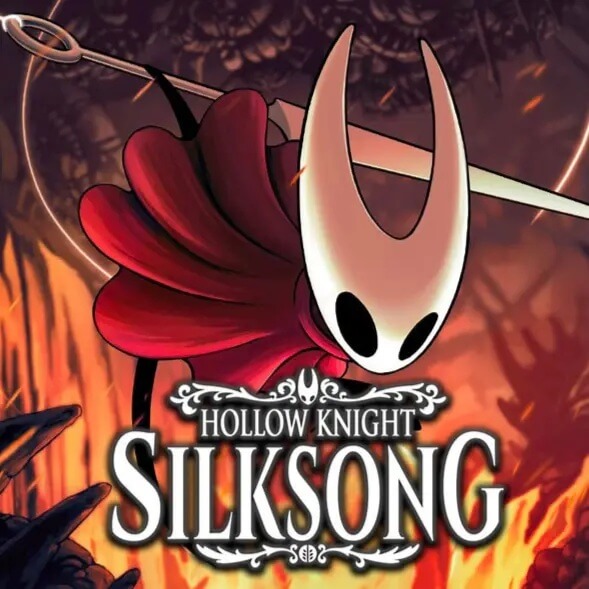
One of the most hotly anticipated games in recent years is Hollow Knight: Silksong. From indie Team Cherry in Adelaide of Australia, after many delays the studio made a surprise announcement it’d launch on 4th September 2025.
It’s certainly been well worth the wait as, for us, this is an instant classic and a Metroidvania masterpiece. It’s available on all consoles and PC right now and, by Jove, we recommend you give this SOB a whirl.
Silksong is Half Masterpiece, Half Tedious Annoyance
The first Hollow Knight (2017) is a great platformer, but one we weren’t totally enamoured with and considered it a 4/5 type deal.
We play a lot of Metroidvania and 2D platformers and we’ve been surprised Team Cherry’s game has more fandom than, for example, Moon Studio’s Ori and the Will of the Wisps (2020). For us, the pinnacle of Metroidvania.
Seven years in development, Silksong emerged out of the blue after those seven long years of hype. Make no mistake, the demand for this one was high. Even though we’re not quite sure why it was so hotly anticipated, the longer it was delayed the more fans became convinced it was going to be the best thing since cheese on toast.
But it’s now here and divisive.
Across the first 5 hours of what is a 70+ hour game we were convinced this was a masterpiece, 10/10, game of the year contender, and one of the best Metroidvania ever.
There’s a huge amount to marvel at in Silksong, not least with the staggering brilliance of its world layout/level design (Metroidvania play out across one giant, interconnected map). Team Cherry’s work is up there with the very best games developers and it’s a relentless marvel.
Just look at this thing in action and the glorious flow of it all (courtesy of IGN).
We began playing in early November, two months after its launch, already aware the game’s high default difficulty was a contentious talking point. But those first 5 hours were gaming bliss and we could handle it all, even if it could be frustrating.
Add into that the game’s wondrous controls, atmosphere, amazing graphics, and composer Christopher Larkin’s mesmerising Silksong soundtrack.
We found it breathtaking and couldn’t wait to knuckle down and explore the rest of this sprawling adventure.
Then we reached Greymoor. At that point, an already difficult game steps things up a notch, purely through Team Cherry’s game design decisions. This includes normal enemies with sporadic attack patterns that seem ripped from the notorious NES romp Ghosts ‘n Goblins (1985), whose attacks are enough to drain your energy bar in a few hits.
And there are many of them. And they’re all over the place. And if you die you have to backtrack large distances, having lost all your money, and which is essential to make progress in the game (but you always keep losing it).
The difficulty issue continues ramping up from there, concluding with the already notorious Last Judge at the end of Act 1 who is a goddamn nightmare of frustrations. The relentlessness of all this has affected the way the game has been received and, yes, we have to dedicate an entire section to it below.
Damn and Blast! Addressing the Difficulty Debate of Silksong
Silksong has created a big fuss in the gaming community due to its difficulty. On one side, you’ve got people frustrated by how ridiculous it can be, whilst others (generally the True Gamer brigade) think it’s how games should be.
The game is punishingly hard. The first Hollow Knight was difficult, too, but the sequel steps things up a gear and it can be stunningly irritating. As there are so many boss battles, which require millimetric precision and if you die you often have to travel large distances to get back there, it’s far more frustrating than enjoyable.
Defeating yet another boss after the 25th attempt doesn’t resonate with us. It’s a relief another chore is over rather than a sense of accomplishment. But it’s not just the bosses, you can get caught out suddenly by random enemies (some of them very frustrating to kill), or make a tiny error, and you’ll die and have to traverse half a map to recontinue where you left off.
Team Cherry’s focus on exploration and critical thinking around the difficulty is commendable, as if you get stuck you can go off exploring to discover new items. The problem here is many of the items you discover don’t help your wider progress.
Last night (8th November) we found a new item, for example, for a different style of fighting. It doesn’t help in any way for the rest of the game and is utterly useless. Why did we bother?
It’s also barely worthwhile putting in the time to get items that increase your health bar, as enemy hits drain it so rapidly.
You get a default feature to regenerate your health, and a powerup that allows you to prevent that being stopped if you get hit by an enemy. However, if you’re regenerating and get hit… it just means you don’t die, but the actual regeneration of your health is stopped and you’ll just die soon after as you’ve got one bar of health left.
Things like that are just baffling. Why is that in the game? What’s the point of developing a feature like that when it’s fundamentally redundant?
This relentless loop of death, traversing back to recover your corpse and loot, death, repeat, another boss battle, dead-end blocks, annoying enemies, and unfair gameplay developments is tedious beyond belief.
Some professional games journalists have actively marked the game down due to it being deliberately frustrating. Video Games Chronicle gave Silksong 3/5 and stated:
“A game that intends to make you suffer, even to its own detriment. Team Cherry’s sequel has a clear mission statement, but doesn’t seem to consider the consequences …
[It’s] caught in a web of trying to bind two conflicting genres together, with the expectations and norms of each half damaging the other. The beauty of its art design and precise, joyful feel of its movement are inarguable wonders, but the tiring and demotivating nature of its sadistic approach to challenge ripples throughout the entire experience of exploration and combat.”
We can only agree with that, unfortunately, as it’s frustrating the developers cut off the game’s accessibility.
As another annoyance with this is how these games trigger off the elitist True Gamer bros. The ones who roll out “people are just upset because other games handhold them and lol they can’t deal with it” every time there’s a very difficult game. The people who use playing a game on a high difficulty setting as a sign of status and superiority (ridiculously entitled and immature as it is).
Team Cherry has played into their hands and allowed them to get on their high horse about it all again. When there was a simple way around this for the devs. And that was to accommodate for all types of players to enjoy their game in the way they want, using the famous modes:
- Easy
- Normal
- Hard
We refer back to 2021 when we reviewed the excellent FPS DUSK. Created by solo indie dev David Szymanski, he included all three of those modes, which resulted in a True Gamer Bro having a meltdown on Twitter about it. This is how the exchange went.
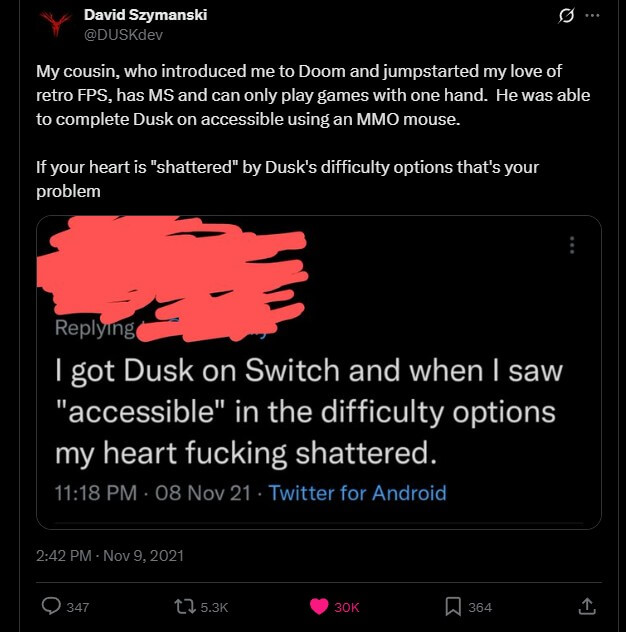
That’s the sort of attitude the True Gamer bros have, they treat Easy mode like it’s some horrendous tragedy for game and insult to the artform/purity of picking up a controller (i.e. they’re being ridiculous).
As for the devs, it’s like Team Cherry got stuck in an obsessive, insular world where their brilliance wowed them into obliviousness. As if they forgot to make the game fun. As unfortunately, it so often isn’t.
This isn’t a niche title such as Getting Over It with Ben Foddy (2018), where there’s an existential Camus type philosophical conundrum to overcome. A game designed to be absurdly difficult and ridiculous, almost impossible, to attract a specific type of person.
Team Cherry has already rolled out four patches to fix some elements of the difficulty (but the patches were mainly about fixing bug issues). But the game would benefit enormously from at least a Normal mode. Until then, huge proportions of the game are tedious and obnoxious to labour through.
CONCLUSION! The Frustration of Hollow Knight: Silksong
This game is so astonishingly good in many respects. Incredible with its level design, imagination, sweep, atmospherics, and once again proving 2D platformers offer some of the best moments in modern gaming.
It also looks wonderful, draws you into its world at every second, and Christopher Larkin’s soundtrack is a wonder.
But then there’s the difficulty. For us, this removed a lot of the enjoyment and left the game as frequently tedious. We’ve had a good research around online and many gamers are saying the same thing.
Some of the game design choices are obnoxious. We hate having to put it like that, but the devs have designed Silksong to make players suffer. The plot of the game is about suffering, to guide the main character through a fallen kingdom, but the themes are the same as Ori and the Will of the Wisps. And Moon Studios designed that game with three difficulty settings.
The result was we gave up on this one at the end of Act 1.
We have lives to lead. We’re in full time work, there are other hobbies we want to indulge in, and fun video games we want to play. We’re not “gitting gud” by spending 100 hours endlessly dying and repeating the never-ending bosses and in-game enemies as Team Cherry don’t want to add more accessible gameplay modes.
The developer has addressed minor issues with the difficulty in four patches, otherwise it’s showing no interest in offering even a Normal mode to balance out the experience. It’s a real shame, as without that baffling and obstinate stance Hollow Knight: Silksong would be in our top five best modern 2D platformers.
As it is, we can only suggest (unless you want to punish yourself for whatever reason) to skip this one and get yourself Ori and the Blind Forest and Ori and the Will of the Wisps.
Very similar to Silksong but better games, plus they have difficulty modes to choose from and are, as a result, fun to play.
