
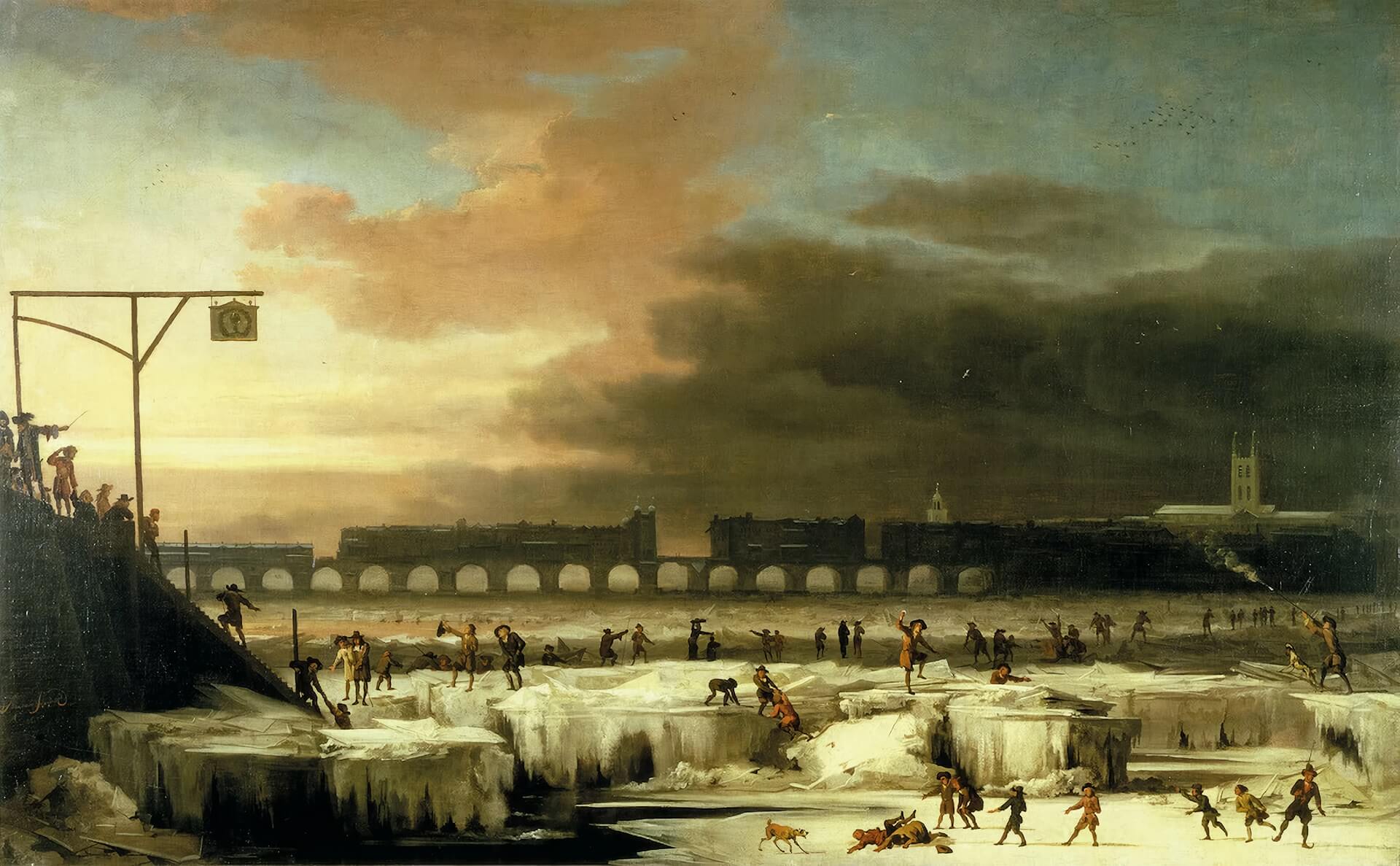
Old London Bridge was a glorious ode to organised chaos. It stood from 1209 to 1831 covering the span of the River Thames between the City of London and Southwark.
This features explores the various paintings that showcased its weird design, a ramshackle batch of houses piled along the stretch of the thing. It was a bustling market area and just looking at paintings you can imagine how cramped it all was. Thus, let’s dive on in and see why this thing ever existed.
The Disorganised Chaos of Old London Bridge
London Bridge is falling down,
Falling down, falling down,
London Bridge is falling down,
My fair lady.
There’s the nursery rhyme you’ll no doubt know. The earliest record of the rhyme it dates to the 17th century, but it may have existed since the Late Middle Ages. The violence suggested in the lyrics may nod to a Viking invasion back in 1014, as the bridge had been in place as a Roman structure until the end of the Roman rule in 5th century Britain.
At some point it was rebuilt, destroyed in the 1066 Norman Conquest, then rebuilt again by King William I (William the Conqueror). The bridge’s destructive history continued on from there. Like this:
- Repaired/updated (the records are unclear) by King William II
- Destroyed by a fire in 1136
- Rebuilt by King Stephen of Blois (amusingly, referred to historically as just… Stephen)
- King Henry II created a monastic guild (Brethren of the Bridge) to put in place a fully timber London Bridge
- King Henry II eventually recommissioned the bridge be upgraded to stone (he also requested a chapel be placed in its centre, a memorial to his friend Thomas Becket, the Archbishop of Canterbury, who’d been murdered)
Construction began in 1176 and dragged on at great expense through until 1209. 33 bloody years!
And King Henry II died in 1189, so King John appointed a French monk called Isembert, also apparently a bridge building master, to take over the project in 1202 and get the job done. This he did. Bravo.
A Precarious Life on the Old London Bridge
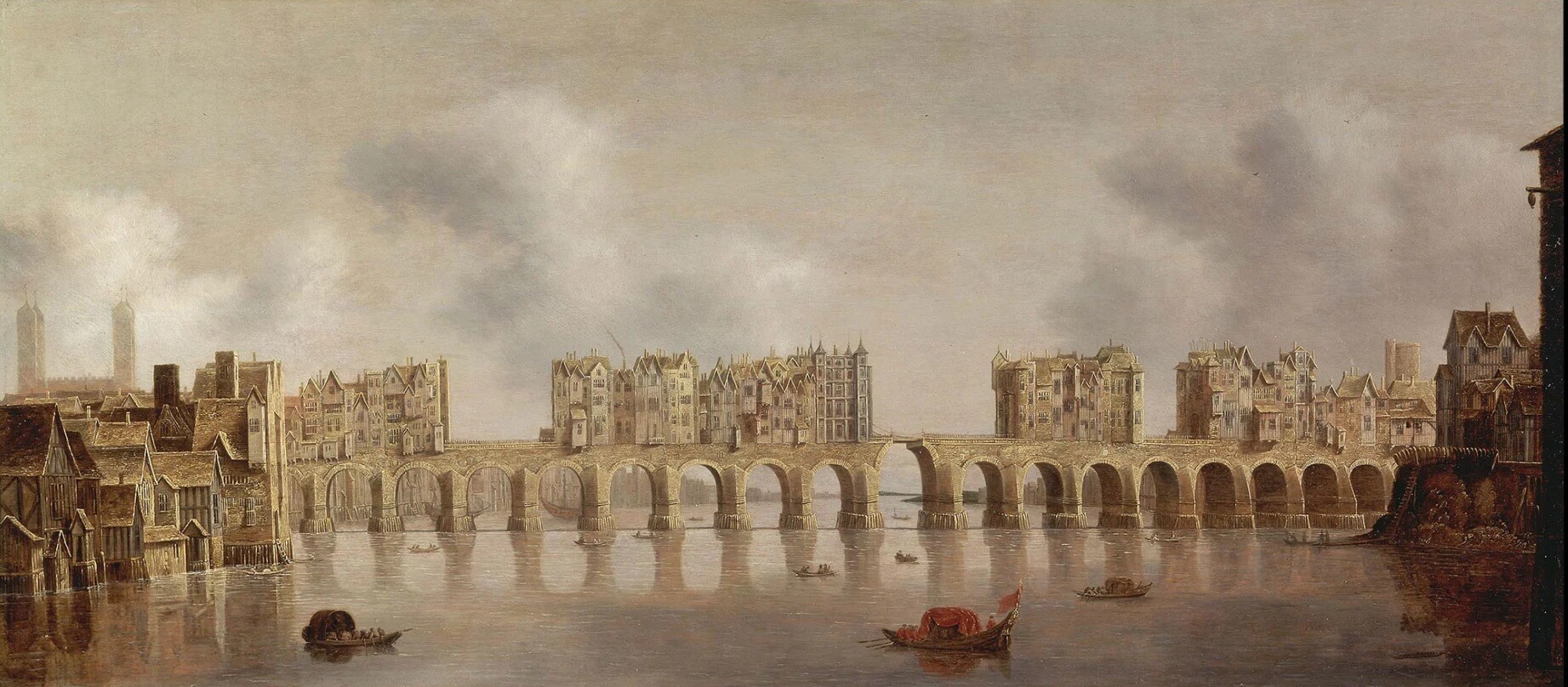
The eccentric use of houses was there from the off. During the 14th century the total buildings reached its peak at 140. They were added as a way to pay for the maintenance of the construction, with the inclusion of rents and tolls for those running a business there or passing across the bridge.
It looks akin to Howls Moving Castle (2004) in the Studio Ghibli film. Houses stacked precariously atop each other, some jutting out over the Thames, and all seemingly created with no sense of order.
There’s an incredible English Heritage feature on Old London Bridge that goes into more detail on London’s weirdest structural effort. It notes on the structure:
“This incarnation of London Bridge was slightly downstream from its wooden predecessors and from the site of the bridge which today bears the name. It survived in that position for more than 600 years.
The longest inhabited bridge in Europe, its roadway was lined from the outset with shops and houses. It served as the gateway to the city and was a place of religious pilgrimage and royal pageantry.”
For visitors to the city, it was pretty captivating. Dutch Golden Age painter Claude de Jongh (1605-1663) was clearly fascinated by them. He travelled to England on several occasions between 1625 and 1650 and painted the piece at the top of this section, plus the below image.
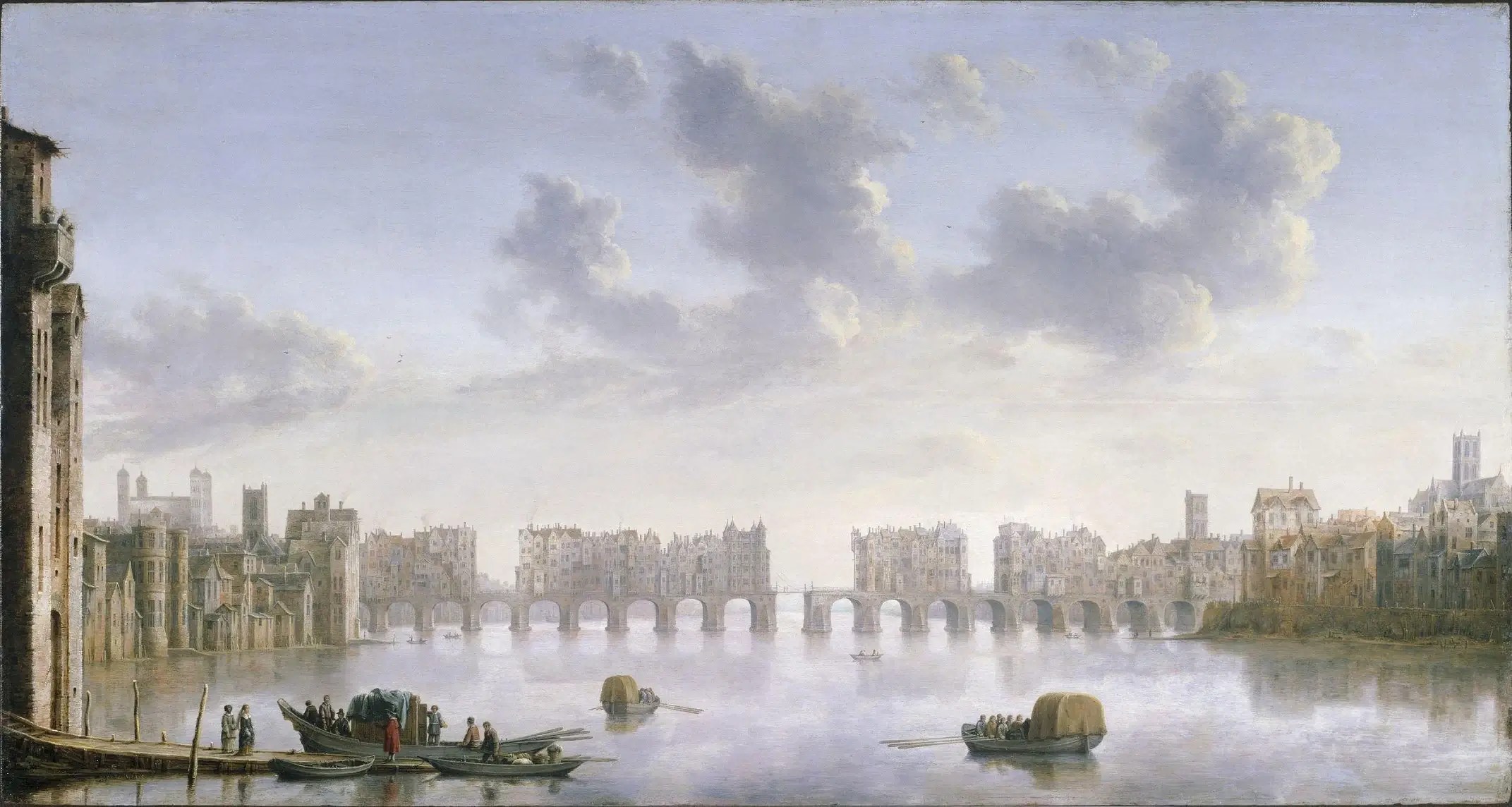
The bridge was rooted there, overseeing many generations, and many painters over the centuries captured cultural events. For those living on the thing, life would have been chaotic.
Boats on the water faced strong currents, so it would’ve been likely many crashed into each other (or the bridge). Then there’s the general fire hazard overload the buildings represented on the bridge.
Plus, within the confined, claustrophobic walls of the central street there were markets, shoppers, and horse and cart passing through. Going with that were regular reminders of the brutality of the times, the heads of traitors impaled on pikes on the stone gates at the front of the bridge.
In fact, a German tourist called Paul Hentzner (1558-1623), a lawyer and travel writer, noted this:
“On the south is a bridge of stone eight hundred feet in length, of wonderful work; it is supported upon twenty piers of square stone, sixty feet high and thirty broad, joined by arches of about twenty feet diameter. The whole is covered on each side with houses so disposed as to have the appearance of a continued street, not at all of a bridge. Upon this is built a tower, on whose top the heads of such as have been executed for high treason are placed on iron spikes: we counted above thirty.”
Apparently, heads were no longer impaled there after 1661. Not out of kindness! But to stick them on Temple Bar instead.
But when not busy getting mugged, or staring at severed skulls, you could go and use a public lavatory. There were two installed as multi-seat latrines.
Amusingly (ahem), in 1481 one of the latrines collapsed and plunged five men into the River Thames. In one of the most comically tragic events imaginable, they all drowned (unfortunately).
Despite all that sort of stuff, there were genuine moments of joy to be had at Old London Bridge.
A great example is depicted in Frost Fair on the Thames (circa 1685). The artist is unknown. The bridge’s structure altered waterflow sufficiently so the Thames would easily freeze over. When it did, locals would head out onto the ice and have a rave.
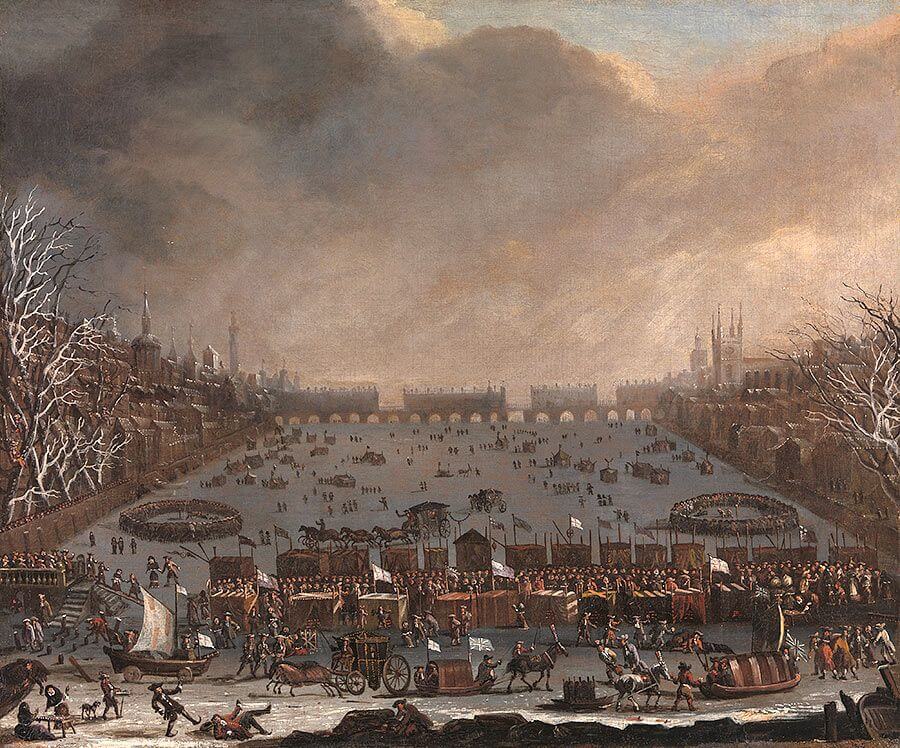
Curiously, the sky here with its masses of clouds suggests there’s either a mass of pollution or a huge fire. That’s fairly apt, as the bridge had a long and tumultuous history.
After its successful completion, the thing soon hit structural issues, with a major collapse in 1281. An organisation called Bridge House was created in 1282 to cover for that, with two bridge wardens appointed.
There was another structural issues in the 14th century, too, and across subsequent centuries there were various fires that destroyed large quadrants of the precariously perched buildings.
English painter Samuel Scott (1702-1772) painted one of the final few images of the houses. Below is from 1757, with the buildings removed for good inn 1761. By this point, the bridge was falling into disrepair and needed replacing.
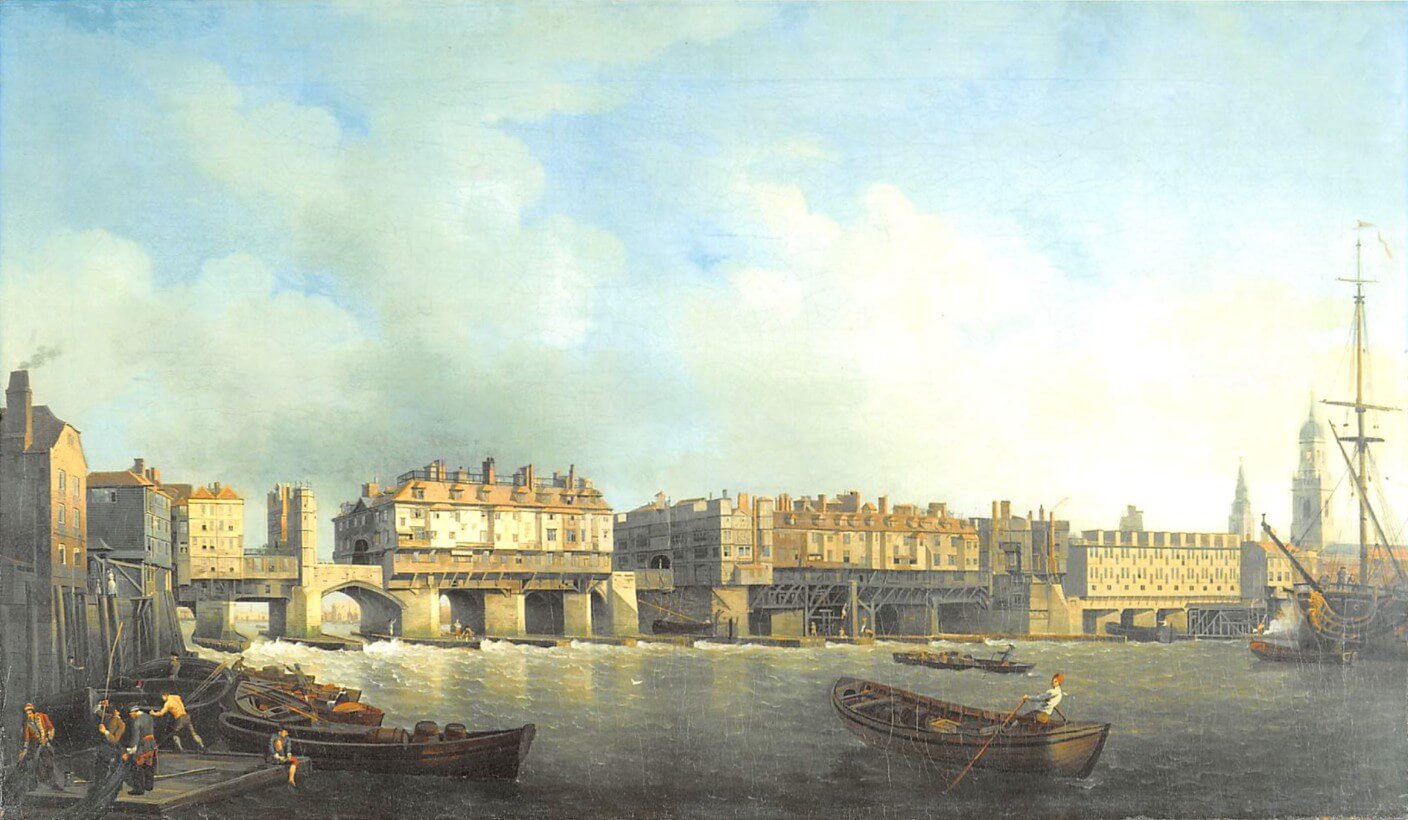
At that point, as depicted above, it’d been standing for almost 600 straight years. Sometimes it was near to collapse, it caught fire many times, but did manage to escape relatively unscathed from the Great Fire of London of 1666.
600 years! The home of a phenomenal amount of history; lives lived, pockets picked, arguments had, births, deaths, and British fisticuffs.
The whole thing was eventually replaced by New London Bridge in 1831, which remained in place up until 1967. After which, the rather underwhelming concrete slab that is the Modern London Bridge was introduced in March 1973.
And it is underwhelming. It’s boring and for those citizens and tourists crossing it everyday, there’s no hint at all of the mayhem that took place over its arches for hundreds of years.
AI Brings Old London Bridge Back to Life
Those old paintings don’t really do the strangeness of the construction justice. Thanks to the MIRACLE of AI (ahem), we can get a reasonable understanding of what the place was like.
We can only imagine living in such confined quarters was chaotic, but good enough fun. Given how frequently boring life must have been back before Netflix, living on Old London Bridge would have at least provided some ongoing intrigue.
But there we go, watch that video, bask in the vibes, and mourn the loss of London’s weirdest ever structure across the Thames.
