
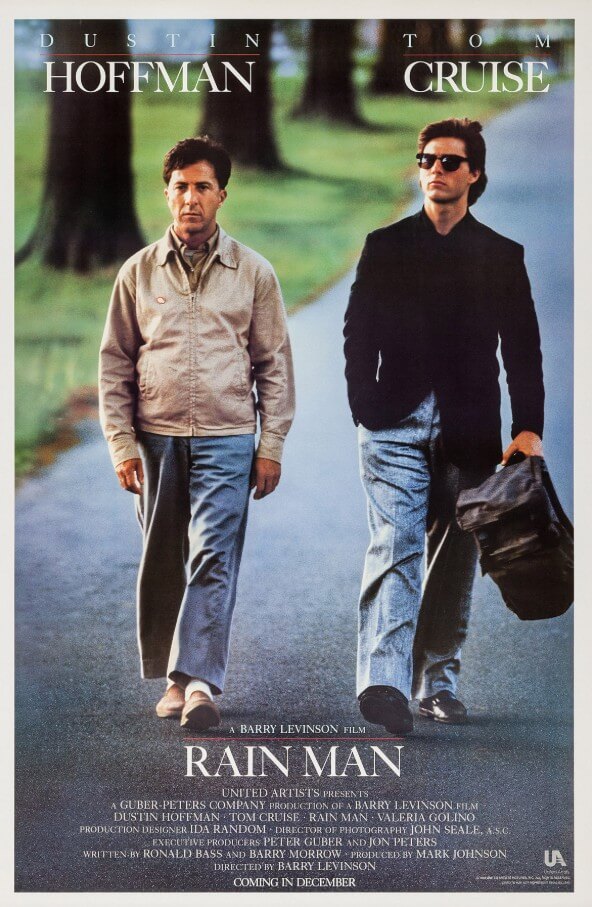
Yesterday, we watched Rain Man properly for the first time. We remember watching it around 1999 when it was on TV, tuning in when about 30 minutes had already gone. We watched the rest of the film, remember thinking “Huh so that’s what autism is“, and moving on with our teenage lives.
For 1988, when the film launched, Rain Man is a good depiction of an autistic savant and brought greater public understanding towards autism.
Much less was known about the condition at the time, so it was intriguing watching the film, its clunky ’80s technology, bad hair, and in amongst it Dustin Huffamn’s really quite impressive performance. LET US DISCUSS!
Everyone’s Autistic These Days in Rain Man’s Savant Landscape
Right, we got our ASD diagnosis almost four years back now. To get a better understanding of things, we read books on the topic, watched documentaries, and took in a bunch of films.
Rain Man is a well observed take on savant autism (a very rare form of the condition).
More recent films have handled the autistic savant topic, such as with Claire Danes in 2010’s Temple Grandin movie (a very fine and uplifting in its own right). That’s based on Grandin’s real life and the production was overseen by Grandin.
Rain Man’s screenplay was written by Barrow Morrow and Ronald Bass, with Morrow basing the story on Kim Peek (1951-2009). It’s now contested he actually had FG syndrome (everyone has FG syndrome these days…), which was only first observed in 1974. Symptoms include intellectual disability, hyperactivity, macrocephaly (abnormal head size), and savant skills.
Peek had an exceptional memory and was remarkably smart, but also had developmental disabilities. Despite this showcase of genius, he got a low average IQ score of 87. Even though he could easily recount the contents of over 10,000 books page by page.
Rain Man was the highest grossing film of 1988 ($429 million off a $25 million budget), won four Oscars (including Best Picture), and brought much wider public attention to autism.
After the film’s success, Peek toured around the US to demonstrate his uncanny abilities to an eager public. Ever since, Rain Man has kind of become “the autism film”. Thus, let’s explore a couple of its scenes and what it got right (and wrong).
Raymond’s Mania for Routine in Rain Man
The plot follows the fictional characters of Charlie Babbitt (Tom Cruise) and Raymond Babbitt (Dustin Hoffman). Their father dies and Charlie essentially goes on a personal journey of discovery, discovering he has a brother, and learning to care more from family rather than money.
Two scenes really stood out for us. At the start of the film, Tom Cruise’s character Charles is insufferable in his arrogance and ’80s era capitalistic egomania. When he discovers he has a brother, who has inherited the family estate fortune (but he doesn’t understand the concept of money), Charles intends to manipulate the funds out of him.
He’s also left baffled, frustrated, and eventually exasperated by Raymond’s insistence on extreme routine.
This includes having an autistic meltdown if his routine is clearly falling apart (a very accurate depiction for certain autistic people). For neurotypical people, this will come across as bizarre and often infuriating. This is played for absurdist comedic effect in Rain Man, when Charlie finally snaps due to Raymond’s never-ending list of hyper-specific needs.
As Mr. Charlie Babbitt rants in amusing fashion.
“What difference does it make, what difference does it make where you buy underwear!? What difference does it make? Underwear is underwear! It is underwear wherever you buy it, in Cincinnati or wherever!”
This scene captures very well the sense of exasperation many families will have with autistic family members. And Charlie, new to this sort of thing, can’t comprehend why everything has to be so specific.
What Rain Man also does very well is Charlie’s eventual understanding of the condition.
The more time he spends with his brother, the more he comes to realise his needs. Raymond is disabled, but still a human being with his own life to lead. Charlie comes to appreciate that quite quickly, although in hamfisted fashion at times. Such as his odd way of trying to ensure Raymond gets to watch the TV show he wants to watch (otherwise he’ll have a meltdown).
As the film progresses, Charlie improves his approach at handling these situations. He grows as a person in that process, dropping his arrogance and desire for wealth. He makes a legal attempt to take sole care of his brother, which is ultimately denied by a court-appointed psychiatrist through a conservatorship (in US law, this means someone who can’t make a decision for themself).
But Rain Man ends on a positive note, with Charlie pledging to visit Raymond regularly.
A big part of Rain Man is Charlie putting aside his self-obsession and realising there are other people in the world to care for. This self-growth helps him reunite with his girlfriend Susanna (Valeria Golino), who had been on the verge of leaving him. That side of Rain Man is terrific.
On the other, the main issue is the film is presented as “this is what autism is”, which was down to lack of medical understanding at the time. Since 1988, we’ve come to realise autism is a huge spectrum.
We did some research around online and found generally positive feedback on tis 1988 depiction. But that Raymond Babbitt as an autism depiction doesn’t remotely cover the full range of this complex, vast spectrum.
A notable consideration on that being a Pioneer of Autistic Representation in Film:
“These days, Rain Man is remembered as a stereotypical, misconceived portrayal of an autistic adult. However, at the time, autism in film was incredibly rare, and Raymond Babbitt could have been a way worse character. Raymond is an individual with unique sensory experiences, routines and rituals, and ways of communicating. He is a savant, but that is because he was modeled after a real life savant, rather than because autistic equals savant in people’s heads. Unfortunately, the general public conflated Raymond Babbitt the autistic character with the idea of autism as a whole. In other words, everyone who saw Rain Man thought that every autistic person rocked, hit themselves, counted toothpicks, and spoke the exact same way as Raymond. Raymond Babbitt is a stereotype originator.”
In The Art of Autism, there’s a piece from June 2021 called A Look Back at the Movie Rain Man by Nils Skudra:
“Through its depiction of an autistic main character whose severe symptoms require specialized institutional care, Rain Man fails to provide a more multifaceted representation of how different individuals on the spectrum can succeed independently in the outside world. When watching this film, it would do well for contemporary viewers to keep in mind the significant strides that have been made in professional and popular understanding of autism in the subsequent three decades, which they can thus appreciate in comparing present-day knowledge of autism’s diverse nature with the perceptions featured in Rain Man.”
We agree with that, but at the same time we can’t fault the film too much. It’s a 1988 production, which at least brought attention to the condition and put it on the public conscience.
The joy of modern films is to ensure a narrow image of ASD is dispelled. There are plenty of them around doing just that, the downside being we’re unlikely to see a Rain Man type blockbuster sensation again to sway public opinion.
Instead, the focus has turned to one of the (few, frankly) benefits of social media. Where people can share their experiences, or write books, or do podcasts, across modern technology to get the point across.
Like we are here on this blogging platform of WordPress. It kind of means autistic people now have a greater voice, which is only ever a good thing. Underpants.
