
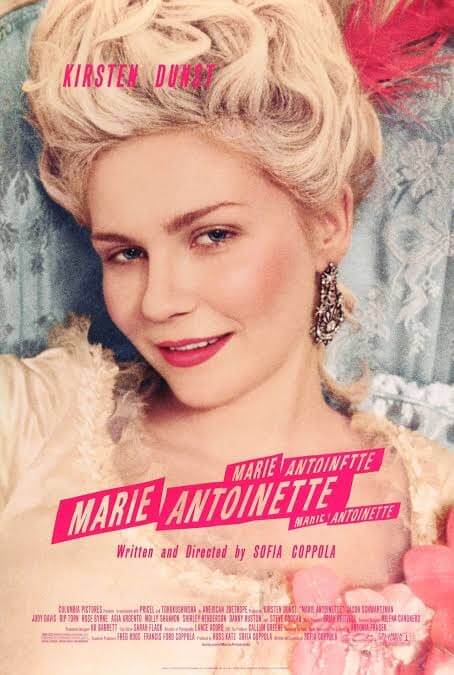
Written and directed by Sofia Coppola, this was her first film after the surprise smash hit Lost In Translation (2003). Marie Antoinette launched in May 2006 and is an unconventional historical drama.
Coppola intentionally didn’t focus too heavily on historical accuracy, instead creating an insular world for the notorious Antoinette to go romping around in. The result is an underrated, vibrant, and sharp film that 20 years later has had a re-evaluation.
There’s a Lot of Luxurious Living in Marie Antoinette
Set in 1770, 14 year old Archduchess Marie Antoinette (Kirsten Dunst) is the youngest daughter to the Holy Roman Empress Maria Theresa of Austria. She’s shipped over to France to marry Louis-Auguste the Dauphin of France (Jason Schwartzman), himself only 15 years old.
The goal of that is seal a beautiful alliance between France and Austria.
When in France, it isn’t long before Antoinette finds she’s going to be frogmarched around a lot and doesn’t have much say in the pomp and ceremony of French monarchy life. The staggering lunacy of the routine, and the total lack of any privacy, soon become readily apparent.
Louis-Auguste and his wife are supposed to gift kids to the nation. However, he’s an unusual person with a passion for locksmithing and, although he gets on well with his wife, he appears shy and has a low sex drive.
This heavily delays the arrival of royal children, creating political tensions.
To deal with pressure, Marie Antoinette keeps herself busy by living the most lavish existence humanly possible. She splashes out on fancy dresses, remarkable cakes, fine wines, dances, events, and all sorts of other stuff. The spending soon becomes extreme.
And this is what we liked about the film and Sofia Coppola’s direction.
It shows a bunch of rich people living life famously and you’re there with them, cut off from the rest of France, with zero concept that perhaps not everyone else is having such a grand time of it.
Coppola also sprinkles an unusual soundtrack across the film, largely featuring new wave and post-punk bands. There are also more familiar classical flourishes.
Sometimes the use of bands backfires as some of the songs included we couldn’t stand. Other times, it’s goddamn inspired. Such as the Masquerade Ball scene with all that 18th century pomp and ceremony set to Siouxsie and the Banshees’ Hong Kong Garden (1978).
One of the things we did notice here is a few young pre-fame actors. Tom Hardy makes an appearance later on as some random nobility called Raumont. Plus, there’s Rose Byrne as the extravagant Yolande de Polastron, Duchess of Polignac (Byrne is excellent in 2025’s If I Had Legs I’d Kick You).
Steve Coogan has a role, too, as Antoinette’s advisor Florimond Claude, Count of Mercy-Argenteau. Marianne Faithfull also turns up in a small role as Empress Maria Theresa.
As for the handling of this famous story, as the narrative progresses it becomes clear there’s civil unrest in France.
The French Revolution began with the Storming of the Bastille on 17th July 1789. The angry mob then stormed its way over to the royal palace, with the King and Queen refusing to flee prior to the mob’s arrival. The film concludes as they’re forced to relocate to the Tuileries Palace in Paris.
For the record, Antoinette was later executed on 16th October 1793.
From the records we looked up on her personality, she wasn’t some horrible toff who sneered down on all around her. According to historical records, she was affable and charming, but also extravagant (of course) and frivolous. She never did say “let them eat cake” (that was political propaganda) and showed some concern about the nation’s poor. She offered personal charity through financial donations during food shortages. She even redirected hundreds of thousands of francs from her budget to help needy parishes.
However, she also showed a great deal of systemic indifference through her wildly excessive spending. She got the nickname Madame Deficit due to her desire for constant luxury.
During her 15 years in the French court, she spent between 8-10 million livres (around $20,000 a day) and ordered 300 new custom gowns annually. But that amounted to only 0.02% of the country’s national debt.
And that’s what Coppola captures. The giddy, wild excess and all of that leading to a revolution finally catching up to their ignorance. We don’t see the brutality that follows, more the self-absorbed antics of the elite. As if there could never be consequences for their actions.
Gosh… it’s almost like there’s a lesson in there for the staggering wealth inequality we see in modern times. 🎂
The Production of Marie Antoinette
To mark the film’s 20th anniversary, the documentary the Making of Marie Antoinette launched in late October 2026. It was directed by Eleanor Coppola (1936-2024) and the personal records she kept during the 2005 film shoot.
Sofia Coppola served as producer of the documentary to oversee its conclusion.
As for the original film, it was a modest commercial success. Off its $40 million budget it made $60.9 million back. We can’t recall hearing about it in the slightest, to be honest, as keen film buffs back then. We’d just started university in London when it launched, but have no memory of it being advertised.
Coppola adapted the film’s script from Antonia Fraser’s biography Marie Antoinette: The Journey and the production crew had unique levels of access to the Palace of Versailles. The film was shot in France, with Milena Canonero and six assistant designers working on the lavish costumes.
That was so extensive it required seven transport drivers to ship all the costumes everywhere. Plus, the enormous amount of fancy cakes seen in the film were provided by French brand Ladurée.
Now, we enjoyed the film a lot, but contemporary reviews were mixed.
Coppola publicly admitted the film takes a lot of artistic liberties over historical accuracy, with many critics criticising the film’s focus on style over substance (some describing it like a pop music video). If you’re expecting a serious drama about this story, then it’s definitely not for you. It hurls itself on a sympathetic front into Antoinette’s bombastic lifestyle, unapologetically, and if that’s what you want to see then here it is.
Just be aware of what really happened to the doomed Queen. Later charged with depletion of the national treasury, conspiracy against the internal and external security of the state, and high treason.
The journey from her prison cell to the guillotine at Place de la Révolution took one hour. According to records, the crowd jeered at her the entire way, but she maintained her composure throughout.
