
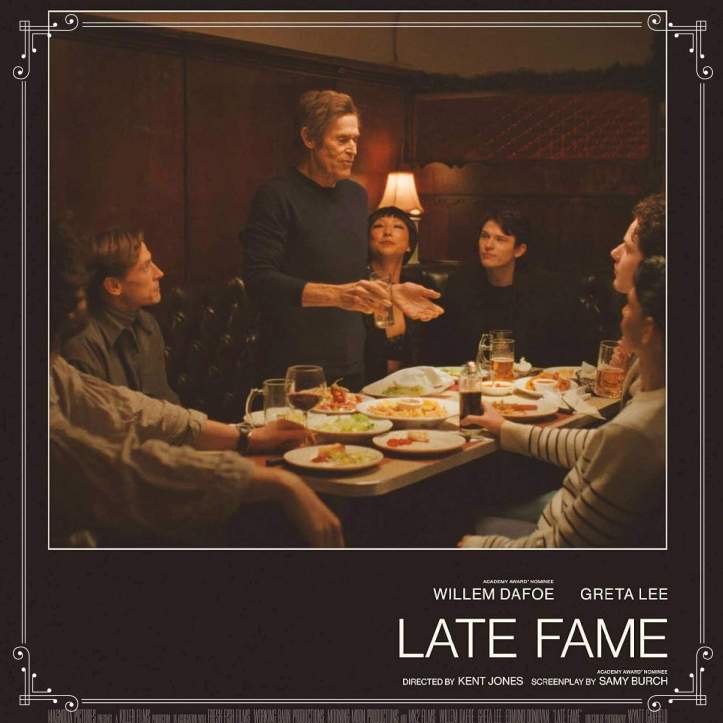
Directed by Kent Jones, this very enjoyable 2025 drama film stars Willem Dafoe and Greta Lee. With a strong script by Samy Burch, the story follows working-class mail clerk Ed Saxberger. Late in life, he’s suddenly hailed as a creative genius when some young bohemians rediscover his 1970s poetry.
Late Fame goes on to explore themes of generational divide, nostalgia, and authenticity vs. performative egomania. Dafoe and Lee are on great form, offering a bittersweet account of a man rediscovering his youth.
Everything as a Performance in Late Fame
Set in modern day Manhattan of New York, we’re introduced to Ed Saxberger (Dafoe) who lives a low-key life working at the post office, then playing pool with his mates after.
He’s long since moved on in life, but in the late 1970s he was part of the bohemian art scene where he released a poetry book called Way Past Go. After publication, it fell into obscurity and eventually drifted away from the art scene.
One day, out of the blue, a pretentious rich kid studying at NYU (New York University) turns up hailing Saxberger as an undiscovered hero of modern prose. This is Meyers (Edmund Donovan), who persists with his efforts and gets Saxberger to meet his peers at the bohemian creative group called The Enthusiasm Society (WARNING, also, some minor SPOILERS are further below in this review).
Although a group of pretentious rich kids, Saxberger is nevertheless flattered by the unexpected attention, enjoys hanging out with the enthusiastic young people, and starts to reconnect with his life from 50 years ago. This brings him to reminisce, digging out his old photographs from the ’70s and remembering who he used to be.
Saxberger is then particularly affected by spending time with the charming, flamboyant, and beautiful Gloria (Greta Lee, who was so fantastic in Past Lives).
Headed by Meyers, The Enthusiasm Society pushes to do a live reading night and have Saxberger read a new poem as the highlight. He’s initially enthusiastic and is also pleased by the affections of Gloria, who is always flamboyant and flirtatious.
The purpose of Late Fame is to highlight not all is at it ever seems.
Meyers, for example, is hugely performative. He’s using Saxberger to try and add some worth to his prestige and career prospects, to be the guy who rediscovered a genius. The others in his group are also only there for ego purposes, not really for the love of their craft.
Meanwhile, Gloria’s behaviour proves problematic as she’s incapable of switching off from her theatrical persona. The one occasion we see her being herself, she’s minus her makeup and it all comes out. She’s tense, tired, and distant. The next time we see her, she’s too drunk to perform various poetry readings (although the inebriation appears to be part of her act, making her personality a difficult haze).
Through it all Saxberger has a reality check, rejects the validation seeking that had briefly reared itself back into his life, and returns to where he has long found routine and comfort.
All of which makes for an effective contemplation on ageing, former ideals, and the nature of recognition. Very important in this era of instant gratification through social media. What even is fame anymore and why would you want it? We think that’s what Ed Saxberger realises. This isn’t what it seems to be and he has, in fact, lived just a grand life minus all the external focussing of mighty intellectuals (or otherwise).
Very good stuff, then, and at 97 minutes it delivers its concepts in pitch-perfect fashion, led by two brilliant lead actors at the top of their game.
The Production of Late Fame
The film had a limited release at global cinemas and made $1 million. It’s now on streaming platforms ready to buy/rent and watch. It received critical acclaim but, this is an odd one. As it’s such a gentle, lowkey, contemplative film we doubt it’ll get much more attention going forward and be lost in the mass of other films constantly coming out.
A bit like what happened to the film’s protagonist, really, so we’re being the Meyers here and flagging the film up. Get it watched, you philistines!
But get this… our favourite Sandra Hüller was initially pencilled in for the role of Gloria. That was confirmed in May 2024, but she dropped out of the project as she’s got so many demands for her time right now. Which is a bummer, but her replacement is just as fantabulous in Greta Lee.
The script is adapted from Rhapsody: A Dream Novel by Arthur Schnitzler. It was adapted in 1999 as well in the form of Eyes Wide Shut, Stanley Kubrick’s final film before his early death. Late Fame takes quite a different adaptation to Kubrick’s work.
Everything was shot in New York and New Jersey at the end of January 2025 and into February.
