
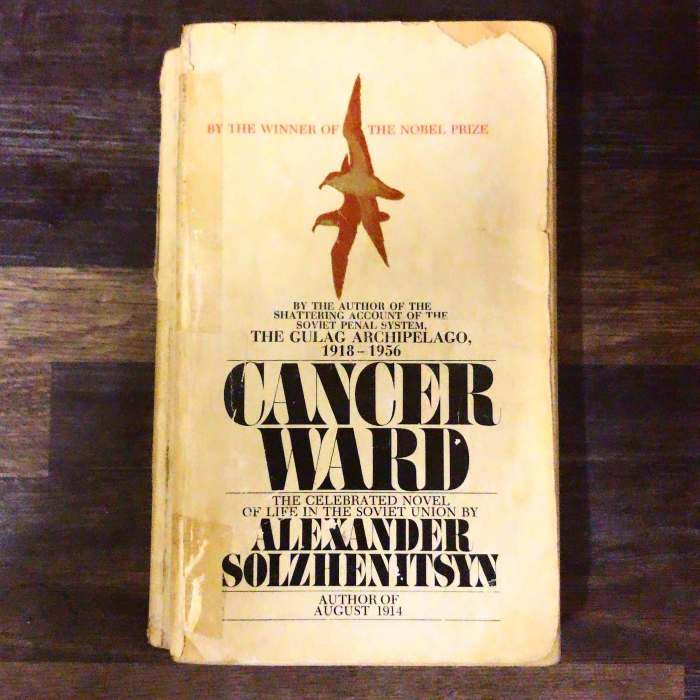
This semi-autobiographical work by master writer Alexandr Solzhenitsyn first launched in 1966. Cancer Ward (Раковый корпус—Rakovy korpus) was distributed in in samizdat, a form of dissident self-publishing, but was banned by the state in 1967.
The book’s complex history in Russia continued from there. We’ll cover that more at the bottom of this book review.
Focussing on the narrative, this is an outstanding work of fiction. Whilst it is about one patient’s battle with cancer, the book also explore the moral complexities of those living under Stalin’s Great Purge of 1936-1938.
Across over 440 pages, Solzhenitsyn’s searing prose makes this is a time classic and one essential for all avid readers to cover.
Encroaching Death and Cancer Ward’s Consideration on Stalin’s Great Purge
“Sometimes I feel quite distinctly that what is inside me is not all of me. There is something else, sublime, quite indestructible, some tiny fragment of the Universal spirit. Don’t you feel that?”
Alexandr Solzhenitsyn had a dramatic, often bleak life filled with battles and suffering. You can read this in his other works, such as One Day in the Life of Ivan Denisovich (1962).
A lot of his canon, although only covering a short period in the narrative, are vast works encompassing political strife, personal suffering, and the human condition.
Cancer Ward is set in 1955 (shortly after the death of Joseph Stalin, yet it’s also before Nikita Khrushchev’s verbal assault on Stalinism in February 1956 (On the Cult of Personality and Its Consequences, or the “secret speech”).
Solzhenitsyn developed undiagnosed cancer in the early 1950s. Due to the lack of diagnosis (largely as he was facing exile), he almost died. But he was eventually allowed to receive treatment in 1954.
As you can expect, these experiences fuelled much of this narrative. In a story that’s packed with aphorisms and affirmations on the spirit of being.
“As the two-thousand-year-old saying goes, you can have eyes and still not see. But a hard life improves vision.”
Cancer Ward is about a group of patients undergoing early forms of treatment in a dingy hospital. The treatment methods, by modern standards, are quite brutal and frightening.
Oleg Kostoglotov is the central character.
He’s spent time in a labour camp and was exiled to Asia under the notorious Article 58 (used by the state to prosecute counter-revolutionaries).
Kostoglotov comes to know the various patients on the ward and learns of their life stories, beliefs, backgrounds, and expectations. Some have accepted death. Others view their cancer as a minor inconvenience before they expect to return to normal life.
Despite the bleakness of their collective situation, there’s a lot of inspiring musing amongst Solzhenitsyn’s prose and his patients’ musings.
“It is not our level of prosperity that makes for happiness but the kinship of heart to heart and the way we look at the world. Both attitudes lie within our power, so that a man is happy so long as he chooses to be happy, and no one can stop him.”
And there are many wise contemplations on death.
“By dying young, a man stays young forever in people’s memory. If he burns brightly before he dies, his light shines for all time. In his musings during the past few weeks Vadim had discovered an important and at first glance paradoxical point: a man of talent can understand and accept death more easily than a man with none—yet the former has more to lose. A man of no talent craves long life, yet Epicurus had once observed that a fool, if offered eternity, would not know what to do with it.”
One of the main elements of Cancer Ward is that focus on the moral responsibilities involved in Stalin’s Great Purge. For example, there’s a patient who urged a man he knew into jail.
Now he’s paranoid the man will come after him for retribution.
But others on the ward feel guilty simply through their inaction. They stoically accepted Stalin’s rot and didn’t act, all in order to preserve themselves for an easier life. But all whilst their fellow citizens died.
Kostoglotov navigates his way through the foreboding of political upheavals ahead, all alongside the debilitating nature of his illness and its uncertainty.
He does survive the work and, after his release from hospital, he visits a zoo. There he wonders over the animals and how their freedom is forever lost, even if they were released.
As with Solzhenitsyn’s over major works, it’s quite the onslaught of gritty subject matter. One that epitomises a major political shift at the mid-point of the 20th century, which impacted across the world.
It’s an exceptional book.
Solzhenitsyn won the Nobel Prize in Literature (1970) and it’s works such as this that secured such legendary status. He overhauled the way writers approach Russian epics, modernising his narrative structures with a focus on ethics and sharp deliberations.
Even though this work is now over 60 years old, its writing feels entirely in the present. And that’s down to the power of the author’s phenomenal creative capacity.
Cancer Ward’s USSR Censorship Battles
As you can see from the picture at the top of this review, our copy of Cancer Ward is an early edition. It’s actually a 1972 US print that features, in its opening pages, considerable praise for Solzhenitsyn as a writer.
The New York Times and other critics hail him, in 1968 reviews, as a top-tier author on the global stage. But they regret how the USSR seems to resent this status.
At the front, and the back, of the edition there are featured various letters from Solzhenitsyn regarding his censorship battles. These are very detailed and highlight the frustration the author felt at dealing with these cultural blockades.
One letter is a May 16th, 1967, letter appealing for support against his oppression.
“Thus my work has finally been smothered, gagged, and slandered.
In view of such flagrant infringements of my copyright and ‘other’ rights, will the Fourth Congress defend me? Yes, or no? It seems to me that the choice is not without important for the literary future of several of the delegates.
I am of course confident that I will fulfil my duty as a writer under all circumstances—even more successfully and more unchallenged from the grave than in my lifetime. No one can bar the road to truth, and to advance its cause I am prepared to accept even my death.”
Despite the book’s ban in the USSR, and thanks to his efforts appealing to Europe and North America, Cancer Ward was published in English from 1968 onward.
Alexandr Solzhenitsyn’s Exile (and eventual) Return to Russia
Solzhenityn’s exile from Russia was ended in 1990. The Soviet Union collapsed on December 25th 1991 and the writer returned to Russia in 1994. His wife Natalie joined him.
However, their two sons remained in the US (although one later also returned).
Solzhenitsyn spent the rest of his life living in dacha in west Moscow. He died of a heart attack at the age of 89 in August 2008.
To our lingering regret, we hadn’t read his work by that point. Only in 2011 did we finally get round to reading Cancer Ward and immediately thought of it as a masterpiece.
Based on our research, his final work appears to have been Two Hundred Years Together (2003). This was a vast volume (in keeping with his focus on epics) of Russian-Jewish relations from 1772 to the present.
