
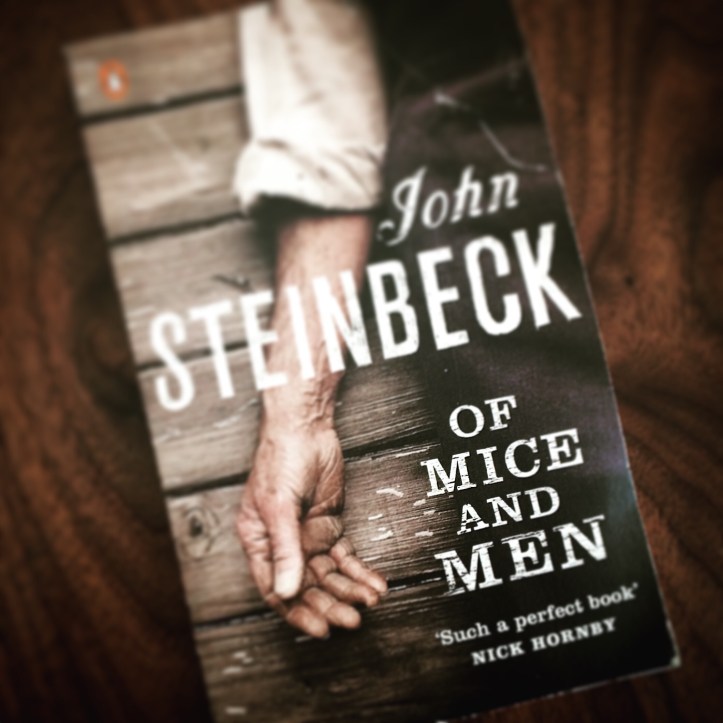
Of Mice and Men is John Steinbeck’s (1902-1968) classic novella is the legendary tale of George and Lennie as they tackle the American Dream and male friendship.
This is a brilliant work of fiction, at once crushing in its conclusion. But also somewhat uplifting in its depiction of male friendships. It’s a must to read and we’re here to explore its various themes.
The American Dream and Fate in Of Mice and Men
“As happens sometimes, a moment settled and hovered and remained for much more than a moment. And sound stopped and movement stopped for much, much more than a moment.”
Published in 1937, it concerns streetwise George Milton and his friend Lennie Small. It’s the Great Depression and they’re out looking for ranch work in California.
This element was adapted from Steinbeck’s experiences as a teenager in the 1910s, with the title taken from Scottish poet Robert Burns’ 1785 effort To a Mouse. A translation of one of its most famous lines:
“The best laid schemes of mice and men / Often go awry.”
In a slight 120 pages, Steinbeck sets out something of a classic American story in the grand tradition of the Jack London’s Call of the Wild.
That and Hemingway’s award-winning Old Man and the Sea (okay, so the latter was released after Of Mice and Man, but whatever). There’s the sense of economic strife and the hard working, down on their luck individuals battling across a giant country to scrape their way through life.
George Milton is trying to get work. He’s, essentially, responsible for looking after Lennie Small, who’s mentally disabled in an era where this would be viewed as a nuisance.
Lennie is tall and powerful, however, which makes him highly effective for working on ranches, but Milton has the tough job of convincing the top honchos at farms he’s fit to do the job.
They’re outsiders, really, but ones who do have a dream. They’re secretly working towards one day owning a farm, with the childlike Lennie quite infatuated with looking after the pet rabbits they intend to keep.
It’s not clear how long they’ve had this dream, but they keep relying on the positive emotions it creates to lift their spirits in difficult times.
They do land work in Salinas Valley, though, on a pretty farm that initially appears an excellent spot for them. However, the boss’ son, Curley, has a Napoleon complex a mile wide. Despite their fortunes seemingly being on the up, Lennie’s heavy-handed tendencies lead to a shocking tragedy, which builds to a gut punch of an emotional ending.
It’s an excellent novella. Themes of friendship abound, as well as loneliness and a voice for the dispossessed – these are themes many modern readers can identify with in a post-recession society.
It’s interesting to note, in the UK, George Orwell’s first book Down and Out in Paris and London recently received live readings in London in opposition to the homelessness crisis, austerity, and widespread poverty afflicting England (legacies of a Tory rule).
Of Mice and Men could easily bolster such a movement with its message. The compassionate Steinbeck, as with Orwell, clearly had an inner desire to get the voice of working masses across, which came out in later works such as the excellent A Russian Journal (reviewed next week).
However, stripping away any political messages, Of Mice and Men is simply a moving account of a tragic relationship in an era of economic turmoil – as a read, it’s highly recommended.
Of Mice and Men’s Film Adaptations
Of Mice and Men has been adapted twice to film, with Gary Sinise’s (arguably most famous for his role in Forrest Gump – Lieutenant Dan) 1992 effort remaining popular to this day.
It took part in Cannes in the same year and was nominated for the prestigious Palme d’Or – although it has a slightly awkward start, with Sinise directing it develops into an excellent film, with John Malkovich on particularly fine form as Lennie.
It was very much a passion project for Sinise, who’d read the novella in high school. Crediting it with introducing him to literature, after seeing the play as a student he’d found it overwhelmingly emotional. We think he captures that side of the story affectingly in the final stages of the film.
There was also an adaptation in 1939. This was taken from the play version, rather than the novella, and was directed by Lewis Milestone.
It was nominated for a batch of Oscars, too, but Gone With the Wind was released in the same year – as you can imagine, that one pretty much dominated the Academy awards. Frankly, my dear, I don’t give a damn. Steinbeck’s classic lives on regardless.

we thought we covered it ages ago – but then came a new Teacher lol 😂 with his great enthusiasm and explanation;) 🕺🕺🕺😂😉😉
LikeLiked by 1 person
Mercy buckets! Yeah, I was reading A Russian Journal the other week and suddenly realised I’ve not done Of Mice and Men! Shocked, I was! But I’ve made up for my error.
LikeLiked by 1 person
😂😂😂
LikeLike