
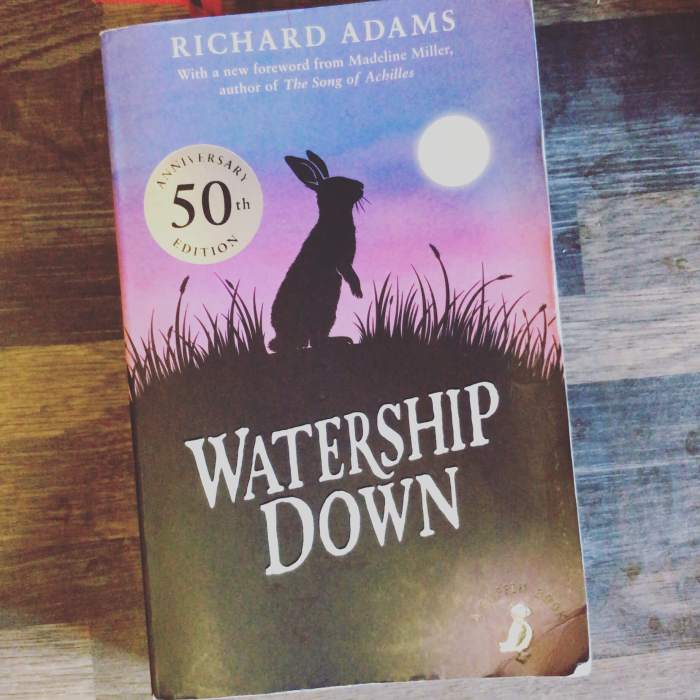
First published in 1972, Richard Adam’s legendary (and notorious) Watership Down remains a classic of fantasy fiction.
In the late 1960s, Adams (1920-2016) used to tell his daughters a story involving rabbits. That was to liven up their car trips. His kids loved it so much they convinced him to write a full book.
After 18 months of writing, and some 600+ pages later, he’d finished what we’d class as a masterpiece. One packed with pathos and crucial life lessons.
Watership Down: Authoritarianism, Belonging, Violence, and Bunny Rabbits
This story of adventure and totalitarian horror is set in Hampshire, England. It concerns the adventures of a small rabbit group. There are four parts:
- The Journey
- On Watership Down
- Efrafa
- Hazel-rah
If you were wondering, the book’s title is taken from the Ecchinswell, Sydmonton and Bishops Green hill in Hampshire. It boasts a 778ft summit above sea level and remains a popular spot for cyclists and walkers.
Adams used many other local locations to his home for the book.
Events start in Sandleford warren, where the young runt buck rabbit Fiver has an alarming premonition. He is a seer and foresees a terrible fate for the warren and its inhabitants.
In a daze, he convinces his brother Hazel to speak with the Threarah (Chief Rabbit) about evacuating the warren with immediate effect.
As you can imagine, that doesn’t go down too well.
Fiver is insistent and he convinces Hazel, with a batch of other rabbits, to flee the warren and pursue a new life. The pair are joined by the likes of the super smart Blackberry, wise Dandelion, and the brave but obstinate Bigwig.
Once free from the warren, the terrible dangers of the world encroach.
Under Hazel’s sensible leadership, they gradually overcome numerous challenges in the pursuit of their new home. They begin to work as a team to overcome obstacles, such as when they reach a river and Blackberry proposes a piece of wood guides them across.
“Hazel had no idea what [Blackberry] meant. Blackberry’s flood of apparent nonsense only seemed to draw tighter the mesh of danger and bewilderment. As though Bigwig’s angry impatience, Pipkin’s terror and the approaching dog were not enough to contend with, the cleverest rabbit among them had evidently gone out of his mind. He felt close to despair.”
Adams did a terrific job helping you worry about these characters, who you realise are under terrible threat at every single minute of their lives.
They face dogs, cars, farmers, deceitful fellow rabbits, and (later in the work) a complete megalomaniac in the form of General Woundwort.
Its epic themes are complemented by the effort Adams put into developing out this world. The rabbits are partially anthropomorphised, but not like The Wind in the Willows (1908)—more they just have some human characteristics.
For example, they have a complex culture with their own language, proverbs, poetry, and mythology. They also have advanced psychological states.
But they are presented as rabbits doing rabbit-based things.
Chapter 6 introduces this lore. The Story of the Blessing of El-Ahrairah is told by Dandelion (a character loosely based on Adam’s personality).
This is a Book of Genesis style Garden of Eden parable about how rabbits came to be such hunted prey. Adams used Frith as “god” amongst the work’s culture and mythology.
“Frith called after him, ‘El-ahrairah, your people cannot rule the world, for I will not have it so. All the world will be your enemy, Prince with a Thousand Enemies, and whenever they catch you, they will kill you. But first they must catch you, digger, listener, runner, prince with the swift warning. Be cunning and full of tricks and your people shall never be destroyed.”
In the 1978 film adaptation (more on that further below… yikes!), this section was animated beautifully.
The work has a methodical pace. The narrative takes its time to gradually develop its settings and themes, which some modern readers may find slow going.
However, this leads to some incredible plot developments.
Not least when the rabbits finally discover Watership Down and make their home there.
Soon after, they discover the magnificent black-headed seagull Kehaar. He’s injured and the rabbits help to get his wing back in working order, Hazel realising the bird will be a useful ally.
“‘You hurt? You no fly?’
The answer was a harsh gabbling which they all felt immediately to be exotic. Wherever the bird came from, it was somewhere far away. The accent was strange and guttural, the speech distorted. They could catch only a word here and there.
‘Come keel – kah! kah! – you come keel – yark! – t’ink me finish – me no finish – ‘urt you dam’ plenty!’
The dark brown head flickered from side to side. Then, unexpectedly, the bird began to drive its beak into the ground. They noticed for the first time that the grass in front of it was torn and scored with lines. For some moments it stabbed here and there; then gave up, lifted its head and watched them again.
‘I believe it’s starving,’ said Hazel. ‘We’d better feed it. Bigwig, go and get some worms or something, there’s a good fellow.’
‘Er – what did you say, Hazel?’
‘Worms.’
‘Me dig for worms?’
‘Didn’t the Owsla teach – oh, all right, I’ll do it.'”
Kehaar is a brilliant character you soon grow to love. In the film adaptation, he speaks with an Eastern European accent (voiced by The Producers star Zero Mostel in one of his final film roles).
His boisterous personality adds an intriguing dynamic, as his friendship with the rabbits is often quite amusingly confusing for all concerned.
But what lies ahead for the rabbits isn’t pretty. They attempt to find does for their warren, which leads them to discover the Efrafa.
The despotic General Woundwort doesn’t take kindly to this request. That sets up a pitched battle between Hazel’s group and the Efrafa, with the former’s goals being to liberate the warren.
And that, dear reader, is where things start to get very bloody brutal.
Watership Down is a fantastic book. Reading this for the first time at 38 (around 30 years after seeing the film for the first time) is almost cathartic as an experience.
For multiple reasons. Not least as we can now look at our beloved Brian Jacques’ Redwall series in a new light.
Jacques (1939-2011) was a Liverpudlian writer who produced some 22 books as part of his series. We read those religiously as kids—a more perfect fantasy series there couldn’t have been for young Mr. Wapojif.
And we see now Jacques took inspiration from Watership Down.
Now, reading Adam’s work was like returning to a Redwall novel. But the themes are somewhat more representative of nature. Although Jacques maintained Adam’s harsh, realistic brutality in Redwall, with a liberal leaning and a focus on many strong female characters, the characters are quite heavily anthropomorphised.
Whereas what plays out on the hill of Watership Down is rabbit warfare. It gets ugly and makes clear nods towards the events of World War II.
But, by heck, this is a story for the ages.
There’s no holding back. It’s a harsh onslaught of nature and its consequences. That may prove distressing for some readers (kids and otherwise), but books like this must exist to help us comprehend the carnage.
Let’s Take a Peek at the Traumatising Watership Down Film Adaptation (1978)
The 1978 adaptation of Watership Down is one of those films that instantly makes us think of our childhood. We watched it in the early 1990s and, yes, it scared the living bejeezus out of us.
And yet it’s also quite the magical tale (no pun intended).
We remember the day we watched it. In summer, it was a cold night all the same. We were a bit ill for some reason, but this was on TV and we watched it feeling a bit chilly. Enthralled, but appalled. The bunnies!
Ever since it’s been locked in our memory as a key component of our adolescence.
We think of the film and it conjures up memories of childhood, youthful innocence, and the sense of foreboding about what the big out wide world may hold when we grew up.
Despites its notorious status, in 1978 the British Board of Film Classification (BBFC) passed the film with a U (suitable for all ages) certificate. This still seems a bit baffling, but at the time it stated its reasoning thus:
“Animation removes the realistic gory horror in the occasional scenes of violence and bloodshed, and we felt that, while the film may move children emotionally during the film’s duration, it could not seriously trouble them once the spell of the story is broken, and that a ‘U’ certificate was therefore quite appropriate.”
However, in 2022 the BBFC slapped a PG rating on for:
“Mild violence, threat, brief bloody images, language.”
And by “language” it’ll be referring to the bit where Kehaar screeches at the rabbits to, “Piss off!”
To be fair, there are only a few scenes of total, gory carnage in Watership Down. They are, however, highly memorable. We think it’s the ominous threat of death and violence that’ll upset some children. The unsettling, tense, harrowing nature of events unfolding.
What is this tortuous world the cute bunnies live in!?
In October 2018, Irish journalist Ed Power wrote in How Watership Down terrified an entire generation:
“In 1978, one of the greatest British animated films of the past 50 years was released – and arguably traumatised an entire generation. From today’s viewpoint, it’s perhaps baffling how Watership Down … could be considered a kids’ movie.
It plunges down a rabbit hole of distressing imagery from the start and rarely lets up. In one early scene, sensible bunny Hazel (John Hurt) attacks another rabbit after an attempt to stop him and his psychic brother Fiver (Richard Briers) from leaving their warren – and Hazel is the hero. Most haunting of all is the ghastly fate of the rabbits who ignore Fiver’s warning to flee. They are buried alive when their home is destroyed to make way for a housing development.”
Despite its disturbing nature, we don’t have any issues with it. Frankly, we think it’s important for children to watch (and read) things like this.
We must note there was a 2018 remake of the film, starring the voice talents of James McAvoy, Olivia Colman, and John Boyega. It met with good reviews and, as you can see below, isn’t quite as harrowing as the 1978 edition.
Standards have changed, of course, but this isn’t us having a THE WOKE MOB stupidity moment and how we’re all too soft these days.
As you have to be very dumb to keep taking that stance.
But should the 1978 film still be shown to kids now? In 2016 journalist Henry Barnes noted in Watership Down too violent for tots?:
“Victory for outrage! After they unwittingly let their kids watch an animation featuring scenes of bloodied bunnies tearing the merry hell out of each other, a group of parents ‘slammed’ Channel 5’s decision to screen Watership Down on Easter Sunday. The people screamed so loud, in fact, that the system buckled. If it was released now the film, rated U by the British Board of Film Classification in 1978, would receive a PG rating, according to the BBFC chief David Austin. Not that the film’s being reclassified, but… sweet, meaningless pacification.
The violence of Watership Down, a children’s film about a group of rabbits trying to find new home, was ‘arguably too strong’, Austin told the BBC. ‘The film has been a U for 38 years, but if it came in tomorrow it would not be,’ he said. ‘Standards were different then.’
He’s right. Kids back then were tougher. Born in a recession, they played Connect Four just for fun and wore corduroy without complaint. Watership Down’s challenging moments – Fiver the rabbit’s apocalyptic visions, the bloody turf war between rival broods, the Black Rabbit of Inlé (the bunny Grim Reaper) – would wash like so much gore off a mangled pelt.”
Then, in 2022, it finally got its PG rating.
THE WOKE MOB!? No, tough as nails ’70s folk baulked at the film in 1978, too, suggesting it was a bit on the horrifying side for children. Even right-wing papers like The Telegraph have noted this.
Kids in 1978 didn’t breeze over this film. As noted above, Watership Down traumatised a generation of young ones.
But, hell, some kids these days play Grand Theft Auto V and worship Andrew Tate. If anything, many are desensitised to violence.
With the passage of time, we now have a new version of the film to watch. One that won’t leave your kids in floods of tears and dribbling all over the floor. That’s probably a good thing.
Not that anyone should mollycoddle kids from harsh reality. Just teach them in creative, intelligent ways.
At primary school in the early 1990s we were taught about WWII and the Holocaust (referenced with events and symbolism in Adam’s work) when we read the Diary of Anne Frank in lessons.
And decades back, we remember our kid selves being very taken with the ending of this 1978 film. Watching as we did, at not even 10 years old, observing heroic and noble Hazel’s actions throughout the sweeping narrative.
Yet in the epilogue he’s old and slow; the Black Rabbit visits him on the hilltop. Hazel, after a final glance over at his family, relinquishes his soul and dies.
It’s a poignant and effective look at life and death. One powerful for any reader in understanding how chaos, loss, and mortality must be experienced—whether you want to or not. These are important life lessons for everyone.
Now you have the choice of a watered down version, too. It’s all about choice and that’s a good thing.

Bonus weird fun fact it inspired the RPG Bunnies & Burrows, a bizarrely influential entry into the world of RPGs
LikeLiked by 1 person
And I’d never heard of that! Googled it, though, and been interesting reading about it: “Published by Fantasy Games Unlimited in 1976, the game centered on intelligent rabbits.”
Better than unintelligent rabbits, I guess.
LikeLike