
Okay, we’re in a David Byrne type of mood after watching the outstanding twice concert film Stop Making Sense (1984) at the cinema.
David Byrne launched his eight studio album American Utopia in 2018. He decided to turn it into a stage show, too, which began later the same year.
Receiving rave reviews, famed director Spike Lee decided to do a full feature recording and it was filmed at the Hudson Theatre in New York during the show’s 2019 run. The result was very ruddy good indeed.
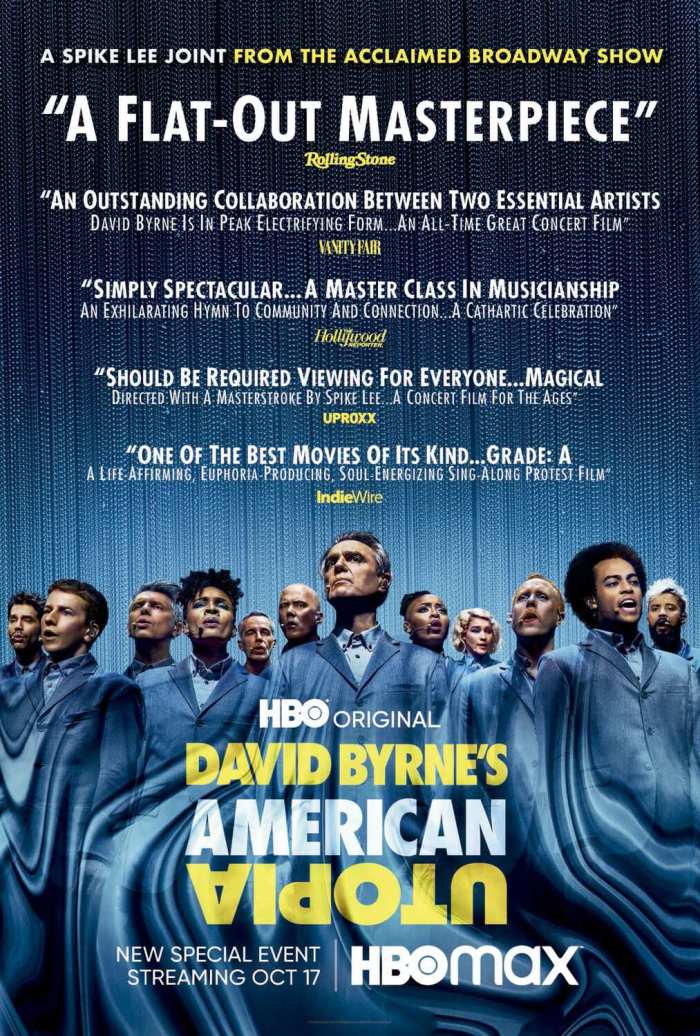
David Byrne’s American Utopia
To be clear, American Utopia is a concert film. It features a mixture of new songs written by David Byrne, some from his older solo work, and a few Talking Heads classics.
The show begins with Byrne on stage by himself with a (fake) human brain on a desk. Whilst discussing the nature of human development and, as we get older, the propensity for X to kick in, he picks it up and launches into the song Here.
What follows is a brilliant set of music, performed with 11 musicians. They provide backing vocals, percussion, and electric guitar work.
There are also complex choreography set pieces they perform with Byrne—it makes for a lively show with a lot going on.
Occasionally, the music stops and Byrne provides a brief TED talk type show. Here he discusses American life, encourages everyone to vote (the shot was prior to the 2020 US election), jokes about, and nods to his own battles in life (introversion and autism).
That then breaks away and you get moments like this (there aren’t many clips from the show online, so audio will have to do).
The clip below, a performance of Zimbra in November 2021, isn’t from Spike Lee’s film. But it has the same vibe about how the film works.
Some words from Byrne, bits of daft humour, then some music.
Everyone in those grey suits with blue shirt. Instrument in hand, they perform some trademark Byrne dance moves and enjoy themselves.
Towards the end of the show Byrne does get more political. That’s annoyed some right-wing viewers online due to the singer’s, apparent, “champagne socialism” agenda.
Byrne flags up America’s awful voting turnout figures (again, prior to Trump’s removal from power in 2021). And he encourages everyone to register and vote.
Note—he doesn’t tell the audience who to vote for. He just encourages everyone to get out and express their democratic right to shape the future of America they want.
But the song Bullet appears to highlight Byrne’s distress over the violence endemic in the US (see our recent film review of Mass). And his desire for change and a more peaceful future.
After this there’s also a song used from American rapper and actor Janelle Monáe (with her permission) called Hell You Talmbout. It’s a protest song about the deaths of African Americans due to racial violence.
It’s important to stress we think American Utopia isn’t a polemic or a piece of propaganda. Above everything, it’s a life-affirming stage show with a joyous melody to it that’s suitable for all ages.
And the show ends with Talking Heads hit Road to Nowhere from 1985.
This leads Byrne and his band to head straight into the audience, where they waltz about. We must note American audiences are much more proactive than the English ones we’re used to, everyone up and about dancing in their seat.
It’s not like that here. Sit down and shut up! That’s our motto. Rather!
The curtain comes down. Then we see some behind the scenes footage of the cast jumping about exhilarated by the performance, after which Byrne is filmed wrapping up for the night.
He comes out of the back of their theatre in a big puffer jacket, cycling helmet, and embarrassedly tries to ignore the fans queuing to cheer and wave him off.
There’s no stretch limo to whisk him off into the night. No helicopter to whoosh him off home to his mansion and many acres of land.
Instead, he gets onto his bicycle and rides off into the night.
Byrne is a long-term resident of New York and has always chosen bike as his preferred transport choice.
That’s one of the reasons why, in his late 60s at the time of the recording, he’s physically fit enough to do a set like that. Then be able to cycle home after.
We think it’s a fitting way for the film to end, honing in on Byrne’s idiosyncrasies, dislike of celebrity culture, and a desire to just bloody get home already and chill.
But it’s a brilliant show and Spike Lee’s direction is terrific. He makes you feel very much like you’re there in the theatre watching.
If you didn’t catch American Utopia during its various production, get the film version and give it a watch. Guaranteed spring in your step after and a brighter world view to go with it.
That, we think, is a magnificent achievement.
The Production of American Utopia
The stage show, and film, were critically acclaimed. Alongside being a great concert/play hybrid, it’s noted for just how bloody uplifting the whole thing is. Very impressive indeed from Byrne and his performers.
The only people we’ve seen online complaining about it are a certain sect of the right-wing community, who’ve been openly curmudgeonly about it.
But that stance is as predictable as flies to a turd at this point.
To watch the show and have anything other than a gleaming sense of delight, hope, and satisfaction is nearly impossible. Unless you have an agenda to pursue.
Anyway, enough of that. The focus of the production was to remove a lot of clutter and wiring from the performance. You watch any gig (such as Stop Making Sense) and there are wires everywhere for performers to avoid.
Here it was all about minimalism and the freedom to move about.
Byrne introduces his band during the gig, highlighting the importance of diversity in the world (taking a pro-immigration stance… the horror).
The performers hail from the US, Canada, Brasil, France etc.
Critical and film buff reactions to the project were overwhelmingly positive. As one user review by rachbruno on IMDB wrote in October 2020:
“This blew me away. I’m a huge fan of Byrne and he’s only gotten better with age. This was so incredible, it was inspiring, moving, inclusive, and hopeful. The music, the instruments, the musicians, the dancing… all of it was just so unbelievably great. Can’t say enough good things about this.”
This review got 41 upvotes and 13 downvotes.
And we’re willing to bet those 13 people don’t like hippies who need to get a job and stop making everything about diversity and inclusion these days. Diddums to them.
The film was nominated for numerous awards.
That includes several best documentary gongs. We wouldn’t really class it as a documentary, to be honest, but maybe they didn’t have a Best Concert Film category at the Chicago Film Critics Association or Florida Film Critics Circle.
It did win for two Primetime Emmy Awards, along with a Special Tony Award. Good. It bloody well deserved one.
Addendum! Reasons to be Cheerful
“We tell stories that reveal that there are, in fact, a surprising number of reasons to feel cheerful. Many of these reasons come in the form of smart, proven, replicable solutions to the world’s most pressing problems. We are part magazine, part therapy session, part blueprint for a better world.”
In 2018, Byrne launched the multimedia project Reasons to be Cheerful.
The name kind of gives the game away. But, yes, it’s a self-help website/magazine based on global stories “for people who hate self-help magazines”.
“Reasons to be Cheerful was founded by artist and musician David Byrne, who believes in the power of approaching the world with curiosity—in art, in music, in collaboration and in life. Under the banner of Byrne’s non-profit organization, Arbutus, Reasons to be Cheerful embodies this sensibility, applying it now to the future of our world. Through stories of hope, rooted in evidence, Reasons to be Cheerful aims to inspire us all to be curious about how the world can be better, and to ask ourselves how we can be part of that change.”
Byrne has a mild-mannered, quiet approach to proceedings. But he doesn’t hide his positive intentions with his wider creative projects. That’s for sure.
Across his career he’s also been an actor, filmmaker, producer, music theorist, and visual artist.
And with Reasons to be Cheerful he does, indeed, provide us with reasons to be cheerful. As does American Utopia. If you’re feeling down in the dumps, just watch the film and follow the magazine’s efforts. Sorted.
