
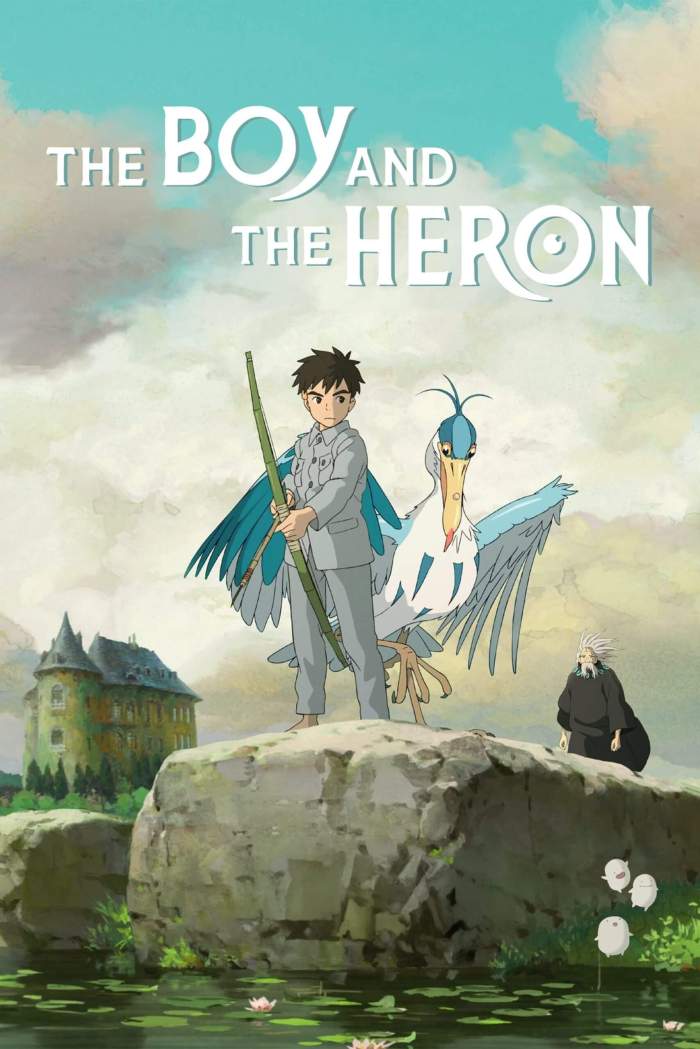
One of the most hotly anticipated films of 2023, Studio Ghibli’s The Boy and the Heron marks Hayao Miyazaki’s first feature film since 2013’s The Wind Rises.
We saw that in Manchester. We saw this one in Manchester, too! On the biggest possible IMAX screen as this thing is a sight to behold.
Asides from its breathtaking appearance, the film is a complex and thoughtful consideration on grief, life, and conflict. It’s a heck of a ride and one everyone should take, so let us be your guide!
Contemplation Galore in Studio Ghibli’s The Boy and the Heron
Now a quick recap—Miyazaki had retired after The Wind Rises. After a director friend of his died, he was worried the stress of making another film would cause him health problems.
But someone as creative as himself was not going to be able to resist another run. And the result is The Boy and the Heron.
In Nippon, its title is Kimitachi wa Dō Ikiru ka (君たちはどう生きるか), which means How Do You Live? This had led us to believe the film was adapted from Genzaburo Yoshino’s great novel How Do You Live? (1937), but it isn’t. This film is an original story.
However, there’s a brief scene of the protagonist Mahito reading Yoshino’s work and finding it very emotional (it’s a damn good book).
Narrative wise from Ghibli’s canon, The Boy and the Heron is closest to the Oscar winning Spirited Away (2001). It is, fundamentally, a coming of age story. But to bracket its complexities within that basic arc is to do it a major disservice, as there’s so much going on.
It’s a film that demands more than one viewing. And whilst not the outright best Miyazaki work (at least in our opinion), it’s right near the top.
The Boy and the Heron’s Multi-Layered Plot (some mild spoilers ahead)
Okay, we watched the English dub of the film. The cast includes Luca Padovan, Robert Pattinson (an incredible performance as the heron), Karen Fukuhara, Christian Bale, and Mark Hamill.
In the Japanese original, the main cast includes Soma Santoki, Masaki Suda, and Aimyon (the Japanese trailer is there above).
The story is about the young Mahito Maki, who loses his mother Hisako in a hospital fire during World War II.
The opening scenes of Mahito running through burning city streets appear deeply autobiographical.
Hayao Miyazaki was born in January 1941 and has said his earliest memories are of the bombed-out cities of Japan. In 1944 his family had to flee from Tokyo to Utsunomia, but after the latter was also bombed they again evacuated to Kanuma.
As he grew up, Miyazaki suffered from serious digestive issues and was told by doctors he was unlikely to live beyond 20. This left him feeling alienated from society.
You can see a lot of this in Mahito.
The boy’s father, Shoichi (voiced rather well by Christian Bale in the English dub), moves the family to a rural estate. He also marries again, this time to a lady called Natsuko.
Whilst Mahito settles into the beautiful residence and attends his local school, he’s regularly besieged by a weird grey heron.
The bird begins talking to him (again, voiced brilliantly by Robert Pattinson) and coaxes him into a nearby, supernatural residence. All with promises of reintroducing Mahito to his mother.
Upon investigation, Mahito exposes the heron to be a kind of bird/human hybrid. One who pulls him into an oceanic and mysterious world where there are rampaging penguins, megalithic dolmen, bubble-like spirits, and deranged man-eating parakeets.
It’s one very supernatural world Mahito enters, with ghostly figures and disturbed individuals as part of a chaotic environment.
We’ve seen some Ghibli fans online saying they’re unhappy about the film, claiming the narrative is too cryptic. It certainly doesn’t offer a clear structure as, say, the loveable and charming Ponyo (2008) does.
Instead, there are many layers of symbolism.
Sometimes it’s not clear what’s going on. And we must admit we were a bit confused at certain points. It is, without doubt, a film that demands to be watched multiple times to gain more from its intentions.
Despite our lack of comprehension, we thoroughly enjoyed the film.
Asides from its appearance (and it’s really a most stunningly beautiful film), the score is superb, and the complexities of the plot more than welcome.
The Boy and the Heron, once again, confirms animated films aren’t “for kids”. Although this is a 12A, there are very adult themes here. And some disturbing imagery. The parakeets, for example, have the capacity to be simultaneously very cute and deeply disturbing. It’s managed in a way we think only Studio Ghibli can get across.
Regardless of its minor imperfections, we think the film is a joy to watch. And it left us feeling rather engrossed at its conclusion.
A Little Bit About The Boy and the Heron’s Incredible Soundtrack
The Boy and the Heron has one of the best Studio Ghibli soundtracks we’ve ever heard.
It’s the work of composer Joe Hisaishi, who’s worked on other films for the studio before. For example, he produced the Princess Mononoke (1997—and our favourite Miyazaki film) music.
The film features Warawara characters that are rather similar to the Kodama forest spirits seen in Mononoke, with excellent music to go with their arrival.
The tone of the music is generally positive and upbeat, trademark Hisaishi. His music draws inspiration more from western symphonic traditions rather than from native Japan.
Over various Ghibli projects he’s provided pop, jazz, electronic, and orchestral numbers. Minimalistic piano numbers have always been prominent. And that features extensively here again.
Before giving way to more dramatic heft. It’s that trademark Studio Ghibli sound that’s so very distinctive to Miyzaki’s movies.
For his work on The Boy and the Heron, Hisaishi has already bagged nominations for Best Original Score at the Golden Globe Awards. Expect the same for the Oscars.
The Protracted Production of The Boy and the Heron
After The Wind Rises, in late 2013, Miyazaki announced he was retiring at the age of 72. The creative urge brought him back in 2018 when he produced the short film Boro the Caterpillar.
That dragged him out of retirement for what he announced would be his new final film, although according to Ghibli insiders he’s now planning another project.
There is no stopping this man!
Storyboarding for the film began in July 2016 and he’d got the basics nailed down by August (also of 2016). Production began in February 2017.
A lot of secrecy about the film then commenced. No one had any idea what it was, other than a few scant details regarding the title—(Kimitachi wa Dō Ikiru ka) How Do You Live? This led to speculation it was going to be a film adaptation of Genzaburo Yoshino’s novel, as it’s a modern classic of literature in Japan and a personal Miyazaki favourite.
However, as we’ve mentioned earlier, this is an original story. It was only clarified as late as June 2023 that the novel is unrelated to the film.
Although it kept the name Kimitachi wa Dō Ikiru ka for the Japanese release, launching with almost no marketing other than a vague poster published on the studio’s social media channels.
In the west we got a full set of trailers and the film has been a big hit, topping many cinema charts around the world (notably in Canada and the US).
The project took so long as the studio is still hand-drawing all of its projects, which led to 60 employees working hard on the project.
That’s paid off magnificently, as the film is quite stunning.
And you can still see it! The film is in cinemas right now, so hasten on down to your local complex if you want to behold this glorious project in all its might.
