
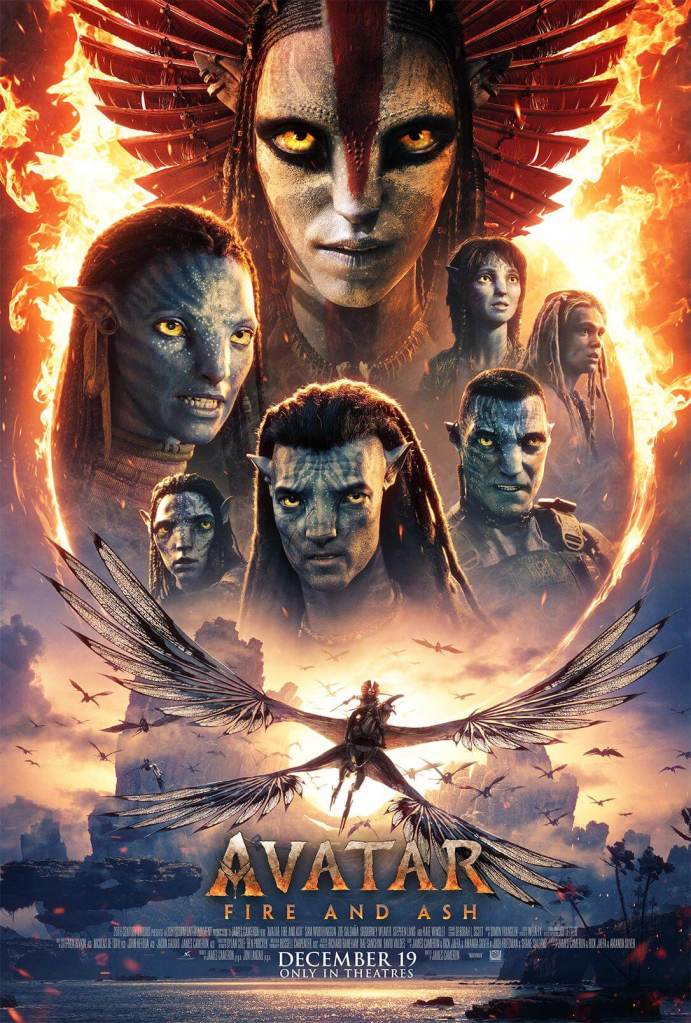
James Cameron’s Avatar: Fire and Ash launched in global cinemas only from December 2025. It’s already wracked up $1.1 billion at the box office, which is great for the film industry as it battles new entertainment forms.
Seeing this in IMAX 3D is quite the experience. If you’re going to watch the film, do so on the biggest screen possible. As whilst the narrative arc gets a bit wonky, there’s plenty to enjoy in this fantasy extravaganza.
Lots of Kidnapping and Volcanoes in Avatar: Fire and Ash
Everything kicks off quickly, with the story returning to Jake Sully (Sam Worthington) and his Na’vi family mourning the loss of their son. His wife, the fearsome Neytiri (Zoe Saldaña), is once more there as the figurehead of the family.
We also have their adopted teenager Kiri (Sigourney Weaver) with a much bigger role this time, plus the ever-annoying Spider (Jack Champion) has his role ramped up considerably. “Whoooo!” (as Spider often yells).
Okay, by the way, from here MINOR SPOILERS are ahead.
Due to complications with Spider, the family decide to make a trip with some local traders to return the lad back to humans. However, along the way they’re ambushed by a new type of Na’vi clan—the Mangkwan.
Those dudes ensure the first 90 minutes of Fire and Ash are terrific.
We were convinced it was going to be the best of the franchise, not least with the arrival of volcano-based warmonger Varang (played brilliantly by Oona Chaplin). She’s the leader of the Mangkwan.
Varang is fire obsessed, highly intelligent, and utterly insane. This mad leader breathes a great deal of new life into the third outing. She even manages to woo main villain Colonel Miles Quaritch (Stephen Lang) and the two begin an unlikely partnership (then relationship).
Her clan initially appears to be the main antagonist in Fire and Ash and they’re genuinely menacing, almost like an overwhelming threat. But the odd thing is James Cameron sidelines the Mangkwan after the first half and returns to more formulaic Avatar territory.
We know he’s doing more of these Avatar films (the next is due in December 2029), so hopefully Varang will play a bigger part next time out. As Fire and Ash really could have addressed longstanding criticisms of the films’ scripts. She could have bumped off the Colonel and become the new antagonist to shake things up.
Instead, she becomes the Colonel’s girlfriend and pretty much disappears from the film.
Once Verang and her clan are sidelined, Fire and Ash pretty much rehashes how Way of Water’s (2022) final act plays out. This is where the film trails off, bringing back the same ending and removing most of the exciting new elements. That includes a looping habit of having:
- X Jake Sully family member kidnapped
- Jake Sully family member rescued
- X Jake Sully family member kidnapped
- Jake Sully family member rescued
- X Jake Sully family member kidnapped etc.
We guess what’s key here is it’s a PG film for a wide mainstream audience, mainly with kids and teenagers high up the intended audience list. We’re sure they’re agog at this thing and wildly in love with the series, so we do feel Cameron has shifted the narrative more to family-friendly fare.
Despite the formulaic chaos in the final chunk of the film, there’s enough great stuff before it to make Fire and Ash well worthwhile as viewing. Preferably on the biggest screen possible, which is why we saw it on IMAX 3D in Manchester city centre.
As a cinematic spectacle, Avatar: Fire and Ash is incredible. The visual style is amazing, plus the score by Simon Franglen is the usual excellent atmospheric, exotic stuff.
However, the standard criticism of the series’ shonky plot is more valid here than ever. He gets away with it this time, but if he does it again the series will trail off completely. Filming of Avatar 4 will kick off again soon, hopefully the focus is on a more distinct script.
The world building Cameron has created is phenomenal and the intriguing new elements have a wider potential. What we hope for is Verang at the forefront so we can revel in the fire-based madness.
The Production of Fire and Ash
James Cameron is doing phenomenal things with technology to create the Avatar films. Very pioneering, landmark stuff. They’re wildly successful, too, as all three have so far made over $6.3 billion worldwide.
Some thespian types remain snotty about motion capture as not “real” acting, but we think that opinion should have been buried long ago. Most of the cast members in the film are terrific, with big props to fan favourite Zoe Saldaña as Neytiri, Oola Chaplin, and Sigourney Weaver on fine form.
This is what goes into it all. Very physical and a great deal of creativity to imagine the world around them.
Fire and Ash had a budget of around $400 million, so far it’s made back $1.106 billion in its first month in the cinemas. Once Blu-ray, DVD, and streaming sales kick in that’ll be even more.
These films are getting people into cinemas, reminding them all of the thrill of the cinematic experience, so we have no problem with his projects. Some of his fans have been requesting he focus on new ideas, but Cameron has also said he’s satisfied artistically and it’s his choice.
Despite all the technological wizardry, big chunks of the film were also shot in New Zealand (Hollywood’s favourite location to make everything look spectacular).
Keep in mind the timeline of the productions, as Way of Water and Fire and Ash were shot back-to-back. So the latest major cast member, Oona Chaplin as Verang, has actually been part of the cast for almost a decade. She joined in June 2017 and did much of her filming in 2018 through to 2024 (with project delays due to COVID-19).
Now, the next issue is the critical reception. Cameron won’t give a toss about it, but Fire and Ash is definitely the least well received of the three films. Again, a shame as it starts off like it could well be the best.
The main criticism is with the plot repeating the same narrative as before.
That’s led to a mixed critical reaction, with the usual batch of Super Intellectuals (i.e. The Guardian’s film critic Peter Bradshaw) going out of their way to make out the film is beneath them and they’re just so much more intelligent than it. There’s plenty of legitimate criticism you can make about the series, but saying it’s “boring” (as a rote critique) is surface level and wrong.
Others have praised it, with IGN handing over 9/10 and The American Film Institute naming it one of the top 10 films of 2025. A divisive one, then, but we get the impression James Cameron thrives off that kind of conflict and it’ll only spur him on to do more of what he wants.

I haven’t seen any of the Avatar films, apart from half of the first. I tried watching it on first release because I’m a sci-fi enthusiast and live in and around where it was filmed, e.g. their sound stage was the old Mitsubishi plant where the first car I ever bought was once assembled, the helicopters routinely flying over my house were commuting Mr Cameron to and from his farm in the Wairarapa, and yes, that WAS Sigourney Weaver seen walking down a central city shopping street, etc etc. Unfortunately I fell asleep, missed most of the the Roger Dean/Yes album cover floating mountains sequence & as a result have been somewhat dubious about whether to tackle the series. They do seem to have some thought-provoking elements though, including “my uber-hot star drive is a dandy weapon” as first proposed by Robert Heinlein (‘Time for the Stars’, 1956).
LikeLiked by 1 person
If you didn’t like the first one, you won’t like the rest of them. But as you live in New Zealand, you’ve basically seen the scenery from the three films so there you go – you can claim to have partially watched all of them. Great technical achievement, but I think the plots would bore you with their simplicity. This one does waste a few opportunities to make the series more dramatic, which is a shame.
The DUNE films would be more your thing, third one is out this year. I think Denis (Dennis) Villeneuve did a great job with those.
LikeLiked by 1 person