
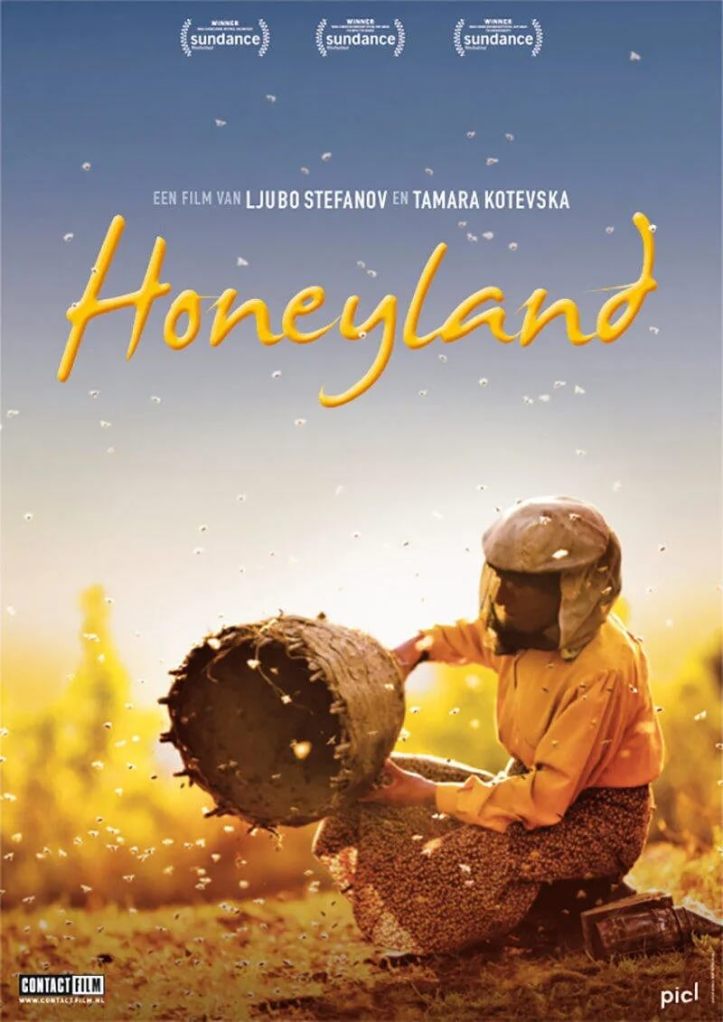
This Oscar winning 2019 documentary was co-directed by Macedonian filmmakers Tamara Kotevska and and Ljubomir Steganov. Honeyland (Медена земја) follows the life of Hatidže Muratova, who looks after wild bees in the remote mountain village of Bekirlija.
The directors recorded 400 hours of footage in the mountains, capturing some beautiful footage of the Macedonia’s stunning rural areas. But within there’s also an impressive look at loneliness, poverty, and the changing nature of traditional jobs.
On the Nuisance of Neighbours in Honeyland
Tamara Kotevska is a brilliant young documentary maker, her latest feature The Tale of Silyan just launched on streaming services in December 2025. She’s actually followed us back on Instagram, so that’s a claim to fame for us there (chuffed about that, we are).
This was her joint second film, the first being Lake of Apples (2017). For Honeyland, she and Stefanov used various documentary styles (fly on the wall, direct cinema, and cinéma vérité) for a hybrid time of it. There are moments of improvisation, active involvement alongside the villagers, plus lingering shots of the gorgeous landscapes.
That and a sparse score by Macedonian band Foltin.
There’s no narration and all the viewer sees is a slow exploration of wild beekeeper Hatidže Muratova’s life. Where she lives is so remote there’s not running water or electricity. It’s living as humans did 200+ years ago.
She uses ancient beekeeping traditions to cultivate honey, then occasionally travels to Macedona’s capital city, Skopje, to sell the honey.
She lives with her 85-year-old mother, who is ill, and leaves a very quiet life. Not married, no kids, but often seen wearing a distinctive yellow top.
However, her life is disrupted when a cow herder and his noisy family move close to her home.
When the directors were filming Honeyland (from 2015 up to 2018) the footage they caught unexpectedly revealed a clash between Muratova and her new neighbours. The small family of four, who spend almost all of their time arguing furiously, somehow many to be severely lacking in self-awareness at all times.
The father of the family takes up beekeeping for a source of extra income, with full support from Muratova, but then he ignores her advice and almost wipes out the local bee colonies.
Muratova does take a shine to one of the family’s sons, a young lad, who she bonds with. They both seem to yearn for some peace and bloody quiet away from the father and mother.
But Honeyland, basking as it does in solitude, leaves the viewer wondering of Muratova’s future.
We do get an incredible snapshot into a unique way of life. In just 87 minutes, there are rolling hills, wild bees, Muratova’s quiet presence, and one very noisy family. But it makes for memorable viewing and a reminder that here we are, in modern society, but some people still manage to channel into the ancient way of things.
The Production of Honeyland
Spurred on by glowing press reviews, Honeyland made $1.3 million at the global box office. That’s an impressive amount for a documentary from a then relatively unknown pair of directors.
It then received nominations at the Oscars and Sundance Film Festival.
The film was initially supposed to be about the Bregalnica river in North Macedonia and rotational farming practices, but when they arrived at the location they met Hatidže Muratova and wanted to make the documentary about her. Muratova refused, but then changed her mind so as to promote an environmental message to the world.
When you watch the film, never does anyone in the film ever look at the cameras. It’s as if they’re entirely indifferent to them being there. Tamara Kotevska has also said nothing was fabricated, filming occurred naturally and nothing was staged.
After the shoot, the directors got some money together and bought Hatidže Muratova a proper house near to her brother and his family. But Muratova also tends to the bees during the peak seasons with those ancient practices.
