
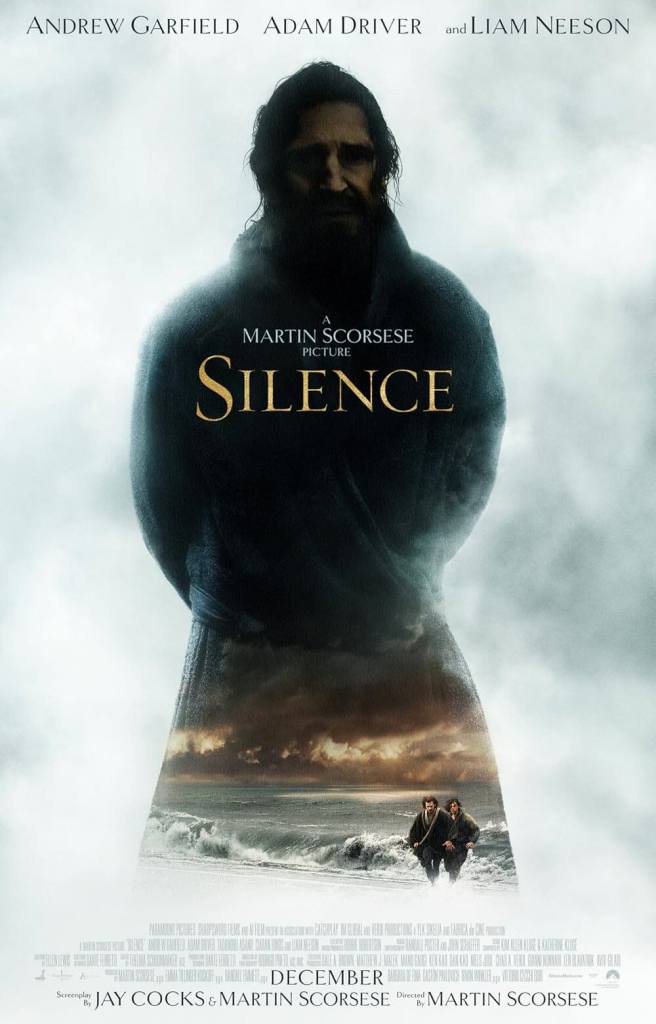
A decade after its launch in late 2016, Martin Scorsese’s passion project Silence is a fascinating time of it. The epic historical drama is almost three hours long and explores some pretty devastating religious themes.
It was a box office failure, but received a lot of critical acclaim. Many film fans now hail it as a masterpiece. We’re not quite in agreement, but it still leaves a lasting impression and has some impressive peaks.
A Crisis of Faith in Silence
Scorsese was 72 when he directed this challenging film. It was adapted from the book Silence (1966) by Japanese author Shūsaku Endō, which adapted the true story of Portuguese Catholic Priest Cristóvão Ferreira (1580-1650).
Ferreira was a Jesuit missionary who travelled to Japan in the 17th-century to convert locals. The Japanese government responded with brutal anti-Christian purges, with Ferreira apostatising after psychological torture. He was forced to register as a Buddhist and spent the rest of his life in Japan.
Silence adapts that story by introducing the fictional priests Sebastião Rodrigues (Andrew Garfield) and Francisco Garupe (Adam Driver). They travel out to Japan to find Ferreira and bring him home.
They do this with the help of Japanese fisherman in hiding Kichijirō (Yōsuke Kubozuka), a Christian facing persecution by the Japanese state.
Once the priests reach Japan, a trip fraught with extreme danger, what follows is a story laced with iconography, symbolism, and alternate religious meaning. They reach a small village and settle there for a while, where many locals have already converted from Buddhism to Christianity.
The government isn’t happy about that and is on the lookout to punish dissenters. Anyone who refuses to apostatise is executed (and WARNING, the below scene shows quite the unpleasant process).
Scorsese wasn’t afraid to shy away from the more brutal element of the book’s themes. At the heart of it all is human suffering and the nature of theological silence.
In time, Rodrigues meets the ōmetsuke (grand councilor) Inoue Masashige, played by actor and comedian Issey Ogata. Masashige’s has worked out that just killing missionaries doesn’t achieve much and actually provides them with a martyrdom they somewhat crave.
The response instead is to enforce horrible suffering on Japanese Christians, make the Portuguese missionaries endure watching it, and tell them the suffering ends if they apostatise immediately.
It’s a clinical brutality that appears in James Clavell’s masterpiece Shōgun (1975), plus the brilliant adapted TV show from 2024. In Silence, Scorsese doesn’t hold back and the scenes of suffering may be gruelling for some viewers.
We can also mentioned the very underrated Tom Cruise vehicle The Last Samurai (2003), which avoids many of the religious themes, but covers the life of a westerner in eastern lands.
Silence sets its theme of suffering alongside the theological discussions the Buddhist Japanese citizens have with their Christian missionary enemies. What Rodrigues isn’t aware of at that point is the Japanese are going to psychologically break him through some very devious, if inventive, means.
Although we don’t think Silence is the masterpiece some hail it as, it’s still a fascinating film and a very good one. The cast offers a strong set of performances, with Andrew Garfield committed to his lead role. At times, he’s great and very convincing. Other times, he wavers a bit.
It’s also a shame Adam Driver’s character disappears from the plot early on. Considering he lost 40 pounds for the role, he’s not onscreen much and he must have been annoyed by that.
The film is beautiful, too, thanks to the work of cinematographer Rodrigo Prieto. Working with Scorsese, he took inspiration from Baroque painters to determine the film’s colour palette (there’s a sweeping sense of blue going on).
Silence fascinated us at it’s based on history and, importantly, pertinent themes. Religion is still a powerful force in the world and Scorsese was determined to get his vision on the big screen.
10 years later and it stands up well, with committed performances and an excellent sense of time and place. It isn’t cheerful viewing, but it’s not supposed to be. As a drama, its relentless pursuit of what it means to be religious, yet have no response from the deity you worship, will challenge even the most pious of soul.
Notes on Silence’s Title
What is the book’s title about, then? 沈黙 (Chinmoku) isn’t just a history book, it’s a theological document, inspired in part by author Shūsaku Endō’s religious discrimination he faced in Japan.
Based on the narrative arc, you can read the name in two ways:
- God’s silence, not responding to prayers, despite human suffering
- Rodrigues’ silence after he apostatises, living out the rest of his life pretending to have renounced his faith
We’ve had a good look at many online comments regarding the film. From the responses, many religious people found it very meaningful and praised it a great deal. We even saw a few comments state it had changed agnostic mindsets and initiated a return/conversion to Christianity.
Now, we’re not religious. Our viewing of it was watching people put themselves in extremely dangerous situations, and forcing their belief system on a nation that didn’t ask for it, for no real reason.
That lovely bleak assessment aside, it’s all based on very real stories that occurred 400 years ago. The Japanese approach was brutal, clever, formidable, and frightening. And we view the film’s success as allowing individual viewer’s the chance to make their own mind up about what it all means. In that, we suppose there’s some solace.
The Production of Silence
Off its $50 million budget, the film only made back $24 million at the global box office. Now, we’re not great at maff, but that constitutes a notable box office flop for Martin Scorsese.
The flop was blamed on its long running time, ultra-serious subject matter, and lack of awards buzz around its arrival. It does take itself very seriously and, other than a few bits of humour early in the film, everything after the 10-minute mark is about punishment and suffering.
Despite its Japanese story setting, everything was filmed in Taiwan. This was to keep costs down, which also extended to the actors. Liam Neeson, Andrew Garfield, and Adam Driver all took major pay cuts over what they’d normally expect.
Filming took place across from January to May 2015, with some location shots and also with film studios in Tapei.
Scorsese is a practicing Roman Catholic and Silence is one of his favourite books (he first read it in 1989). He wasted no time getting the film rights soon after, with the project in development since 1990. Of his passion for the adaptation and its 26 year wait, he said this in April 2016:
“As you get older, ideas go and come. Questions, answers, loss of the answer again and more questions, and this is what really interests me. Yes, the cinema and the people in my life and my family are most important, but ultimately as you get older, there’s got to be more. Silence is just something that I’m drawn to in that way. It’s been an obsession, it has to be done.”
A decade on from its release and there are plenty of film buffs who hail Silence as a masterpiece. It received critical claim in 2016, too, but there were also more negative reviews.
It was generally seen as one of the best films of 2016 and got an Oscar nomination for Best Cinematography. But its status will always be the Martin Scorsese passion project that turned into the box office bomb. Dang.
