
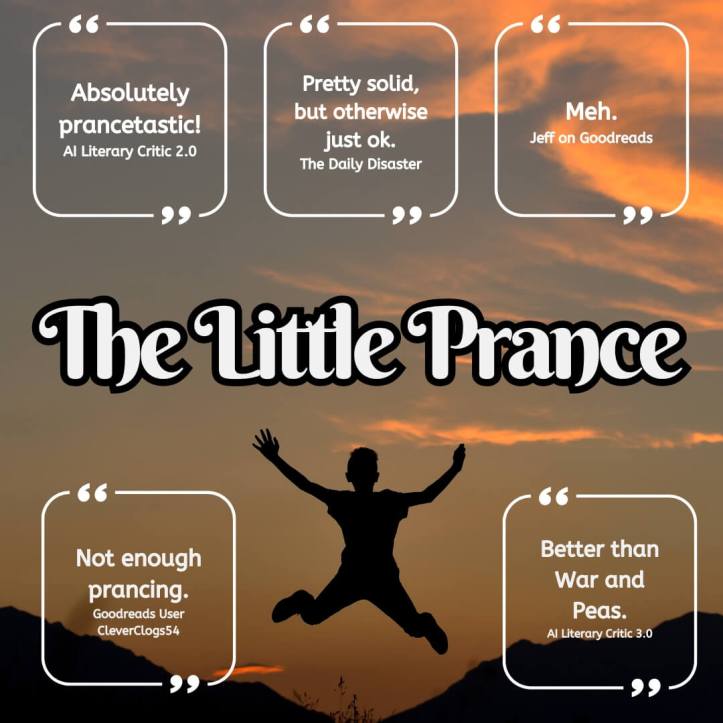
The Little Prince (Le Petit Prince) is a famous French novella by Antoine de Saint-Exupéry. It published in 1943. But did you know The Little Prance also published in 1983, by sheer coincidance (pun intended) as a moving novella about friendship, prancing, and hellish death during wartime.
Today, we’re here to celebrate the oft-forgotten work. It sold poorly upon launch, continues to sell poorly to this day, but for prancing enthusiasts such as ourselves it’s a great undiscovered masterpiece.
The Joys of Letting it All Hang Out in The Little Prance
“Then he pranced. He pranced like he’d never pranced before and, lo, there was much prancing amongst the prance enthusiasts.”
The work was written by noted pseudoscientist Dr. John Doctorson, noted for his extreme views on tennis elbow and athlete’s foot (the latter of which he “cured” through rampant amputations). In 1990, he noted in a rare interview he wrote the book as a:
“Love letter to exaggerated movements.”
The Little Prance is a bit like the film Billy Elliot (2000), but not at all as it’s set in Victorian era England 1879 and follows the exploits of the young man Charles “Charlie” Twistleton Montgomery III and his life in an upper class English family.
To the DISGUST of his mother Ingrid, Charlie befriends a working-class scumbag from a neighbouring town called Derek. The two bond over the popular pastime of prancing about the place, all whilst the mother rages about it big time:
“I cannot abide how you could besmirch the name of our family by proliferating your being around such a disgraceful specimen! Charles Twistleton Montgomery III!! Are you listening to me?!? Your fatuous friend, Derek… his family do not even own but ONE acre of land! You have brought great shame on our family to associate with such pustules of society!”
Regardless, Charlie disobeys his mother in secret. Spending many hours, days, weeks, and months together, by their teenage years they’re set to compete in The National Prancing Championships and are eager to see each other do well.
Alas, Charlie’s mother Ingrid doesn’t like the possibility of Charles “Charlie” Twistleton Montgomery III losing to the various lower class plebs in the competition. Thus, she deigns it so to sabotage leading contestants and shatter their dreams through:
- Leg breaking
- Poisoning
- Blackmail
- Nasty glares
- Enforced volunteering into the Anglo-Zulu War
After Ingrid threatens Derek’s mother with a monocle, Derek is sent off to the Zulu War, thus removing her son’s lead competitor from the contest.
However, when Charlie discovers what has happened, in DISGUST he quits the competition, signs up to the Anglo-Zulu War, and meets Derek out on the front. There, as arrows and spears rain down from all around them, the duo prance about the place in joyous unison.
The end.
A most moving tale indeed, although it is disappointing there aren’t more swear words across the 250 pages. Would it have killed the author to drop a few “bastards” or something? So, one mark off for that, otherwise this is a solid 4/5 from us and well worth a go.
The Long-Forgotten Sequel: The Little Prances
As we closed for press, it came to our attention of a 1985 sequel called The Little Prances. This one is set during the inaugural Eurovision Song Contest on May 24th 1956.
Charles “Charlie” Twistleton Montgomery III’s great grandson Charles “Charlie” Twistleton Montgomery IIII is continuing the family tradition by prancing for a career.
Held in Lugano, Switzerland, his song is titled Prance and involves a variety of piano, French horns, and his own prance solo. The 500 page novel explores the build-up to the event, his extensive training, and his personal disappointments after receiving 0 points for his performance.
To be honest, we though it was crap. Read the first one instead.

How will it help my athlete’s foot to have my rampant amputated??
LikeLiked by 1 person
You discovered that elusive prancing point—that delicate moment where elegance springs in delicate ethereal hooves. 🧑🩰
LikeLiked by 1 person
I do love a bit of prancing. In fact! I’m prancing as I type this response. 🕺
LikeLike