
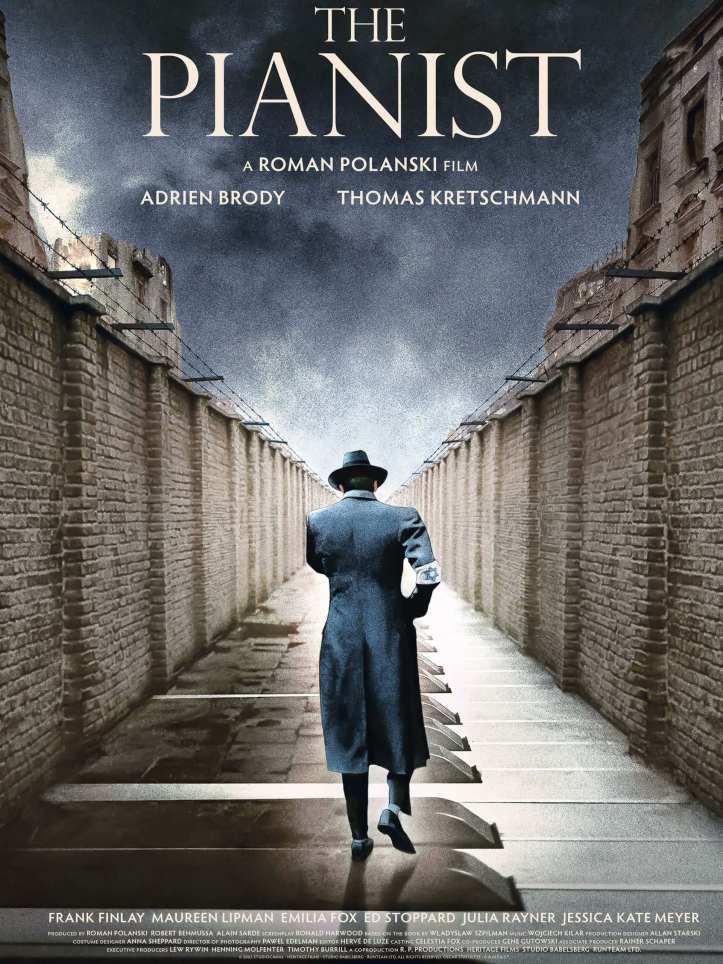
The Pianist (2002) is a brutal film, one we’ve watched twice with a 20 year gap between viewings. Watching it during the week again and we think Roman Polanski’s film is a near enough masterpiece.
We’ve not covered Polanski’s work before due to the nature of allegations against him dating to 1977. But we make an exception for The Pianist, as this is a harrowing film about Polish pianist Władysław Szpilman and his battle to survive World War II. And it’s certainly one of the best WWII films.
Escape and Survival in The Pianist
Director Roman Polanski is now 91. This was a deeply personal project for him, as he is a Holocaust survivor. Around 10 at the height of Nazi concentration camps, he escaped into hiding and evaded the notorious camps.
His mother, however, was killed at Auschwitz. His father survived his time at Mauthausen, whilst their son’s battle for survival included tales of being used as target practice by Nazi soldiers.
Whilst Polanski lived out his survival story, Władysław Szpilman (1911-2000) was doing the same. The Pianist is adapted from Szpilman’s memoir, which he wrote and had published in 1946. Polanski’s film doesn’t hold back on the realism and it can be as shocking as Spielberg’s Schindler’s List (1993) in its depictions of genocide.
Where it differs from Spielberg’s work is its exploration of survival and a central theme of isolation—forced into hiding.
It’s much like what Anne Frank’s family were forced into—hiding. The difference is Szpilman was often alone, in random flats having to remain silent, as he was separated from his family.
For the first 40 minutes viewers spend time with his lively family members, who are all sent off to a centration camp. It’s not mentioned directly in The Pianist, but we looked it up after. None of his family members survived.
We don’t learn of their fate, but we are left to watch on as Szpilman’s situation lurches from bad to worse. Ultimately, it’s a matter of sheer desperation and he then finds himself face to face with Nazi Captain Wilm Hosenfeld (Thomas Kretschmann).
Lucky for Szpilman, he bumped into a Nazi who was long since disillusioned and disgusted with Hitler’s vision and had actively been saving as many Jewish citizens as he could (see also the underrated Valkyrie from 2008 for more on internal Nazi defectors).
Thanks to Hosenfield’s efforts Szpilman survives, but the film does accurately depict the chaos in the immediate aftermath of war. All of which is led by Adrien Brody’s exceptional performance.
Away from that, there are some genuinely horrifying scenes that’ll sear themselves into your memory—perhaps most notably a Warsaw Ghetto scene and defenestration (being thrown from a window).
We used to wonder, when we were younger, why directors covered this topic. But it’s for the same reasons the survivors wrote books about it from 1945 onward. And when you watch a film like The Pianist you realise its values, keeping these stories alive, hopefully fending off a repeat, and shining a light on brave souls.
It’s a humbling thing and made all the more so by Adrien Brody’s impeccable lead performance.
Notes on Captain Wilm Hosenfeld
Captain Wilm Hosenfeld isn’t in the film for long, but it’s a memorable appearance. He’d risen the Nazi ranks to the position of Captain but, as we mentioned, began using his position to offer refuge to persecuted individuals.
This began as early as autumn in 1939, so he managed to spend the war doing this without detection. It’s an important reminder many Germans were against what was going on.
As depicted in The Pianist, Hosenfeld discovered Szpilman by chance at Aleja Niepodległości, Street 223. This was a very large house, but it was in November and freezing cold. This is all portrayed accurately in the film, with the pianist playing Chopin’s Nocturne No. 20 in C♯ minor after the Captain enquired about his work.
Once the war ended, the Captain surrendered and was held as a POW (prisoner of war) in Minsk and Bobrujsk. The Soviets sentenced him to 25 years of hard labour for war crimes.
By that point Szpilman had returned to normal life in Poland, but in 1950 finally discovered Captain Hosenfeld was the man responsible for saving him. He spent the next few years dealing with the Polish secret police to try and get Hosenfeld released.
Unfortunately, whilst at Stalingrad, Hosenfeld’s health plummeted and he died aged 57 in August of 1952.
This is one element of the story we think The Pianist doesn’t cover overly well, as the conclusion of the film breezes over this aspect. We had to go off and research this more to fully understand what happened.
The Production of The Pianist
The above interview was with the man behind the story and aired on ABC in January 1985. He lived through to July 2000 and the excellent age of 88.
To play him, director Polanski initially wanted Joseph Fiennes (Ralph’s brother). However, he was busy with a stage project and so open casting went out with 1,400 actors auditioning in London. Polanski turned the lot of them down.
Then, by chance, he watched war-romance film Harrison’s Flowers (2000) and offered the role straight up to the relatively unknown Adrien Brody.
Brody promptly went all-out method acting in preparation. He:
- Abandoned public life for several months to understand the nature of enforced isolation
- Gave up his apartment and car
- Lost 30 pounds
- Learned to play the piano (four hours a day)
Perhaps that final point is the most impressive, as he was determined to master some of Chopin’s most difficult works. He won an Oscar for his efforts and rightly so, it’s easily his best performance (in our opinion). However, the experience of the project left him with a sense of mourning. He later said:
“There is an emptiness that comes with really starving that I hadn’t experienced. I couldn’t have acted that without knowing it. I’ve experienced loss, I’ve experienced sadness in my life, but I didn’t know the desperation that comes with hunger …
I was very disturbed by what I embraced and of the awareness that it opened up in me.”
Despite the subject matter, The Pianist was a box office success. Off its $35 million budget it made $120.1 million, highlighting that cinemagoers are willing to see challenging drama when it’s available and to this standard.
