
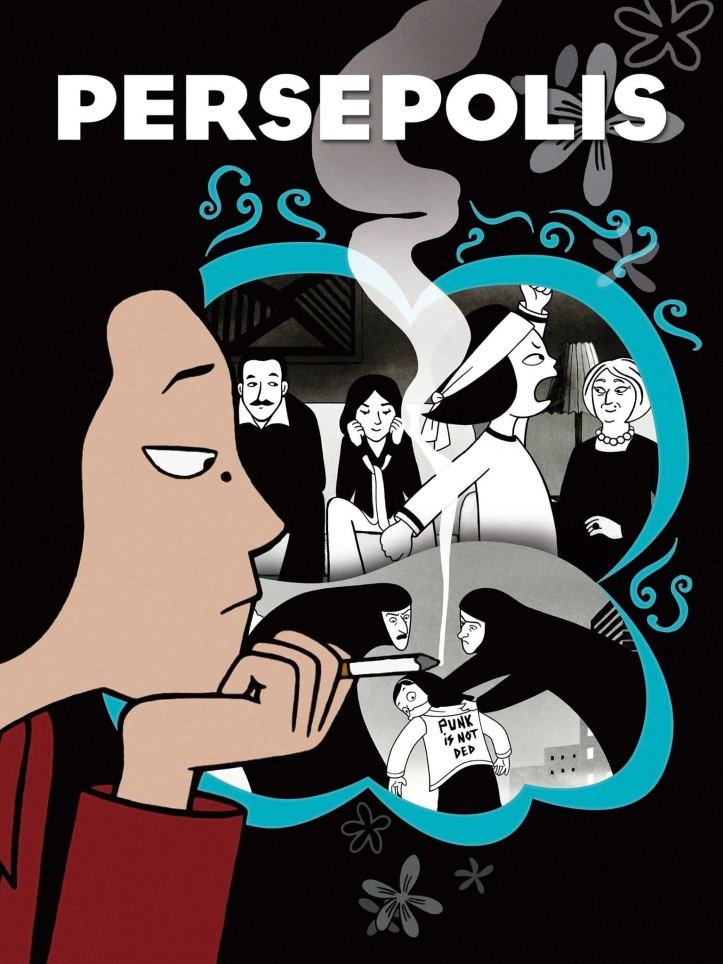
Following the news of the sad passing of Marjane Satrapi in June 2026, we decided to revisit her 2007 animated film Persepolis. Almost 20 years after its launch, it remains a brilliant insight into the Iranian Revolution.
A heavily autobiographical story, the narrative follows Marjane from a child up to around age 30. She’s a rebellious spirit, listening to rock music, and sticking it to the system, all of which makes for a very fine historical drama.
Rock and Revolution in Persepolis
Persepolis was first a 2000-2003 graphic novel by Satrapi, which is an incredible story to tell. Born into an upper-middle-class family in November 1969, across the 1970s Iran faced many social and political upheavals.
Her parents and family members are left-wing leaning, but Islamic fundamentalists win the post 1979 Iranian revolution election and strict Islamic laws are placed on the country. Then the Iran-Iraq War broke out in September 1980.
These elements remind us of the modern classic Waltz with Bashir (2008) a bit, with themes of war and loss of innocence, everyday people lost to the mayhem of it all.
And in that mayhem some people step up and rebel.
Influenced by her extended family members, Satrapi starts listening to black market heavy metal music and likes wearing Western clothes. She’s also expelled from school for challenging state propaganda.
Her parents fear for her future, so they send their daughter to Paris where she studies at French lycée, Vienna, a secondary school. She meets intellectual sorts who she, at first, finds interesting. Then later considers them pretentious.
At that point in the film, Satrapi’s life takes a giant step away from her Iranian background. She starts falling for guys, gets messed around, is frustrated by bureaucracy wherever she goes, and constantly clashes with authority figures.
It’s someone wanting to life their life free, but always coming up against tedious, and heavily Conservative, rules and regulations.
She has a lot of anger in her, quite rightly on many occasions, which she channels into belligerent outbursts. These are played for comedic effect in Persepolis, Satrapi reflecting on her youth now with calmer eyes.
It was a remarkable early phase of her life and that’s what Persepolis captures. This is a story of exile and displacement. An intellectually curious young woman forced by a sexist and oppressive state to flee her home country, which leads to formative year adventures in search of personal identity.
Watching this, it was a reminder to us how fortunate we were with our upbringing. Life in England was free from bother for much of the ’80s, ’90s, and ’00s.
But as for the film, this is no doubts a modern classic. Rewatching it, we found a funny, moving, and passion account of one woman and her journey to self-acceptance. That story has now, sadly, come full circle, but she broke new ground with this work of hers.
With Persepolis, Satrapi was the first woman to be nominated for a Best Animated Feature Oscar.
The Production of Persepolis
Off its $7.3 million budget, the film was a small hit and made back $22.8 million worldwide. As it was a co-production between American and French studios (mainly the latter), it was selected as the French entry into the Oscars, where it went far and got a nomination for Best Animated Feature.
Despite its success, Iran’s government complained about the film to the French embassy in Tehran (later protesting its showing at a New Zealand film festival in July 2008). They wanted it dropped from film festival circles, but instead it was a critical and commercial success.
To make it, Marjane Satrapi and Vincent Paronnaud wrote the script. 20 animators were hired to work on the full production. After the film’s success, she went on to work across various other projects. That included a 2019 biopic on Marie Curie.
Following the death of Satrapi’s husband in April 2025, she reportedly struggled with depression. A close friend issued a quote for the press stating:
“She died of sadness a little over a year after the death of Mattias Ripa, her husband and the love of her life.”
Persepolis does occasionally hint at Satrapi’s depressive issues and she makes an attempt on her life at one point. We’re taking from the above message this is what likely happened in June 2026.
It’s a very sad loss, as she had a great mind and, alongside her creative talents, a keen sense for social justice. And that leaves us to mention this one glorious quote from Marjane Satrapi to round off this review:
“In life you’ll meet a lot of jerks. If they hurt you, tell yourself that it’s because they’re stupid. That will help keep you from reacting to their cruelty. Because there is nothing worse than bitterness and vengeance. Always keep your dignity and be true to yourself.”
