
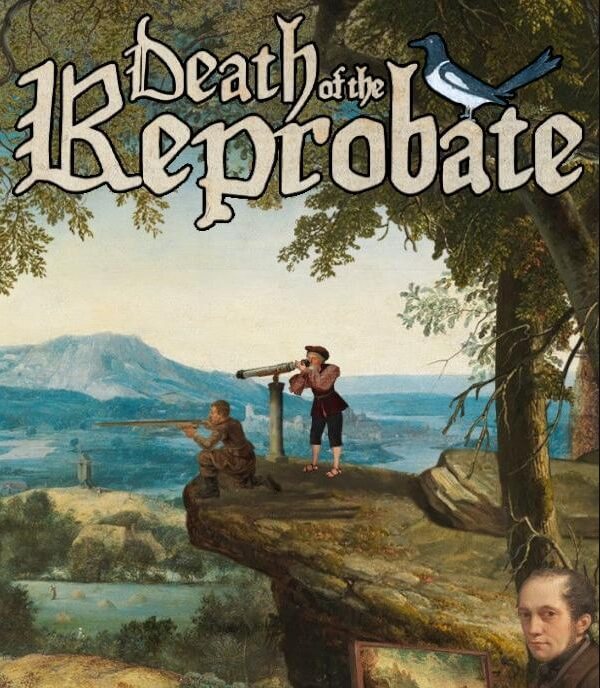
Following on from the absurd and amusing Procession To Calvary (2020), solo indie developer Joe Richardson launched the closer to his history adventure game trilogy with… this.
Death of the Reprobate arrived in November 2024, so we’ve been slow getting to it. But the silly sausage of a thing, riffing off Monty Python type humour, is a welcome release. Artistic, crude, daft, and funny, it’s a point-and-click well worth your time.
Silliness Galore in Death of the Reprobate
This is a game of highbrow buffoonery. Richardson uses a collage and cut-out animation style that Terry Gilliam made iconic in the Monty Python TV series.
As a process, it’s very similar to the show. Richardson can use old Medieval-era art pieces as they’re in the public domain, so he arranged them as he saw fit. All to tell the tale across the Renaissance, Rococo, and Romanticist eras.
The story is set in the same world as The Procession to Calvary and brings some of the characters back from that. You take control of a character who must meet the dying Immortal John, whom wishes to bestow onto thee his dying wish. Thus, you go around exploring meeting all sorts of Medieval weirdoes doing strange things. Hark!
Death of the Reprobate is about an hour and a half long (gameplay wise). It is a point-and-click style adventure game, really, but one where the emphasis is very much on daft humour and ridiculous shenanigans.
The good news? The game is funny! It’s a particular type of humour, we suppose, but it has laughs we particularly like and that’s fine by us. It’s funny, delivers on its concept in punchy fashion, and the relentless absurdity of it all appealed to us a great deal.
There are some puzzles and stuff, too, but why concern yourself with that? Just point and laugh at the stupid Middle Ages people. Hah. Hahahah!
How Eduardo Antonello Rerecorded a Bunch of 16th Century Music
Richardson has combined the three games into onto trilogy called the Immortal John Triptych. That’s just about to launch (as of August 2026), so maybe get that if you want all three in one. The full soundtrack has been made available by Akupara Games on its YouTube account.
In the first two games, Joe Richardson used public domain classical pieces to provide the score. For the trilogy closer, music was structured by Brasilian composer Eduardo Antonello. He designed the pieces to adapt as the story progresses, recorded by himself Medieval and Renaissance instruments. From his website:
“[He’s] a multi-instrumentalist with an emphasis on the repertoire from the 13th to the 18th centuries, Eduardo has a bachelor’s degree in harpsichord (2009) and a master’s degree in interpretative practices from the Federal University of Rio de Janeiro UFRJ (2012), and was awarded with scholarships for scientific initiation and a master’s degree under the guidance of prof. Dr. Marcelo Fagerlande.”
Antonello basically turned into a one-man orchestra for the game, but he noted in an interview:
“Early music allows for a great deal of freedom in improvisation and instrumentation. Very often, the scores are really just a skeleton or an outline of the piece, and it is up to us to bring that music to life.”
And he does that rather magnificently. It all adds a air of charming fun and games to what’s an absurd adventure, but one steeped in a sense of time and place.
