
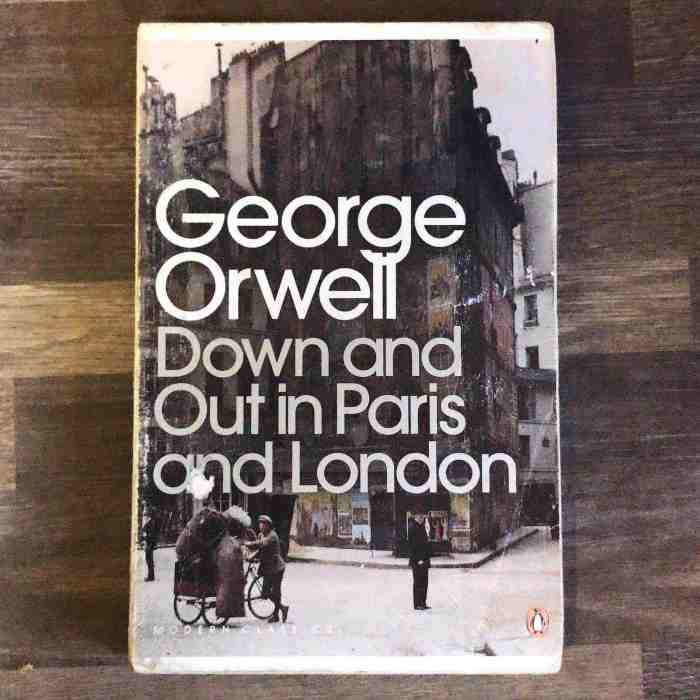
This is one of our all-time favourite books. We first read George Orwell’s Down and Out in Paris and London in late 2001.
Having grown up reading fantasy novels as a teenager, it was a revelatory moment. It showed us a new world of literature and the possibilities therein.
Whilst this certainly isn’t Orwell’s best book (not by a long shot), many readers would still say it’s their favourite of his. As it captures a sense of youthful idealism, pitching the reader back into a world of being hard up in your 20s.
We think that timeless qualities is why it resonates to this day, alongside its critique of capitalistic greed and trappings of low-paid workers in its system.
Social Criticism and Capitalist Critique in Down and Out in Paris and London
“All that is required of them is to be constantly on the run, and to put up with long hours and a stuffy atmosphere. They have no way of escaping from this life, for they cannot save a penny from their wages, and working from sixty to a hundred hours a week leaves them no time to train for anything else.”
To note, we love this book so much we did a podcast on it (see MoroniCast #15: Down and Out in Paris and London).
What is it about this book?
It’s one, over the last 15+ years, we’ve handed over to people to read. Usually people who don’t read much, have asked us for a suggestion, and this is the one we’ve flagged up. And they’ve almost always loved it (except for one former colleague).
We think that’s down to a few things:
- Its accessibility, not being laden down with excessively fancy language.
- Relatability through Orwell’s depictions of mundane working life.
- The dark humour inherent from working mundane jobs.
- A sense of youthful energy.
- Orwell’s compassion.
It all shines out from the pages, particularly in the wonderful first half of the book. Set in Paris, we meet the near penniless young Orwell. He’s in a knackered out hotel, he has little money, so he seeks out his Russian friend—the charismatic Boris.
These two form an unlikely partnership (a polite and reserved Brit alongside a garrulous, charismatic Russian).
And it is enormously relatable. That stage, for most of us anyway, in your early-late-twenties where getting into work is as hard as nails.
You push like crazy to land some basic role, dishwasher or otherwise, and it’s a goddamn nightmare competition just to land something like that. You blag, you hope for luck, you show enthusiasm, you get rejected for some weird reason, and you keep trying.
Although Orwell flirts with poverty, he and Boris eventually land work in a bustling hotel (Hotel X). And this where the work comes alive, with the writer’s documentation of what it takes to function in those hectic minimum wage roles.
“Hotel work is not particularly hard, but by its nature it comes in rushes and cannot be economised. You cannot, for instance, grill a steak two hours before it is wanted; you have to wait till the last moment, by which time a mass of other work has accumulated, and then do it all together, in frantic haste.”
Around these depictions of frantic hotel life in 1920s Paris (a wonderful time capsule in itself), we’ve got the social life Orwell depicts.
This leads to one of the most memorable chapters in the book.
Capturing Those Merry, Drunken Parisian Nights
“The queer thing about Fureux was that, though he was a Communist when sober, he turned violently patriotic when drunk. He started the evening with good Communist principles, but after four or fives litres he was a rampant Chauvinist, denouncing spies, challenging all foreigners to fight, and, if he was not prevented, throwing bottles.”
Whilst Orwell poses the book as autobiographical, we must factor in this is more semi-autobiographical than anything else.
He was out there in Paris leading a life in the 1920s, but whether or not Boris and the like ever existed we’ll never know. There’s a possibility Boris, for example, may be a composite character of many people Orwell knew around that time.
Regardless, Orwell captures lively scenes. Such as the drunken nights workers spend on Saturdays in a bistro at the bottom of Hotel de Trois Moineaux.
Although the chapter is drenched in wine and has a fun spirit about it, there’s some terribly poignant about these people getting wasted.
“For many men in the quarter, unmarried and with no future to think of, the weekly drinking-bout was the one thing that made life worth living.”
Orwell notes the few hours of drunkenness where they’re perfectly, wildly happy and the masters of their universe. And it’s brilliant, but also very sad.
As a chapter it encapsulates everything about the drudgery of the situation, trapped in low paying work and the only celebration is that occasional drunken escapade.
Down and Out as a Critique on Capitalism
There’s some confusion about George Orwell’s political stance. We’ve seen, for example, Daily Mail readers comment that the writer’s brilliant Nineteen-Eight Four (1949) is about “the lefties”.
Just to note, it isn’t. This is because Orwell was a democratic socialist.
Nor was it about the far-right, it’s a book conveying the dangers of any extremist government with fascistic tendencies.
That book is his most famous. One of those novels that most people will have on their bookshelf, probably they’ve read it, but will know little else about the author’s canon.
As if they did, they’d soon notice an incredible strong anti-capitalist streak in Orwell’s writing. Here and in other works, such as The Road to Wigan Pier (1936) and Keep the Aspidistra Flying (1936).
There’s a very powerful piece of prose at the end of the Parisian section of the work. What he wrote in the early 1930s still applies to this day, regarding haughty rich types.
“From this ignorance a superstitious fear of the mob results quite naturally. The educated man pictures a horde of submen, wanting only a day’s liberty to loot his house, burn his books, and set him to work minding a machine or sweeping out a lavatory. ‘Anything,’ he thinks, ‘any injustice, sooner than let that mob loose.’ He does not see that since there is no difference between the mass of rich and poor, there is no question of setting the mob loose. The mob is in fact loose now, and – in the shape of rich men – is using its power to set up enormous treadmills of boredom, such as ‘smart’ hotels.”
We’ve seen that non-stop from the UK government (the Conservatives) since 2010. Which has had devastating results through the Tory austerity policy following the 2008 recession.
This has led to much poverty across the nation, with over 10 million people now living from paycheque to paycheque.
Statistics from early 2023 in the US show the figure is over 60% of Americans face the same issues. That is not an economic system that works very well. No matter how many inane soundbites you throw at it to cover up capitalism’s failings (“if you’re poor, you should work harder” etc.).
And it has thrown light back on to Orwell’s various compassionate works.
Not just here in Down and Out in Paris and London, which in Parisian sections does have a more jovial tone to it. But then the London sections are pretty much stripped of that, presenting England’s horrible stance towards the homeless in all its glory.
Following on from this work there was then Road to Wigan Pier, so bleak in its depiction of working class life.
We did read Orwell’s Animal Farm at GCSE in 1998. As important as the work is, we do think it should have been accompanied by this. As it’s a magnificent, timely book with a strong message for societal equality.
One that’s been ignored in favour of mindless individualism over the last 15 years.
Down and Out’s Prescience and Relevance to Modern Life
There’s a lazy argument that because someone may have a Netflix account and a smartphone on subscription they’re overstating their poverty.
The argument against the left is no one is in poverty in the west, it may be “relative” poverty but it’s not on the level of third-world situations.
Yet if you can’t afford food or shelter, then that is poverty.
Food bank usage in the UK has skyrocketed over the last 13 years, coinciding with 13 years of hard-right Tory rule. In-work poverty is high, wages low, the cost of living at breaking point. Yet a lot of the population has no issue with that, instead complaining about immigrants and “the woke mob”.
It’s a confused situation and one born out of a media narrative.
Down and Out in Paris and London is a slight work in the face of all that’s unfolded on the political landscape in recent years. Yet within its pages, flawed structure to the chapters and all, is a pertinent message on how to run society properly.
It’s one the elites won’t get, too self-absorbed as they are with personal interests. And in their ignorance, they’ll never truly understand what they’re responsible for.
For those who are interested, read this book with an open mind. As it approaches its 100th anniversary, it’s never been more relevant.
