
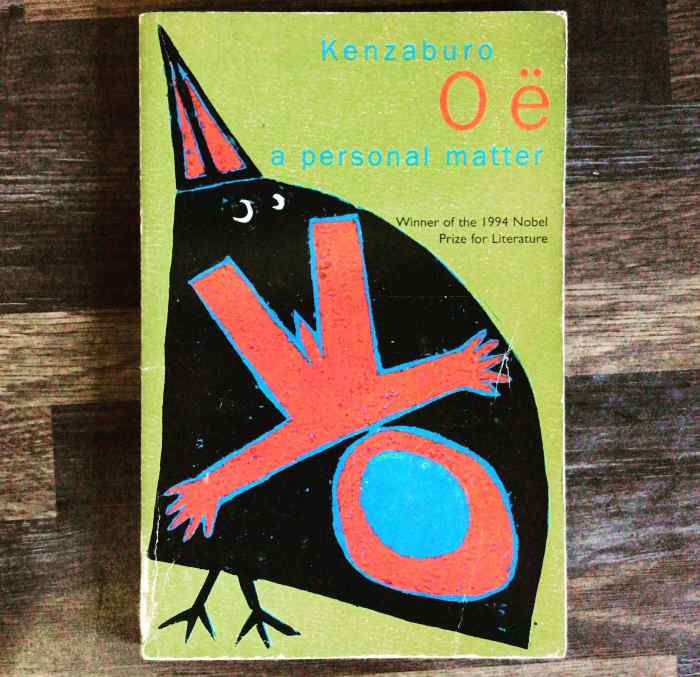
Here’s a 1964 novella from Nobel Prize winning writer Kenzaburō Ōe (1935-2023). He was a major presence in Japanese literature across the 20th century, covering topics such as politics, sociology, and philosophy.
A Personal Matter (個人的な体験—Kojinteki na taiken) was first published in English in 1968. It’s a semi-autobiographical tale and quite an unflinching one.
It’s the story of a young father who attempts to deal with the birth of a seriously disabled newborn son. Many existential themes abound in what remains a graphic but searing account on family life struggles.
Letting Go of the Past (and your dreams) in A Personal Matter
“More often than not he finds what he is looking for, and it destroys him.”
Just to note, but this isn’t a cheerful book you read on a casual basis. Its topics are very serious, treated that way, and the work is a consideration on how the central character deals with a traumatising situation.
The writer was influenced by the likes of Jean-Paul Sartre, whose 1945 novel The Age of Reason (opener to The Roads to Freedom trilogy) must surely have been a big influence on A Personal Matter.
Ōe centres the plot on Bird, who’s a 27-year-old Japanese professor working at a Japanese university. It’s the early 1960s.
Bird is ill at ease with his existence and he plans a potential trip to Africa, viewing the sweeping plains out there as potentially culturally, and personally, liberating. He’s quite repressed as a person, but hardy and conservative in his approach to many things.
This is likely to due his upbringing, which contained moments such as this:
“One day Bird had approached his father with this question; he was six years old: Father, where was I a hundred years before I was born? Where will I be a hundred years after I die? Father, what will happen to me when I die? Without a word, his young father had punched him in the mouth, broke two of his teeth and bloodied his face, and Bird forgot the fear of death.”
But his dreams are seemingly quashed when his son is born.
At hospital, a doctor informs him a large brain hernia is clear on his son’s head. Bird’s wife doesn’t know, at least to begin with, but he must immediately wrestle with the revelation and what it means for the rest of his life.
In fact, he feels a sense of shame having to tell his family and friends about what’s happened.
But his son isn’t expected to survive very long anyway. He attempts to do the doting husband bit:
“He was performing the role of the young husband who has been visited by sudden misfortune.”
But then Bird’s behaviour goes off the rails a bit. He has a sexual encounter with a friend called Himiko. He also gets drunk and has to attend university the next day heavily hungover—he promptly vomits mid-lecture.
Then he starts worrying about being fired.
His paranoia, self-doubt, concern over his ambitions, and more spiral him into a well of depression. He’s left to ruminate the following about his dilemma:
“You’re right about this being limited to me, it’s entirely a personal matter. But with some personal experiences that lead you way into a cave all by yourself, you must eventually come to a side tunnel or something opens on a truth that concerns not just yourself but everyone. And with that kind of experience at least the individual is rewarded for his suffering. Like Tom Sawyer! He had to suffer in a pitch-black cave, but at the same time he found his way out into the light he also found a bag of gold! But what I’m experiencing personally now is like digging a vertical mine shaft in isolation; it goes straight down to a hopeless depth and never opens on anybody else’s world. So I can sweat and suffer in that same dark cave and my personal experience won’t result in so much as a fragment of significance for anybody else. Hole-digging is all I’m doing, futile, shameful hole-digging; my Tom Sawyer is at the bottom of a desperately deep mine shaft and I wouldn’t be surprised if he went mad!”
The story gradually sees Bird take responsibility for his life, although often in unconstructive ways (he plans to indirectly kill the child).
A Personal Matter concludes with it apparent Bird understands what must be done. As in, he accepts a new sense of maturity and his family commitments.
All of which concludes what we found to be a riveting novella.
We first read this in 2014 and instantly became a big fan of Kenzaburō Ōe’s work, with his clear, crisp, and forceful writing style driving the narrative.
It’s certainly a difficult subject matter for some people to consider. Again, this isn’t breezy reading. There are very difficult themes being challenged here.
But the fact it’s handled in such accomplished fashion highlights the mark of Ōe as a writer. It took bravery and skill to write this, and consider some of the darkest concepts a human may well face, but from out of the other side there emerges an existential clarity.
Notes on Hikari Ōe
We must note the semi-autobiographical element of A Personal Matter.
Ōe’s son, Hikari, was born in 1963 with a brain hernia. After struggling to comprehend this reality, surgery eventually saved their son. But left him with learning difficulties.
Hikari Ōe is not a composer, but one who is autistic and developmentally disabled. He lacks physical coordination and says little.
Yet he could express himself through music, eventually being taught the basics in musical notation. He now largely composers chamber music, his first release selling over a million copies after its launch.
His father wrote the 1996 book A Healing Family about their life together, along with his wife Yukari.
Notes on Kenzaburō Ōe’s Literary Brilliance
Having sadly passed at age 88 in March 2023, readers are now left with his impressive body of work as some solace.
Along with being awarded the 1994 Nobel Prize in Literature, Ōe also won Japan’s prestigious Akutagawa Prize short story award for Shiiku (飼育) in 1958.
He began writing in 1957 and, as you can see from his Akutagawa win, rapidly rose up the ranks of Japanese literature as a top-tier national writer.
The Nobel society awarded his work was it showcased:
“An imagined world where life and myth condense to form a disconcerting picture of the human predicament today.”
Although in the 1960s his narratives were quite sexual in content, he eventually moved away from that to focus on topics at the fringes of society. He became an activist, campaigning against war and the use of nuclear weapons.
In his New York Times obituary Nobel Laureate and Critic of Postwar Japan it was noted he was:
“a Nobel laureate whose intense novels and defiant politics challenged a modern Japanese culture that he found morally vacant and dangerously tilted toward the same mind-set that led to catastrophe in World War II.”
Very sad news of his passing for his family, but his incredible body of work will remain for future generations to learn from.
