
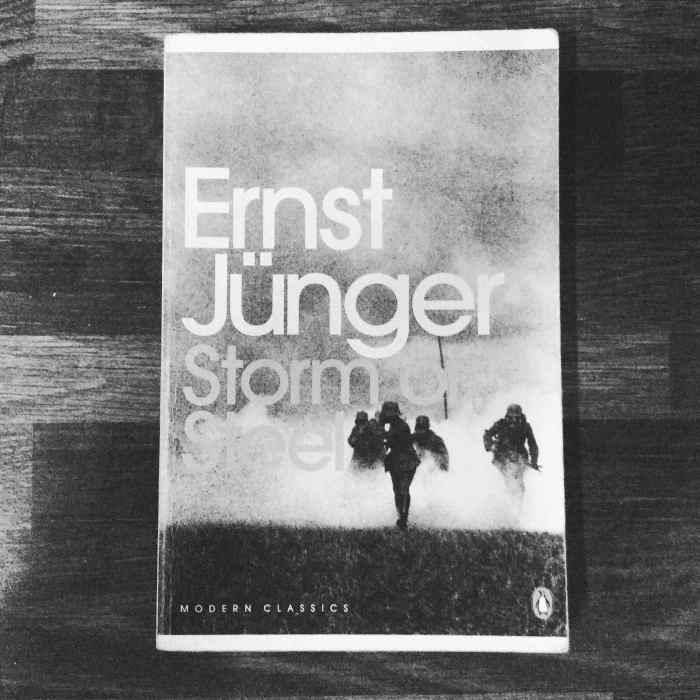
This World War I memoir was written by Ernst Jünger (1895-1998). Storm of Steel (In Stahlgewittern) was first published in 1920, making it one of the first accounts of wartime experiences available.
A powerful and shocking account of First World War horrors, it places readers in the trenches with the sounds of bullets whizzing past their heads.
The power of the work launched Jünger’s writing career, but the work is still of extreme interest. Unlike other works from the era, such as Remarque’s All Quiet on the Western Front, this work depicts war impartially. That’s without support, or condemnation, of what took place between 1914 and 1918.
Storm of Steel’s Stark Accounts of Warfare From the Trenches
“In war you learn your lessons, and they stay learned, but the tuition fees are high.”
This is an autobiographical story, beginning with Jünger’s arrival in Champagne with the 73rd Hanoverian Regiment.
He recalls his wounding in April 1915 at Les Éparges, which was where he first experienced a battle. Once he’s recovered, back into the action he goes. In the great tradition of WWI books (fiction or otherwise), the onslaught then begins.
Back in 1920, Storm of Steel must have felt like a landmark work.
In some respects, we can draw a parallel with works such as Alexander Solzhenitsyn’s One Day in the Life of Ivan Denisovich (1962). These classics of literature drew attention, for the whole world, the goings on during horrific events.
And Jünger reveals himself to be stoic in his consideration on the bloody events.
“Throughout the war, it was always my endeavour to view my opponent without animus and to form an opinion of him as a man on the basis of the courage he showed. I would always try and seek him out in combat and kill him and I expected nothing else from him. But never did I entertain mean thoughts of him. When prisoners fell into my hands, later on, I felt responsible for their safety and would always do everything in my power for them.”
Yet he did seem to revel in some of the carnage. It’s not really documented in many war books, but there must have been a certain thrill at times during combat. At least for some soldiers.
Our grandfather was a desert rat during WWII. After the war, he recounted to our parents how it was the best time of his life! A stark contrast to the many harrowing accounts of wartime life from most other combatants.
Jünger notes along these lines the following.
“Trench fighting is the bloodiest, wildest, most brutal of all … Of all the war’s exciting moments none is so powerful as the meeting of two storm troop leaders between narrow trench walls. There’s no mercy there, no going back, the blood speaks from a shrill cry of recognition that tears itself from one’s breast like a nightmare.”
Of his own potential violent death, Jünger clearly felt at ease with its possibility.
“I supposed I’d been hit in the heart, but the prospect of death neither hurt nor frightened me. As I fell, I saw the smooth, white pebbles in the muddy road; their arrangement made sense, it was as necessary as that of the stars, and certainly great wisdom was hidden in it. That concerned me and mattered more than the slaughter that was going on all round me.”
In Lindsey Fitzharris’ very moving The Facemaker (2022), she documents how many soldiers preferred to be killed outright in battle. That’s rather than face the many gruesome, lifechanging facial injuries soldiers had to endure.
But Jünger came through it all. He covers how his platoon was annihilated by the British at the village of Guillemont.
He was away, following another injury, so was spared death.
In 1917, he was present for the Battle of Arras and the Third Battle of Ypres. At further battles he was wounded again, this time with a bullet through the chest.
Jünger faced 14 significant wounds during the First World War.
He won the Wound Badge due to this. It’s really quite astonishing reading through this onslaught he had to face, which he recounts almost with a cheerful sense of in-your-face-death optimism.
Storm of Steel was first published in English from 1929, the same year All Quiet on the Western Front was released. These two classic works went on to face a very different fate in the decade ahead, although viewed in modern times they’re both just as striking.
But whilst Remarque’s book was so openly anti-war, you can view Storm of Steel either way—with a sense of pacifism or gung-ho, chest-beating nationalism.
Some critics have accused it of promoting heroic masculinity and glorifying war.
It’s an excellent book, but worth noting that distinction. As a certain political party leader in Germany during the 1930s favoured Jünger’s account of bravado and death in the name of the fatherland.
Nazi Germany Book Burnings and Storm of Steel’s Escape
In the early 1930s, the Nazis burned many books they considered to be liberal, Jewish, socialist, communist, progressive, or anti-war.
This led to All Quiet on the Western Front being banned in Germany and piled on bonfires. For posterity, some of these culture purges were caught on camera.
Storm of Steel received quite the opposite reaction and was spared.
However, this phase of history does always interest us. Other books to face naked flames included works by Karl Marx, Karl Kautsky, Albert Einstein, Helen Keller, Bertolt Brecht, August Bebel, and even Ernest Hemingway.
Basically, any work seen to be out of line with Nazism.
Ernst Jünger’s Post-War Career and Continued Divisive Nature
Jünger still causes debate over his political beliefs and intentions to this day.
He never outright aligned himself with Nazi ideologies, but he did approve of the invasion of France during WWII. He was even part of one of the forward units during the invasion.
But by others accounts we’ve read, he actively despised Hitler. He was eventually dismissed from the army in 1944 after implications linked him to the plot to kill Adolf Hitler.
When the war ended, he then courted controversy for his previous actions. Not helped as he continued to write provocatively during the Cold War.
As noted in Slate Magazine’s Ernst Jünger and the Nazis:
“His two collections of linked short essays, On the Marble Cliffs and The Adventurous Heart, are the easiest introduction to his literary talent and political vision. The talent is unquestionable. The vision is quite otherwise. But when he finally realized what Hitler had done in pursuit of the ideal of strength that he had himself cherished, even he was obliged to consider that his espousal of Darwin (the struggle for existence) and Nietzsche (the will to power) might have depended on some sort of liberal context for its rational expression. He died in 1998, his name much honored, with good reason, and much in dispute, for better reason.”
That commented is adapted from writer Clive James’ Cultural Amnesia: Necessary Memories from History and the Arts (2007).
In his Penguin Modern Classics edition we have, Michael Hoffman wrote in February 2003:
“He and Hitler did exchange signed copies of their books, but even that seems like a mismatch: My Struggle for Fire and Blood. There was always something aloof and solipsistic about Jünger – the word ‘aristocratic’ is often misapplied to him – that meant that as a soldier and a writer and even an ideologue he was in it for himself, and never quite, at that. He was never a novelist or a politician or a penseur [thinker], though with elements of all three.
An intriguing man, then. As Hoffman noted, Storm of Steel wasn’t a personal account. It was about the war.
Jünger’s unusual, sometimes vague, stance of life may have been problematic for others, but he never placed himself at the forefront of his situations. Even when, in the 1930s, sales of this book hit six figures and he was peak fame.
What did he do? Move to the countryside with his family for a quieter life. At least, until, WWII beckoned.

I have a copy of this book. Given to me by the managing editor of Penguin NZ, personally – he figured I should read it. It’s sitting next to my 1920s edition of ‘All Quiet on the Western Front’.
LikeLiked by 1 person
Wow, that’s amazing! And I’d keep that 1920s edition, it’ll be worth quite a lot by now I should think. Both excellent books, no doubt about it.
LikeLiked by 1 person