
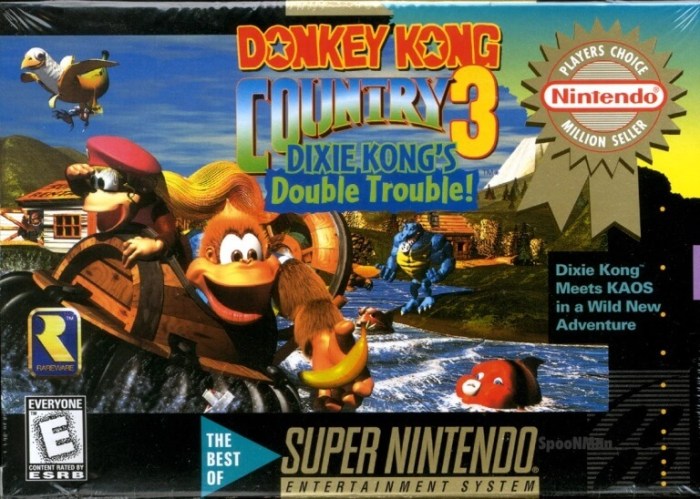
Wrapping up the Super Nintendo’s iconic DKC trilogy, in 1996 gamers got Donkey Kong Country 3: Dixie Kong’s Double Trouble.
You could argue this is the best entry in the series. As much as we love the game, we’d still say Donkey Kong Country 2 (1995) is the best of the lot.
But DKC 3 still has so much going for it. The game looks amazing, there are fun RPG elements, it’s packed with fun concepts, the game’s world is sprawling, and we want to celebrate all of that here.
Wrapping up the DKC Trilogy in Donkey Kong Country 3: Dixie Kong’s Double Trouble
Just a reminder that Donkey Kong Country (1994) launched in November. This became a habit for British developer Rare as they invested in a SNES trilogy.
Once again launching in November (the favoured month for the series), DCK 3 was also once again an impressive feat from British developer Rare.
Three iconic games in the space of three years.
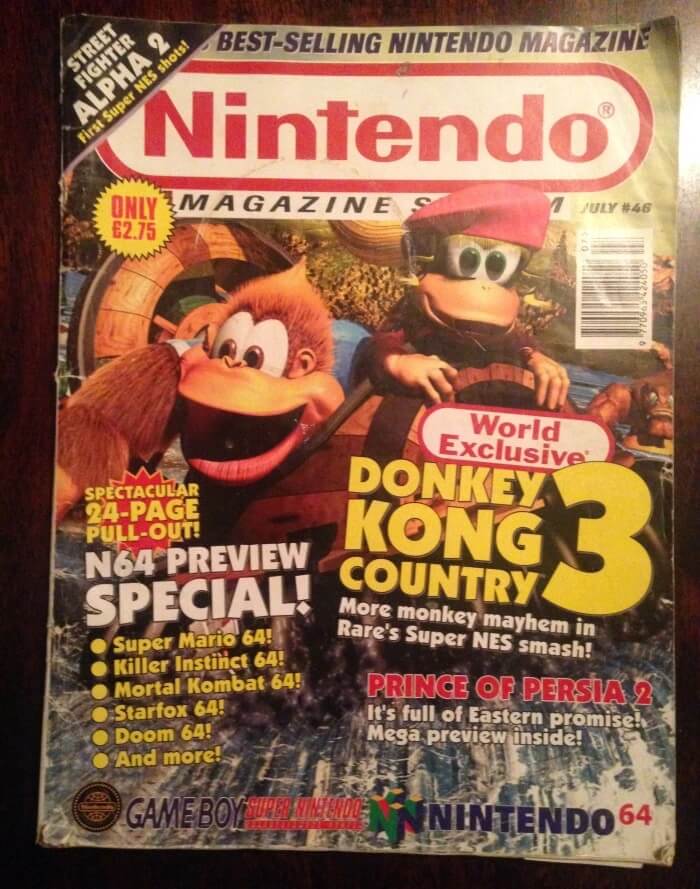
We became aware the trilogy closer was on the way thanks to issue #46 of Nintendo Magazine. Here’s the magazine cover (yes, we still have this from July 1996!).
This issue also reviewed the bizarre Mohawk’s Headphone Jack platformer, which was one of those Mario/Sonic clones that died an immediate death.
You can kind of see why when it’s a garbled mess and up against Nintendo’s genius and the might of Rare’s work.
Anyway, thanks to NMS we were aware DKC 3 was on the way and the hype was very real for it. Although we were (as dumb 11 year olds at the time) actually mulling over whether to “buy” the game when the Nintendo 64 was on the way.
We say “buy” as, naturally, our parents were going to get it us.
Eventually, our mother surprised us with it one wintery day in late 1996 and we rushed back to our bedroom to get on with the adventure! Lovely.
Straight off in level one, Lakeside Limbo, the game has a noticeably more relaxed pace than in Donkey Kong Country 2. The latter is furious in its rate.
DKC 3 is a much more relaxed introduction to the game, with a chance to get to grips with heffalump new boy Kiddy Kong.
The brief plot follows the same concept as DKC 2. In that, Donkey Kong was kidnapped. That left Diddy and Dixie Kong to go off and rescue him.
Here in DKC 3 it’s Diddy and Donkey Kong who’ve been kidnapped.
So, it means Dixie heads up this game all by herself! That’s the last time that happened, although she’s since appeared in the likes of DKC: Tropical Freeze.
We must say Kiddy Kong is a bit of a useless character, rarely do we bother switching to him. Dixie’s airborne ponytail antics make her much more effective on most levels, whereas Kiddy only comes in handy thanks to his gargantuan size.
You can chuck him up in the air to smash cracks in floors. He also, inexplicably, has the ability to skip himself across water like a skipping stone.
Anyway, with eight worlds and 48 levels to explore this game is big (for the SNES).
Cotton-Top Cove is one of our favourite worlds. By late 1996, some developers were reaching serious highs with the Super Nintendo’s technology. Squaresoft was one, if you see Super Mario RPG: Legend of the Seven Stars (1996) with its pre-rendered graphics.
But we’d say DKC 3 wins out on graphical prowess. Look at this thing! Waterfalls that immerse players into the scenery, a sense of grandeur to the stage, and one of the game’s best pieces of music.
Gameplay wise, we must note DKC 3 is still terrific. It’s a great platformer and an expansive game. Rare didn’t phone this one in, despite the SNES nearing the end, as this game is packed with content.
One of the interesting elements of Dixie Kong’s Double Trouble is the use of the Brothers Bear family. There’s 14 of them! And our favourite is Bazooka (a retired war veteran).
This lot trigger off an ongoing item quest in the game we enjoyed back in 1996. You have to take certain items to others and that opens up progress through DKC 3.
It seems a bit tacked on and short now, but back in our day (the non-internet era where you had to try and work stuff out yourself) it dragged for quite a while.
Plus, it was something a bit different. It does all lead to unveiling a hidden world and extra stages. And we must note this was a game we maxed 100% on back in 1996 (quite a rare goal of ours back then… and now, if we’re honest).
The gaming press in 1996 was impressed with DKC 3.
It gained solid reviews, usually around the 4/5 and 8/10 mark. Next Generation magazine gave it 3/5 (a bit harsh) for its 2016 retrospective review.
Back in 1996, NMS gave it a whopping 98%! That’s probably one of the most blatant attempts to get gamers to rush out and buy a game in the closing phases of a console’s lifespan.
The game went on to sell 3.5 million units worldwide.
But the truth was, the world had already seen what the Nintendo 64 was doing (it launched in Japan in 1996). Gamers were now more focussed on Nintendo’s big upcoming 3D platformer, so DKC 3 was there to pass a bit of time until the system launched.
Rare, we want you to know we still loved the game.
And IGN later ranked the game #35 on its list of best Super Nintendo games. And we think that’s an accurate tribute to the game’s qualities.
What Happened to the Music in Donkey Kong Country 3?
First off, there’s nothing wrong with the music in the third entry to the DKC trilogy. It’s still good—on some levels it’s very good. Right up with the other two games.
We always loved the Northern Kemisphere music, which plays as you move between worlds. That instantly casts us back to 1996 whenever we hear it.
We also like Mill Fever, for example, which has a funky pace to it.
As this was right at the end of the Super Nintendo’s lifespan, the overall production polish of the music is higher.
The soundtrack just sounds better than on the other two games. And that’s welcome given numbers such as Cascade Capers make for good listening.
However, overall the soundtrack just isn’t as outstanding as the first two instalments. Notably with DKC 2, where the music is just off the charts brilliant.
British composer David Wise (who created the first two games’ music) did work on bits of the soundtrack, but it was in stepped back form. We presume he was busy on upcoming N64 titles.
Instead, the music to Donkey Kong Country 3 was composer Eveline Fischer who took over most of the soundtrack. You can listen and hear she’s trying to capture what Wise was doing, and she does a fine job, but it’s not quite on the same level.
But then very few game composers are on David Wise’s level, so this isn’t to slight Fischer’s work here! We think most of it is very good.
We should note she also provided the voice for Joanna Dark in Rare’s 2000 FPS Perfect Dark on the N64. Lady of many talents!
Anyway, Donkey Kong Country 3 may lack the outright best soundtrack from the series.
But it’s definitely a highly polished overall experience and an impressive step up, only two years later, over the game that started it all in 1994.
