
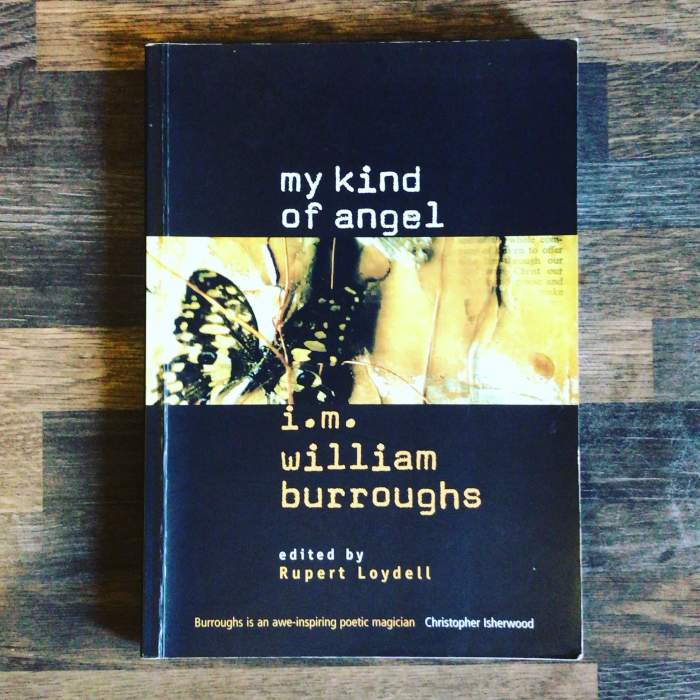
The author of Junky (1953) and enthusiastic US Beat Generation writer, My Kind of Angel i.m. is a look at the interviews and essays of William Burroughs (1914-1997).
He wrote 18 novels and novellas across his long career, along with six selection of short stories and four collections of essays. He was a busy bunny!
My Kind of Angel (1998) was edited by Rupert Loydell and makes for a unique tribute to the still influential Burroughs. Let’s have a gander at it.
The Postmodern Beats of My Kind of Angel i.m.
There’s the man in action. Very classic in that Beat Generation subculture style of sounding off in witty, scathing fashion.
As My Kind of Angel i.m. was published a year after Burrough’s, Loydell’s editing also includes poetry and prose pieces from other writers in tribute to the man.
It’s the type of book you dip in and out of, as you would with Mozart: A Life in Letters or A Concise History of Art—the contents include:
- Interviews from the mid-1970s and throughout the 1980s.
- Essays about Burroughs by Jim Burns, Michael Horovitz, Norman Jope, and Biba Kopf.
- Further contributions by all sorts of folks.
Burrough’s writing style utilised the cut-up technique (découpé), an aleatory literary style popularised by composer Pierre Boulez (1925-2016).
For more about aleatoricism, see Raymond Queaneau’s Exercises in Style.
Boulez classified it as “actions made by chance”, but for Burroughs it involved writing something, cutting it up into strips, and rearranging it to create new content.
Almost like it’s a take on Carl Jung’s notions of synchronicity—meaningful coincidences.
But also kind of like exquisite corpse, or other constrained writing techniques the French surrealists literary group Oulipo messed around with.
In 1975, Burroughs described his approach like this:
“It is simply applying to writing the old collage method that came into painting at the turn of the century. You see, this is really closer to the facts of perception than sequential narrative. Okay, you go out and walk around the city; come back and put down what you’ve seen on canvas… half a person cut in two by a car, parts of a street sign. So it is much closer to the facts of perception, certainly urban perception, than representational painting or sequential writing. Exactly the same thing applies to words.”
Burroughs work involved themes of free will and addiction. He does fall heavily into the addiction literature genre, which other Beat writers did (see Jack Kerouac’s Big Sur from 1962).
There are big dollops of satire in his work, which was very experimental and featured an unreliable narrator. Despite that, much of his work was semi-autobiographical.
Naked Lunch (1959), for example, is about the junky William Lee.
Burroughs was a heroin addict, so you can see what’s going on there. The worked is smacked out of its brains, although not quite on the level of Hunter S. Thompson’s Fear and Loathing in Las Vegas (1971).
We were obsessed with Jack Kerouac and the Beat Generation literary style circa 2010. But have since moved on a bit from it, being more interested in reading about tea, slippers, and sandwiches these days.
But My Kind of Angel is a reminder of why it piqued our 20 something selves.
The many contributions from other writers, all taken from the late 1990s, indicate the influence of Burroughs. Short works include The free and the they by Andy Brown, Scrying the Speculum by M.A. Duxbury-Hibbert, and Attempted Sentences by Alan Halsey.
Some of that lot is poetry and prose.
Others are excitable accounts of Burroughs’ rambling, ranting, debauchery-fuelled writing. From The Legend and His Own Lunchtime by Michael Horovitz (this one from Easter 1992):
“His oeuvre also has affinities with that of Francis Bacon (Bill’s old mate since 1957 in Dean’s bar, Tangier, where Bacon’s then boyfriend played piano): to wit – the savage, sometimes morbidly horrendous vision, cross-cut and scorched under lightning-flashes of caustic humour; flailing homoeroticism; ruthless destruction of failed experiments as of cliched successes; the welcoming – and later the highly conscious nurturing – of chance operations.”
All of which makes My Kind of Angel an interesting read.
Burroughs was eccentric (to put it mildly). He had a preoccupation with magic and the occult. He believed in a “magical universe” and said:
“In the magical universe there are no coincidences and there are no accidents. Nothing happens unless someone wills it to happen. The dogma of science is that the will cannot possibly affect external forces, and I think that’s just ridiculous. It’s as bad as the church. My viewpoint is the exact contrary of the scientific viewpoint. I believe that if you run into somebody in the street it’s for a reason.”
Burroughs was also involved in a bizarre fatal accident with Joan Vollmer. She was 28 and an influential part of the early Beat Generation.
She was also Burrough’s common-law wife.
On September 6th, 1951, in New Mexico, they were drunk and out of it on drugs. The pair decided to play a game of William Tell (shooting an apple off someone’s head) and, predictably, this ended with Vollmer getting shot in the head.
This was eventually ruled culpable homicide, with a lot of confirmed bribing going on to rule the gun went off by accident.
Burrough’s attorney eventually fled the area due to his own legal troubles. In response to that, Burroughs fled to the US and was convicted in absentia (a two-year suspended sentence).
Indeed. Everything seemed a bit more crazy in the Fifties, didn’t it?
