
After our look at A. Wainwright’s Pictorial Guide to the Lakeland Fells series, now this one is a little bit closer to home.
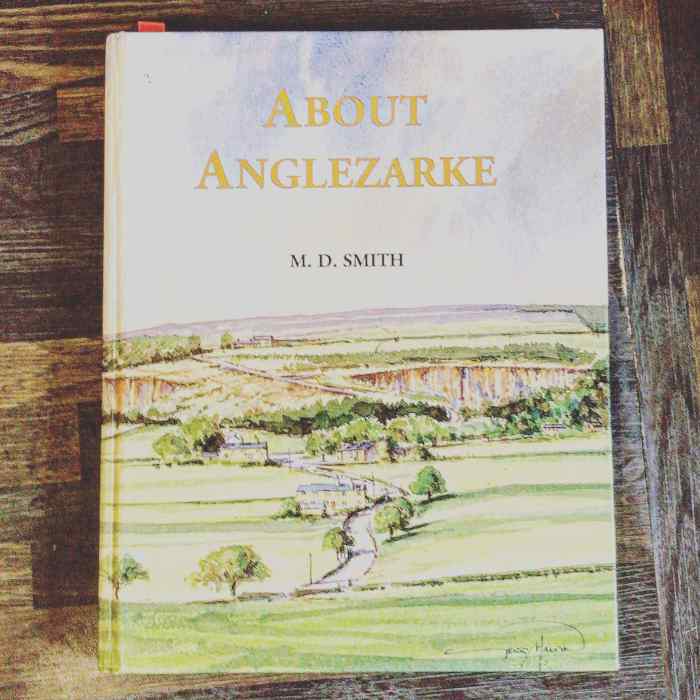
Showcasing the historic views of Rivington of Lancashire, M. D. Smith’s About Anglezarke (2002) covers the history of this idyllic region.
We’re very lucky indeed to have grown up in this area during the ’80s and ’90s. It’s something of a halo for introverts, offering commanding views and plenty of walking routes for you folks in need of a stroll.
About Anglezarke and the Historic History of the Hills
The Anglezarke region doesn’t get much attention in the UK. It’s kind of an ignored secluded spot, with the Lake District bagging most of the countryside press. Boo! Hiss!
In this concise little area of there are notable spots such as Adlington (Aggy), Belmont, Heath Charnock, Rivington, and White Coppice.
It’s all nestled in the Lancashire county, which you may have heard of thanks to that Beatles song (“Ten thousand holes in Blackburn, Lancashire”). The book covers these little villages within the Borough of Chorley.
M. D. Smith lives nearby (as a reliable source informed us) and he notes in his introduction:
“Recording details of local history requires assistance from, basically, anyone who will take the time and trouble to become involved … Some of the photographs loaned to me for publication are extremely rare and much of the documentation has not previously been seen. Together they form the story of our heritage over the last one hundred years or so.”
The front cover of the book showcases Nickleton Brow, Heath Charnock, with its swooping, snake-like road through into Rivington. There’s a restaurant called The Yew Tree drawn on the mid-right, which is still open to this day.
It used to be a pub called The Frozen Mop and has been standing there since at least 1880.
Over 14 chapters the book showcases such history with carefully collected and curated pictures of the area. Rivington and its spectacular views plays a big part of that.
The village has a low population count of 109 people, but it’s close to Adlington and Chorley—folks there flock to the area for chillout time.
That includes boy racers who think they’re the next David Coulthard, flooring it through the various twists and turns (and regularly crashing).
Smith’s work documents all these areas with historic photos, which mean a great deal for people in the area. But also form a historic account of Lancashire life for anyone curious enough to delve into.
Fascinating stuff, then, and well worth us showcasing a few of the highlights of this region. As if you fancy a relaxed time of it, Rivington is the place to visit for a walking holiday.
All Hail, Rivington Pike
Central to the region is Rivington Pike. Basically, it’s a massive slab of land on Winter Hill. It’s a local landmark as, right on its peak, there’s Pike Tower.
The Pike was used as a beacon system as far back as 1139 put in place by Ranulph de Blundeville, 4th Earl of Chester. This was eventually used to warn Elizabethan England of the invading Spanish Armada on 19th July, 1588.
The Tower was built in 1733 by John Andrews (he lived in Rivington Hall). Initially it was a hunting lodge adapted from the stones left over from the beacon.
These days it’s just a kind of landmark.
You can make out Pike Tower from quite the distance, whether you’re in Chorley for some Chorley cakes or in Bolton to rob a convenience store. It’s there off in the distance and reaching it signals the successful end to your walk. Congratulations!
Be noted, if you do plan to walk all the way up the end bit is bloody steep. Once you’re up there? Commanding views of most excellent Lancashire, with Manchester, Blackpool, and the Welsh hills off in the distance.
Yes, it’s also very windy up there. If you’re wearing a hat, be sure to clutch on to it with all your might.
You’ll also note Winter Hill’s transmitting station.
It’s a giant mast sticking up in the air lit up by red lights at night. The thing is a broadcasting and telecommunications site that stands at some 450 feet. If you walk up to the thing, which you can after a trek over moorland, it sways around in the wind.
We couldn’t find a specific date for its construction, but it appears to have gone up in the mid-1950s.
Exploring Rivington Terraced Gardens
On the long, arduous climb up to Rivington Pike there’s an incredible maze-like selection of pathways. Anyone is free to visit this historic hill—see Rivington Terraced Gardens.
A businessman who made his name in soap created all of that.
He was Lord Leverhulme (William Hesketh Lever), 1st Viscount Leverhulme FRGS FRIBA (1851-1925). As the official site notes:
“Lord Leverhulme, the soap magnate and founder of Lever Brothers (now Unilever), conceived and built the Terraced Gardens with the help of Thomas Mawson between 1905 and 1925. After his death, and subsequent sale of the property in 1925, the gardens began to fall into disrepair. The houses were demolished after World War II, and Rivington Terraced Gardens were left to the forces of nature.
60 years later, United Utilities owns the land, and the Rivington Heritage Trust repair and conservation project is underway.
As the project progresses and more of the shrubs, self-seeded trees and mud are cleared away, the original shape of Lord Leverhulme’s garden is more visible. New paths are being discovered, new stairways uncovered, and visitors to the gardens are beginning to see how it once might have been.”
Thanks to recent efforts, the Japanese gardens have been restored to a good standard. When we were growing up here in the late ’80s and 1990s, they had fallen into disrepair and you couldn’t make much of it.
Now you can waltz around and make out quite a lot of details.
To note, the first picture there is of the Pigeon Tower. This is also iconic to the region and something we’ll comment about… now!
Don’t Forget the Pigeon Tower
The Pigeon Tower stands tall and proud near to Rivington Pike.
However, you can’t just walk into it. This video is a very rare, super special occasion allowing visitors to do so. We guess there was some special event on.
Normally you can walk up to it and have a look at the structure, but you can’t go inside (unless you decide to break in, which we advise you don’t).
There’s a tonne of info on this photogenic bit here: The Pigeon Tower.
“Originally called the Lookout Tower, then the Dovecote Tower, the Pigeon Tower as it is now known was built between 1905 and 1909.
Thomas Mawson, the designer/landscape architect of the Gardens, liked to create a tall focal point in many of his landscapes, and the Italian Garden section of Rivington Terraced Gardens was no exception.
The iconic tower was commissioned and erected by Lever as a birthday present to his wife, Elizabeth Ellen.
It has four floors connected by a narrow winding stone staircase. The top floor housed a small sitting room with a fireplace and chimney. This upper room is believed to have been fitted with sewing equipment and musical instruments for Elizabeth Ellen’s entertainment.”
Again, it’s all part of the rich history of Rivington. If you’re suitably intrigued, you have two options:
- Visit the area and take in the sights.
- Get About Anglezarke and read up about the place.
Or have a tour around online to find out more. Up to you. Do the lazy thing and head to the Lake District if you want… just remember that Rivington is OUR LITTLE SECRET and you can head out here for larks, too.
