
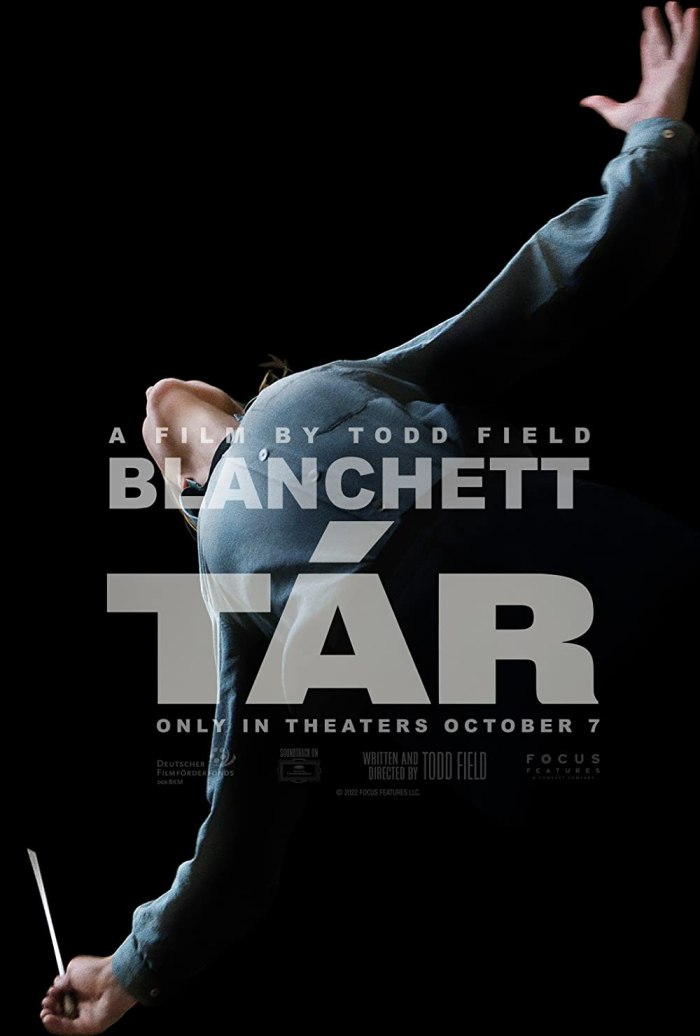
Tár (2022) is a psychological drama starring Cate Blanchett. Written and directed by Todd Field, it was a divisive film that stirred up political debate regarding “cancel culture”.
It offers a complex and intriguing character study of a highly accomplished woman, but one whose personality defects ruin the lives of those around her (including, eventually her own).
Controlling Time and the Nature of Domination in Tár
As an aside to start things off, the title of Tár makes us think of talking like a Northerner. One of our favourites saying from the North Wes of England is “ta very much”, which we reel off a lot online (probably confusing non-locals in the process).
But this film isn’t about that (sadly).
It’s about the fictitious composer Lydia Tár (played in magnificent style by Cate Blanchett). And be warned… spoilers are ahead.
The film begins with a live talk. Chief conductor Lydia Tár (Blanchett) of the Berlin Philharmonic is present promoting her upcoming book Tár on Tár, alongside discussing her career (the journalist interviewing her is Adam Gopnik, a real New Yorker reporter).
She’s wildly accomplished and successful.
And she’s working on the magnum opus for her career, which is a production of Mahler Fifth Symphony.
Running around managing her working affairs is her assistant Francesca Lentini (Noémie Merlant). Tár is also married to concertmaster Sharon Goodnow (Nina Hoss).
Tár is on the hunt for a new cello position in Berlin and trials begin.
Naturally, we get to see some scenes of her at work. She’s passionate, committed to her craft, and bloody brilliant (again, maximum credit to Blanchett on this performance).
After this it becomes she’s not exactly faithful to her wife, with hints she’s likely to favour attractive young musicians.
In what turns out to be the arguably the film’s most notable scene, Tár lectures some music students as a one-off. There she does her thing—waxing lyrical in often arrogant fashion until she insults the nervous leg thumping student Max (Zethphan Smith-Gneist).
Just to note on a technical front, Field was able to film that whole scene in one unbroken take (showing off how professional these productions are!).
Not long after the above, Tár discovers her former young student Krista Taylor (Sylvia Flote) has committed suicide.
That follows on from the composer blacklisting Taylor from her orchestra, although the reason why isn’t established.
From this point on, about an hour into the film, Tár faces an escalating series of stressors as her personal and working life start to fall apart.
What appears to be hallucinations start. Potentially. It’s not clear if she’s losing her mind or if she’s genuinely being haunted.
There are a few scenes in which you can see the ghost of Krista Taylor eerily hanging around in the background.
Whether the film genuinely means Tár is being haunted, she’s losing it big time (or both) is open to interpretation.
The film does open up interesting debate on “cancel culture”.
As we saw one person comment on YouTube (amongst all the people complaining about the woke mob), removing people who abuse their power opens the door for equally talented people to take their place.
Ones who have the opportunity to do their thing without abusing their power.
For us, we don’t think there’s much to debate. It’s apparent Tár is an unpleasant individual and she does get her comeuppance. Her callous behaviour results in the loss of her status. But this is where the film’s intriguing ending has caused further debate.
We actively see her choose the cellist Olga Metkina (Sophie Kauer) over other more competent candidates for her orchestra. Simply as she finds Metkina attractive.
It later emerges Tár’s first name is Linda.
She has a brother, who appears to resent her due to this double life she’s leading. This revelation highlights the composer has kind of fabricated her existence, manipulating people into believing she’s something she isn’t.
She moves to the Philippines to continue composing, but it emerges this is for a popular video game. And far removed from the lofty pretentions of her perfect Mahler Fifth Symphony production.
It’s a peculiar ending. We found it quite absurd at first, but we guess that’s the point. And we think you can read it in a couple of ways:
- Due to cancel culture, Tár has been forced away from great work and can now only function as a “mere” video game music conductor for geeks in cosplay.
- This manipulative individual, after only six months, has worked her way back into a lofty position and will continue her façade unaffected.
From these final scenes it’s clear Tár has no real issue with making the transition from Mahler to this cosplay event in the gaming industry.
Hinting that everything is, indeed, a façade with her.
Everything before this, her book Tár on Tár (with that pretentious title), the Mahler project, didn’t really mean much to her after all. It was more about status, power, and whatever bullshitting she needed to do to maintain those.
She’s a control freak. And her line of work expresses this personality flaw as she dictates time and dominates through that. At least, that’s our take on it.
The alternative is this film proves THE WOKE MOB has ruined society and ensured a film like this can’t be made because of feminism etc.
Away from that, we do think this is an often great film. It’s certainly a slow burner and can be plodding at times, but the performances make it worthwhile.
Central to that is Cate Blanchett.
Her brilliance is well know at this point, so it’s no surprise this is just another outstanding performance from her. She carries the film and makes it what it is—an intriguing character study of a subtly monstrous individual.
Some have argued why, in the aftermath of the #MeToo movement, it had to be a woman depicted instead of a man.
Whatever you make of that debate, Lydia Tár is now a modern day Nurse Ratched from One Flew Over the Cuckoo’s Nest (1975). The film isn’t an all-time classic on that level, but its depiction of this troubling individual offers a lot of fascination.
The Production of Tár
Despite its critical fervour and debate between film fans, the film wasn’t a huge hit. Off its $25 million budget it returned $29.2 million.
Todd Field directed and wrote the screenplay, which he did with Blanchett specifically in mind. He’s even said he wouldn’t have made this film if she had rejected the script.
The film was shot in Berlin during August 2021.
Actors across the film, which included real life musicians/actors such as Sophie Kauer, performed their pieces live on set. This was the case across the whole film—what you hear was performed on set.
Kauer didn’t have any acting experience before this. To prep for the role she watched clips of Michael Caine on YouTube! Well, it worked out fine.
Cate Blanchett isn’t a musician, but she did once play the piano.
For the role she learned to do that all over again, plus she had orchestral conducting lessons to get all the mannerisms right. Help for that came from Hungarian pianist and professor Emese Virág.
She also learned how to speak German.
After that, to get a heavily intellectualised way of talking down, she listened to recordings of Susan Suntag. As there are weighty scenes of long dialogue, where Tár just goes off on one.
It paid off as she’s incredible in the film.
Despite the lack of commercial success, it was nominated for six Oscars (including Best Picture and Best Actress). But it didn’t win any, sadly for the cast and crew.
Still, we’d say it was one of the best major film releases of 2022. Even if it did throw up a bunch of controversy to go with it.
