
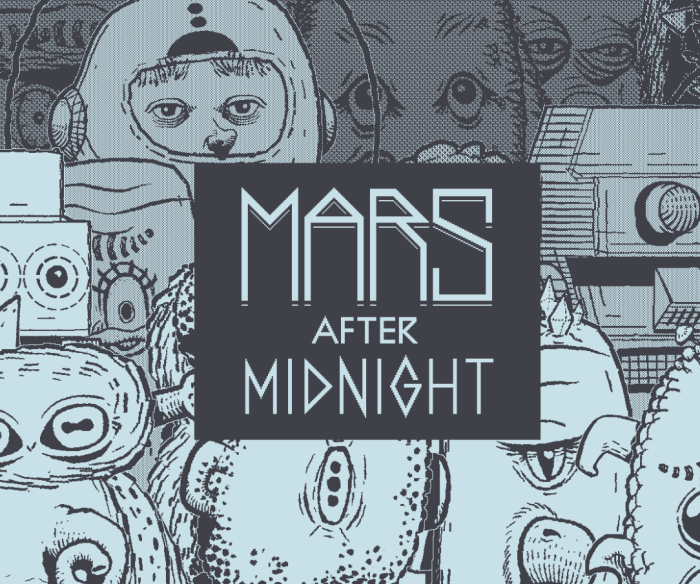
Here’s the very first Playdate game we played! Mars After Midnight is from indie game legend Lucas Pope, the man responsible for the likes of the highly inventive The Return of Obra Dinn (2018).
It’s a fantastic coup for Playdate as his latest project is an exclusive for the handheld. And this is a marvel of a game—funny, weird, wonderful, and so much more.
What’s it about? An Off-Colony Community Support Centre simulator for a bunch of aliens that starts at 1am. We can dig that.
Entrant-Screen Support Sessions for Aliens in Mars After Midnight
As the player, you run a support group that begins in the early morning. You have to pick what sessions to offer local aliens, such as Cyclops Anger Management and various other things.
You need to promote each session during the day by putting up posters. Plus, you need to pick a tasty snack for the night for your attendees to enjoy.
Once you’ve set that all up, you act as the doorman. Aliens knock on the door, you have to screen them, decide whether to let them in, and clear up their dining experience (if you do let them in).
Every time they eat the bastards make a hell of a mess, so you need to sweep everything up super fast before other arrivals crop up.
Intrigued? Well, here are the first seven minutes in action.
To help improve your community support, you can buy stuff such as a translation box (the Blab-o-Dex). This helps you work out what aliens are saying.
That’s vital, as you can use its translations to work out if the aliens are actually invited. Or just there to try and cadge some free cake.
All this stuff is similar in theme to Lucas Pope’s famous Papers Please (2013) where players must screen individuals before they can enter a totalitarian state.
Mars After Midnight is much more silly and offbeat than Papers, Please, which is quite the nerve-wracking experience. Instead, here you’ve got a lovable sci-fi sim that doesn’t take itself very seriously.
There’s about three hours of gameplay. Plus, you get a fantastic and crisp visual style alongside a brilliant retro styled soundtrack that works itself into your brain.
Although the looping support sessions may feel a little repetitive from time to time, there are enough fun little embellishments to the experience to make it one of the best Playdate games.
Mars After Midnight’s Use of THE CRANK!
Behold above the might of THE CRANK!
Okay, so a big (and super epic, like) gimmick with the Playdate is its crank. It’s not super essential to the Mars After Midnight Experience, but its use shakes up proceedings in fun and inventive ways.
Although it’s not a gesture-based game, it does have that feel about it.
You have to clock in for your shift, for example, which requires you to jam in your slot card to a machine. There are a lot of satisfying crunchy moments like that with this title and the Playdate’s retro two button feel.
Retro Gaming Bloops and Bleeps—The Fantastic Sound Design to Mars After Midnight
There’s a rather good retro soundtrack to go with Mars After Midnight. It gets into your skull and you feel the urge to listen to.
All very Game Boy, but with modern flourishes. We’re digging it!
A Few of Lucas Pope’s Intriguing Dev Notes on Mars After Midnight
Over on this Itch.io account, Pope ran a dev log for Mars After Midnight.
He provided extensive dev log notes about creating the game. We get the impression it was a fun and engaging experience for him, the technology of the Playdate offering a much different type of experience.
“The Playdate is a lot of fun to work with — fantastic 1-bit Sharp screen, novel crank input, simple development API, and great support from Panic.
I puttered around trying to find a good concept that I felt worked well with the hardware and this is basically where I ended up. Unlike most of my dire last few games I’m gonna try to make this one a little more light-hearted. Something my kids might like.
Right now the concept is still pretty thin. Think Papers Please, -lite, with no border checkpoint, no desk, no paperwork, on Mars. Actually maybe don’t think that. I only have the elements of a game and not the full thing yet, so things are still pretty open-ended.”
One of the reasons for making the game was to entertain his kids. Particularly with the designs of the aliens and their expressive, weird faces.
Notes on the Face Generator

Pope provided a full face generator update in 2023 (you can also refer to making martian faces if you fancy a few more creative details), which has loads of details about how game development works.
Of the aliens, when you’re screen these dudes prior to the support sessions, you really get a good look at their peculiar mugs.
To make them, Pope did the following!
“The face generator is written in Python but in a C-like style that could potentially port to full C. The idea was to eventually move the code to run on-device and generate an infinite number of faces at runtime.
As the game design solidified I realized this runtime generation wasn’t going to happen. For one, it’s not really necessary: I can generate thousands of faces offline and just include them in the game — each face is just a few kb.
Second, the face generator is not quick. Part of the problem is Python’s leisurely pace but even with conversion to C and heavy optimizations it’d never be as quick as loading a small PNG on-device.”
All these intricate details highlight how difficult game development. How time-consuming. They go to all this effort for people’s entertainment and we find it quite the marvel.
Synthesising Martian Speech
In Mars After Midnight, you have to decode alien speech. This is important during pre-support session screenings. They say stuff like that dude above.
Once again, Pope provided fantastic and detailed insights into this. Check out his dev log: synthesizing martian speech.
“Before there were neural networks and machine learnings to do all our computer talking, speech was generally synthesized by modeling the vocal cords and resonant cavities of the mouth. There’s decades of research into this and probably the most well-known classic example is SAM the Software Automatic Mouth from the early 80’s.”
The example on his page will be familiar to all of us. Stephen Hawking used it with his speech-generating device after his ALS progressed.
However, now we have speech synth systems. Pope would announce vowels into the system, before adding crossfading them for an AHYEEYAH sound. However, this didn’t work! So, the plucky developer created some code to transform the voice.
“In-game, the vowel synth keeps track of which formant sets are used in a word, and the game logic can query which one is currently playing. The full voiced list of aeioumr is reduced down to aom for the mouth frame selection. Add a little shake and bob’s your uncle.”
The fantastic amount of effort he went in to here is highly commendable. Not least with the Blab-o-Dex translation device, which turns the alien’s distorted gurgling into understandable English.
Pope has also uploaded sound design processes to his YouTube channel.
It’s quite uncommon to see a dev go to this much detail with their creative process, but we’re doffing our old man caps to him on this one.
Great game. Maximum effort. Ingenuity overload.
