
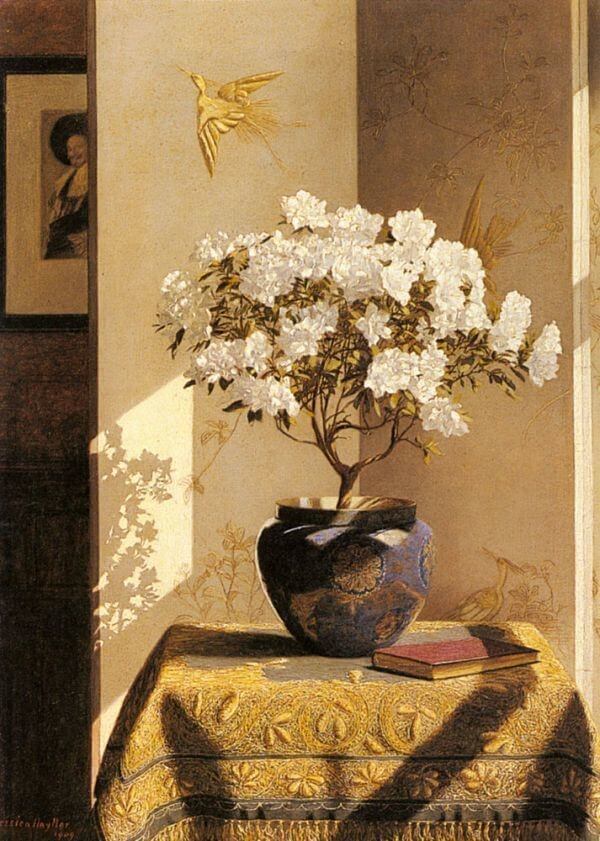
Back in the good old days when women weren’t allowed to vote, a female British artist painted the rather glorious A Sunny Corner.
We discovered this one recently thanks to Art Infinitus on Instagram (see, social media does have some uses outside of the usual egomania and trolling). It’s bloody stunning. Thus, we did our usual thing of going off to explore Jessica Hayllar’s life and anything else about this work.
Notes on A Sunny Corner
There aren’t too many details about this piece. It’s an oil on board number and was completed n 1909. What we like about it is the photographic, peaceful quality it exudes.
You get the sense all was quiet as she painted it.
For all we know she lived next to a steam train track and all hell was breaking loose, but the artist does promote a sense of tranquillity and simplicity. You can see that in other artists’ work, not least with Vincent van Gogh’s iconic works. He also busied himself painting warped landscapes and skulls smoking cigarettes.
Most of Hayllar’s works seem preoccupied with indoor environments, lots of portraits, casual moments socialising, and many flowers. Essentially, she (whether knowingly or otherwise) documented for posterity middle-class Victorian country life. See this one called All Better Now (1896).

The vast majority of her work is very classical and of its time, which is a polite way of us saying we don’t find much of her work overly interesting.
However, the modernistic appeal of A Sunny Corner is there.
It’s curious that, over 100 years later, out of all her works there’s this one painting that really stood out for us. As the other pictures of flowers she completed don’t quite hold the same resonance.
As we found, this is most likely due to not having much choice. The stifling lifestyle conditions for women in that era curtailed many other insprational opportunities.
A Bit About Jessica Hayllar
Jessica Ellen Hayllar (1858-1940) was from London and the eldest daughter of some nine children. From an artistic family, she and her four other sisters took classes—it was Jessica who emerged as the all-conquering, Queen Hayllar prodigy.
She eventually had exhibitions at the Royal Academy in London and the Royal Manchester Institution.
Despite this relative success, art history biographer Christopher Wood noted in The Artistic Family Hayllar (1974) they were “talented amateurs”. Even more modern takes view the canon as portraying themes of patriarchy and imperialism and how women were often confined indoors.
That, sadly, does come across in Hayllar’s work. Why are the paintings always set indoors!?
The fact she was “allowed” to paint is a positive, showing that some social progress was on the way. As opposed to the usual crushing expectations of the time for women to bear children, cook, and mother.
Happily, within her lifetime we had the likes of Georgia O’Keefe’s abstractions and Hilma af Klint’s cosmic angles emerging as forces of nature and revolutionary.

They let females in the fine arts out of doors these days, but we are followed and smacked down each time an audience of viewers or listeners begins to gather.
LikeLiked by 1 person
That’s cool. We don’t have doors in England, just huge open spaces.
LikeLiked by 1 person
In your heads??
LikeLike
You’ve just about made my day with the beautiful art PM. So beautiful. Klimt is one of my favorite artists with is surrealism! Have a lovely day over there.
LikeLiked by 1 person
Yeah, it’s a most striking flower portrait, no? Klimt is also a legend no doubts.
However, I refuse to have a lovely day. I’ll have a LOUSY day, just to spite you. 🌻
LikeLiked by 1 person
Very well then, I’ll have a crappy day too. That will show you! 🤨🦖
LikeLiked by 1 person
One respects one’s decision and one wishes one the best in one’s endeavour.
LikeLiked by 1 person
Indeed. Same To ya.
LikeLiked by 1 person