

For a while we thought the genius of Wassily Kandinsky (1866-1944) was our ultimate artistic dream.
Then we discovered the work of Swedish artist Hilma af Klint (1862-1944). As we’ve delved deeper into her work, she’s come to be an outright favourite artist of ours. An incredible genius visionary, she was aware her work was way ahead of its time, unfit for public consumption, and hidden away from prying eyes for decades after her death.
Now, in 2025, we think the world needs this stuff more than you could ever believe. Thus, onward to embrace and enjoy the abstract world. 🟨
A Spiritual Force of Nature in Hilma af Klint: Visionary
Hilma af Klint: Visionary (2020) came about from talks held at Guggenheim Museum, alongside a major exhibition of the artist’s work over 100 years after they were created in private and seen by barely anyone.
This work contains some intriguing essays, life details on the artist, and those glorious paintings. The essays consider Klint’s work and personality, considering her spiritual leanings and immense creative energy.
“Hilma af Klint’s evolution as a painter of abstract works starts in 1906. She is forty-four years old. She lives in Stockholm, and shares an art studio in the artistic centre of Sweden’s capital. She is unmarried and has no intention of changing this.
For decades she has listened to voices and seen visions. Now she starts with a series of notebook sketches. Next, she transfers them to canvas. This first series she titles Primodial Chaos and she restricts herself to the colours blue, yellow, and green. In the years to come she will stick to painting in series. She will create a large body of work – some abstract, some figurative, a lot a mixture of the two …
Thus, long before Kandinsky, Kupa, Malevich, or Mondrian declared themselves the inventors of abstraction, af Klint was creating abstract paintings in her Stockholm studio – first in small format, then on a monumental scale. All these series together she calls Paintings for the Temple. There are 193 and hey were finished in 1915.”
We’re not artists, but we know the creative process. When you’re really into something you commit to it and it becomes a way of life, rather than a hobby. This writing lark is our particular thing.
For af Klint, we’re on about someone with a startling ability to create works like this (to note, we can’t publish pictures of her work due to copyright… just so you know!).
As for her more conventional work, the naturalistic stuff is in line with the artistic expectations and norms of her era. Basically, lots of landscape paintings and the like. Very good, but nothing distinctive.
Genius is overused as a term, but Klint certainly fits the romanticised vision of a rogue intellectual keeping her real prowess hidden.
Whilst painting her conventional pieces, she was hard at work crafting over 1,200 abstract visions.
It’s intriguing to consider why, for 100 years, she wasn’t classed as one of the 20th century’s great artists. Someone up there with Georgia O’Keefe’s work or whatnot. To understand that, Visionary explores her life and times.
The Voices and Visions Behind Klint’s Work
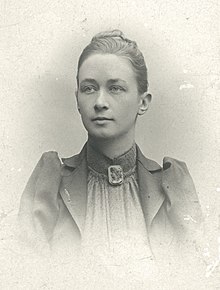
There she is, looking content and unassuming (picture published in 1901, but likely taken around 1895).
Born in 1862 as the fourth child of the Klint family, she had an idyllic upbringing on the island of Adelsö in Lake Mälaren, Sweden. Showing a keen interest in botany and mathematics, she studied at Stockholm’s Royal Academy of Fine Arts when she was 20.
She then worked as an artist and gained minor national recognition for her landscape work and botanical drawings.
Her radical side, the revolutionary work, she kept relatively private. Instead, documenting her ideas in hundreds of notebooks (unfortunately, she destroyed a big bunch of these, for unknown reasons, in her early 70s). That and drawing some pretty enormous abstract pieces that are wall dominating.
It wasn’t until around 2018 that more widespread attention was drawn to her work, not least in the aftermath of the MeToo movement and a rousing response from the feminist community.
The Guggenheim Museum in New York held a major exhibition of her work, which was followed by a 2019 full documentary film (more on that further below).
Much of her work was driven by an infatuation with spiritual and social movements called Theosophy and Anthroposophy. These led her to consider science, creativity, and spirituality through her work.
Hilma af Klint: Visionary explores this with essays written by the likes of Tracey Bashkoff (Parallel Visionaries) and Linda Dalrymple Henderson (The Invisible in Her Occult and Scientific Context).
In Bashkoff’s essay, there’s a note on Klint’s seeming obsession with spirals.
“Of the many abstract forms that af Klint employed in her work, the spiral seems to have held an enduring interest for her. It is a nuanced subject, taking varied shapes and, presumably, diverse symbolic meanings, drawn again from a mixture of faith and science. Spirals initially appear in the automatic drawings of The Five and continue through the Paintings for the Temple and beyond. In Primordial Chaos, the winding spiral is an apt symbol for continual growth and change, for progress and evolution. The Darwinian concept of evolution was still a contested subject at the turn of the century, but its model of development and progress has been assimilated across disciplines, including theosophy.”
Klint believed there was some unknown, powerful force guiding her work. She wrote in her many notebooks she felt some power over her guiding her painting, as if she wasn’t in control.
In her personal life, she lived only with women—her diaries never mention romantic relationships. But her lifestyle choice has led some to suggest she was gay (that’s up for debate).
She was also intensely private. She didn’t seem too interested in fame, fortune, and disliked self-promotion.
However, despite the romanticised image of the lone artist shunning society, scholars have found evidence that she did try to get her abstract work a wider audience. That was in 1920, five years after completing a huge segment of her most dramatic work.
She tried to do this Switzerland, then Amsterdam, although both were unsuccessful attempts. Yet there were exhibitions in London in the mid-1920s and another at the 1928 World Conference on Spiritual Science. She was initially excluded from the latter, but then added to the roster of artists after a friend battled for her corner.
Obviously, nothing notable came from these efforts and that, arguably, is what led to her concerns over her work being way ahead of its time. She died aged 81 in 1944 having only exhibited her work a handful of times to small audiences.
Klint left her body of work (1,200+ paintings and 125 diaries) to her nephew Erik af Klint (1901-1981). Everything was stored in big boxes with strict instructions to keep them shut until 1964. So, no one had any idea what was in them.
Her nephew donated her work to the Hilma af Klint Foundation in 1972, which he helped found. That’s how her work came to be distributed and appreciated, albeit very slowly, over the next 50 years.
Some of the very best pieces can be seen in in Visionary, which is a fine piece of work and a fantastic way to preserve her work for posterity. At only £25, it’s a steal.
The essays are weighty and for deep thinking, so if you’re intrigued by philosophising and the like you can wade in to make sense of it all. Or, just enjoy the incredible creative work that’s, finally, been curated and has its deserved place in history.
Beyond the Visible and a Documentary on Klint’s Life and Work
Back in 2019, the documentary film Beyond the Visible launched. It was available to watch in select cinemas, but didn’t have a huge release schedule.
However, the film has helped bring more attention to her work, following as it did just one year after the notable Guggenheim exhibition in New York.
If you’re intrigued about this visionary’s creative journey, and mysterious life, you can watch the full documentary below.

Wow! Thank you for the introduction! I’d heard of her, now I know of her.
Thank you!
LikeLiked by 1 person
Sorry for the slow reply, I’ve had man flu. And yeah on her work, unfortunately I couldn’t include pictures due to copyright with the HAK foundation. But if you have a look at her work this was so far ahead of its time it doth maketh my jaw drop.
LikeLiked by 1 person
Man Flu?
Is that related to.. mansplaining, man of war or manatees?
I hope this comment is not contagious! I’m a woman and should get Fem Flu. I do believe a Man Flu is deadly for women.
HAF – I love her work, too!
LikeLiked by 1 person
You should be okay, just drink lots of wine and stare at HAF’s artwork. That be a cure. 🍷
LikeLiked by 1 person
True! xx
LikeLiked by 1 person