
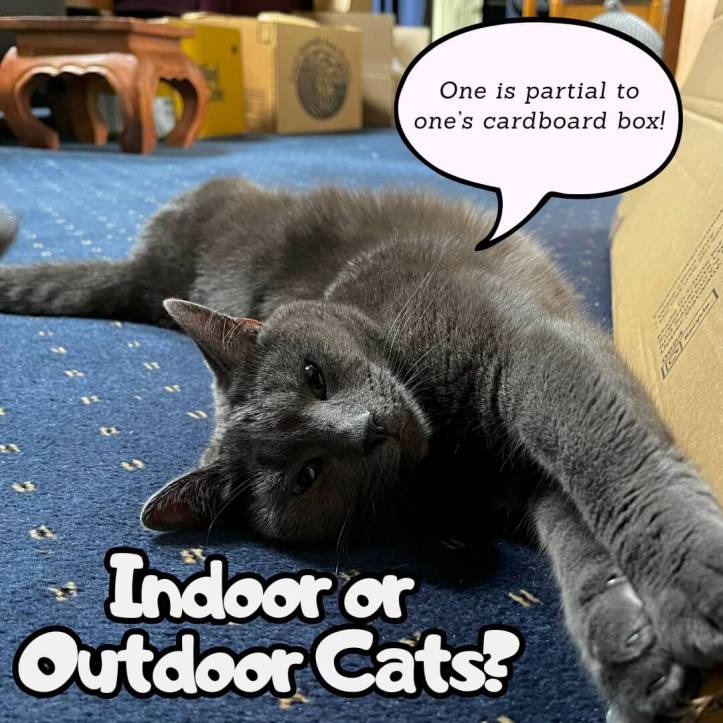
In the world of cats as pets, this is quite the contentious topic. Whilst the rise of indoor cats has grown enormously over the last decade, there are those who believe the outdoor life is the way to go.
Some argue it’s cruel to keep a cat indoors. After all, it’s not its “natural environment”. Well, we’re here today to wade into the debate and see what it’s all about. Meow etc.
Outdoor or Indoor Cats? Enter the Discussion!
We adopted our cat, Susan, in December 2024. After a month we decided to make her an indoor cat, a position she’s happily plopped into.
But recently, when we mentioned this to a friend of ours, he fouled his pants in anger and was convinced this was the most cruel thing we could possible ever do. To support himself, he promptly rolled out some of the most stupid and ignorant debating points possible. But was convinced he was right.
We’d researched this extensively previously, including back in 2017 when we almost got a shelter cat (who was indoor cat only). We’ll well versed in the argument points on both sides, but checking out the online cat community we think the general consensus is thus—indoor cats. Just as a matter of safety to ensure your cat doesn’t get run over. Hell of a lot of cars on the road now.
Whilst our friend had no idea what he was on about and made a FOOL (!!!) of himself, there is still a logical debate to be had there and a strong enough argument for having an outdoor cat.
But for us it’s like getting yourself a lovely new pet dog, opening the door at night, and letting it rampage around the neighbourhood with wild abandon whilst you claim that’s its “natural environment”. It’s not going to take long for it to be injured or dognapped.
Yet with cats, the prevailing tradition in the UK is, “It’s a cat! Therefore, outdoors it goes!”
And so outside goes the beloved kitty to fend for itself. We see them dashing across roads where we live, often missed by centimetres by speeding cars, all whilst their owners are off elsewhere convinced they’ve done the right thing.
Keep in mind the real natural environment for wild cats are forests, grasslands, deserts, and mountainous regions. So we find it confusing why you’d let your cat out on a main road. Do you want you cat to see out the next few months or not? But anyway, for the sake of balance let’s look at the argument points.
The Case For Outdoor Cats
Environmental enrichment—this is the big one. Just being outdoors, sniffing at stuff, investigating, and all that jazz. An outdoor cat gets it all, can go off exploring, and can engage in its natural hunting instincts.
The argument being, then, it’s cruel to deny them this aspect of their life.
Our friend stated his cat lived to 17 and his family let it outdoors, living on a main road in Chorley (of Lancashire), and had no issues. None that he saw, anyway, but there we go—one example where the cat got away with it and lived a happy live. We’ve seen plenty of others over the years who weren’t as lucky.
It does come down to whether you want to accept that risk. If you live near a lot of traffic, there’s a high probability you’ll have to deal with the consequences. It does make us wonder about whether he actually gave much of a damn about his pet.
The Case For Indoor Cats
The outdoor cat stance really stands against how modern life works. Things are much different than they were 30 years ago when we were kids with pets. There are:
- Way more cars on the road
- Far more dogs around
- Lots of people who hate cats
- Airborne diseases and viruses
- Birds of prey
- Local wildlife
In Australia, cat owners are banned from letting their cats out at night. This is to protect local wildlife from being slaughtered. We do think it’s incredibly irresponsible and thoughtless to let your cat out and go on the rampage, with no concern for the damage they cause.
Also, this notion cats need to be in their “natural environment” outdoors makes little sense when applied to where most people live.
Our friend used this “natural environment” as a core argument point, but what is natural about an urban estate like Chorley, on a main road, with cars zapping around, and concrete everywhere?
The core benefit of letting a cat out is for environmental enrichment. But when there are cars hurtling by everywhere and many other threats, that’s often undermined by high levels of stress for the cat as it dodges speeding traffic.
Additionally, there’s the artificially enforced territorial battles cats must face. In their natural environment, cats wouldn’t all live like humans do—terraced up houses near each other, on a main road. Instead, cat owners force their pet into intense neighbourhood battles with other felines. That leads to battles, injuries, and stress.
Cats are extremely good at hiding stress as it’s an essential tactic for life in the wild.
It does baffle us a bit for pet owners to be convinced they’re doing the right thing, letting their cat out into busy urban environments, stressing them the hell out, and then confidently claiming it’s their “natural environment”.
Notes on Susan’s Indoor Cat Life
When we adopted Susan, who’s probably five now, she’d been a stray. We decided to trial run indoor life to see how she adapted to it and, generally, a more happy cat there can not be found.
Crucial to this, as reiterated by Jackson Galaxy as his core mantra, is this:
PLAY WITH YOUR CAT!
This is vital if you’re keeping your cat indoors. Susan is obsessed with play and it’s crucial to engage with her when she wants to let it all out.
As such, verily, we’ve created an environment where it’s accommodating and quiet for her. If you’re not able to provide that sort of home (due to having kids, a dog etc.), then you may well have to let you cat have an escape route into the outdoors.
Our situation seems ideal for an indoor cat to lead his/her best life. As long as you offer these three key things:
- Lots of play
- Environmental enrichment (toys, stuff to hide under, jump over, boxes, stuff to climb, windows to stare out of)
- A healthier diet away from mainstream pet foods (limit the treats to avoid obesity and cat-based diabetes)
Now, if you don’t do the above and ignore your cat then, yes, they’ll get pissed off. Bored and frustrated cats will, most notably, start destroying furniture and “going” outside of their litter box. Thus, the onus is on the indoor cat owner to keep thy pet happily occupied.
For us, it’s the best relationship we’ve ever had with a cat.
The indoor approach has helped us develop a much stronger bond with Susan than would otherwise be in place and we liven up her routine with harness-based trips outdoors.
Given how much cats sleep (and it is goddamn huge amount of time they spend every day napping—up to 16 hours living that glorious sleepy life), a large chunk of their indoor time is spent resting up. This means for the bursts when they’re awake can be spent with play, food, and general merriment.
This is the nature of domesticated pets and why cats/humans have co-existed together for thousands of years. In their human they see a hunk of meat to manipulate for a cosy, happy, lavish lifestyle of being the centre of attention.
If you were a cat you’d be doing the same thing, too.

I can’t decide how much credence to give to it, but bird people also claim that pet cats allowed to roam free are a real extinction level threat to threatened bird species.
LikeLiked by 1 person
Indeed! It’s one of the main reasons I endorse indoor cats. If I let Susan run wild, various local birds would soon be mincemeat. Couple of cool pigeons out there would have to deal with a Stephen King type ending.
LikeLiked by 1 person
Cats love murder so much, yet so snuggly, it’s a trip
LikeLiked by 1 person
Psychotic darlings, it’s a fun life they lead.
LikeLiked by 1 person