
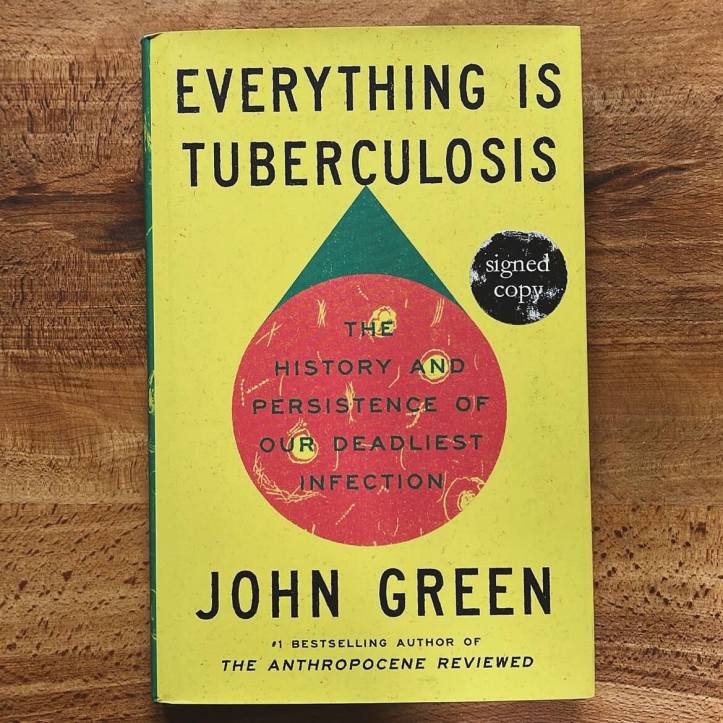
This is a fantastic book by John Green, published in March 2025 and we picked up a signed copy at the Wellcome Museum in London back in October 2025. We finally got round to reading it this week, with its slight 208 pages offering a very moving historical record of one of humanity’s deadliest diseases.
Everything is Tuberculosis explores how the illness has shaped human history, from the arts through to medicine and beyond, with Green arguing the condition is primarily caused by human choices (rather than bacteria). Lets explore its compassionate pages here.
Everything is Tuberculosis: The History and Persistence of Our Deadliest Infection
“The world we share is a product of all the worlds we used to share. For me at least, the history and present of tuberculosis reveal the folly and brilliance and cruelty and compassion of humans. My wife, Sarah, often jokes that in my mind everything is about tuberculosis, and tuberculosis is about everything. She’s right.”
We got a TB jab 30+ years ago and tuberculosis hasn’t played on our minds much since. It feels like a disease of “the past”, even though it continues to kill over a million people annually. But there is a cure, unfortunately some people just don’t have access to that cure.
When we were growing up TB kept cropping in things we were interested in. One of our favourite writers, George Orwell, died of it in 1950 aged only 46. And in the cult classic film Ravenous (1999) the character Colqhuon (Robert Carlyle) recovers from the condition by resorting to cannibalism.
There’s an entire chapter in Everything is Tuberculosis dedicated to creative people who died of the condition. As during the 18th century, the illness was associated with creative genius. Stupidly, of course, as a lot of people got TB and some of them were always going to have a creative streak.
Some of the famous names who died due to TB include Emily Brontë, John Keats, Franz Kafka, Anton Chekov, Molière, and Frédéric Chopin. The disease was particularly associated with Romanticism.
There’s also the great Japanese poet Masaoka Shiki (1867-1902), a haiku master who was still penning new prose just hours before his death. Although he died aged 34, he wrote over 20,000 stanzas. This was one of his last.
Pain from coughing,
the long night’s lame flame,
small as a pea.
Tuberculosis is also a horrible disease. It was called consumption for a long time as it caused patients to waste away under its ordeals, become emaciated and skeletal in the process.
This often lent a pale, red-cheeked look that, in the Victorian era, society viewed as a sign of beauty (so other people, not even with TB, would often try to replicate the gaunt look). Yes, then, the pale and haggard look of people nearing death was viewed as attractive.
But this is not a condition you want to get.
“M. tuberculosis is a near-perfect human predator in par because it moves so slowly. The bacteria has an uncommonly slow growth rate. While E. Coli can double in number about every twenty minutes in a laboratory environment, M. tuberculosis doubles only about once per day. And so infections simply take much, much longer to make an infected person sick, as the number of bacteria remains lower, allowing the immune system lots of time to mount a defense against the pathogen.
But there’s a problem: M. tuberculosis grows so slowly because it takes a long time to build its unusually fatty, thick cell wall, which is a formidable enemy to the immune system. White blood cells struggle to penetrate the cell wall and kill the bacteria from within. In fact, it’s so hard for infection-fighting cells to penetrate the bacteria’s cell what that, instead, white blood cells usually surround it, creating a call of calcifying tissue known as a tubercle.”
And so for many hundreds of years, TB was a bit like leprosy. Something of a feared disease that could get you cast out of society, but also had that strange creative element attached to it.
But this was an era when death was just very common.
“Before vaccination, C-sections, infection control, and antibiotics, the death of children was routine. About half of all humans ever born died before the age of five. Child death was so common that it had to be acknowledged as natural. And so the acceptable times to die in much of the premodern world were 1. Early childhood, or 2. Late in adulthood.
But tuberculosis has long been known for sickening and killing those between twenty and forty-five, during the one period of life when you were supposed to be relatively insulated from illness and death.”
This was a book we bought randomly in October 2025 based on its cover. We like yellow, we love the Wellcome Museum in London, so we picked up a copy as what the hey.
It’s one of those lucky moments as Everything is Tuberculosis is a fine work. It’s tragic, inspired, at times funny, and highlights the precariousness of life on this Earth. It’s only in the last 50 years or so across all of human history that we’ve more or less banished this disease from western society.
Roy Porter’s excellent 2002 work Blood and Guts: A Short History of Medicine reminded us of that, too. How lucky we’ve been to exist in the last half century, coinciding with some actual proper medical understanding.
As in England, if someone you knew got TB tomorrow that’d be considered really bizarre.
Yet, for a long time it was the norm and, for some people, almost a desirable thing. As within that suffering, people penned poetry and are remembered to this day for it. That romantic concept of a tortured genius again.
And a Bit About the Writer John Green
John Green is a American author and YouTuber most famous for his 2012 book The Fault in Our Stars Adapted into a film in 2014). He’s also hosted the innovative podcast/non-fiction book The Anthropocene Reviewed from 2018-2021.
For over a decade, he’s been a major global health advocate and is a trustee for Partners in Health. Everything is Tuberculosis has a big focus on Sierra Leone and its poverty crisis, with one individual called Henry documented throughout the work.
Green met Henry when he was 17, but the nature of TB meant he looked like a young boy. Happily, Henry was able to get a proper treatment regime and is alive and well.
But the book really did make it clear to us how lucky we’ve been. How diseases like TB that seem to belong in a past age are, in fact, still causing havoc across less fortunate regions of the world. Sierra Leone is so poverty stricken as the British Empire designed a railroad system to get all accumulated wealth out of the country as fast as possible. The pernicious nature of that system is still felt to this day.
Due to Green’s status, Everything is Tuberculosis was a hit and topped the New York Times bestsellers list, remaining in the list for some 23 weeks.

Both my maternal grandparents died of this disease, so I found your summary fascinating 👌
LikeLike