
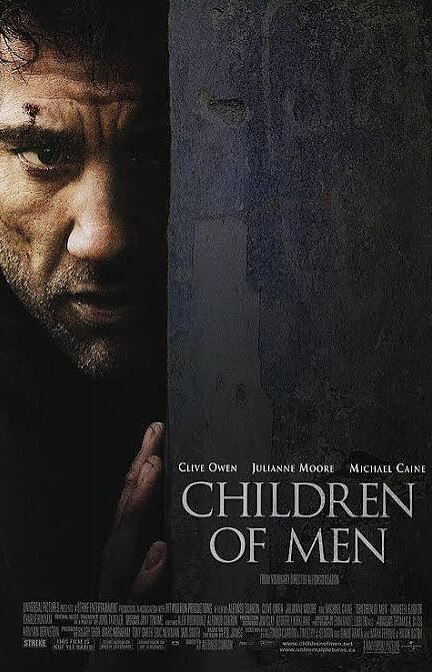
This is a fantastic film co-written and directed by Mexican filmmaker Alfonso Cuarón. Children of Men launched in September 2006 and was a British-American production that met with critical acclaim.
The setting is London 2027 and the dystopian action thriller explores a bleak future world concept of human infertility and humanity on the verge of extinction. The way it delivers this concept is constantly thrilling, with the final 40 breathless minutes some of the most powerful cinema you’ll ever see.
Ramping Up the Intensity in Children of Men
This is the second time we’ve watched the film. The first was back around 2008 and the thing floored us, with many scenes sticking in our brains over the last 18 years. This second viewing has confirmed for us this is a modern classic.
Children of Men almost exclusively follows the viewpoint of Theo Faron (Clive Owen), a former political activity turned cynical salaryman.
He works in London where an oppressive British government enforces strict laws, especially on the immigrant population (which it actively seeks to destroy).
Okay, so some SPOILERS are ahead here. What transpires is Theo is kidnapped by his ex-wife Julian (Julianne Moore), who’s the highly intelligent leader of a far-left refugee liberation group. She manages to coerce him into helping transport the young refugee Kee (Clare-Hope Ashitey) out of the country.
The group is ambushed on their journey and Julian is shot and killed.
Theo travels with new group leader Luke (Chiwetel Ejiofor) to a safehouse. There Kee reveals to Theo she’s pregnant (the first known pregnancy in 18 years) and the gravity of the situation becomes apparent. Especially when Luke reveals his real intentions.
Theo flees the safehouse with Kee and plans to get her to a boat called the Tomorrow, which is off the coast of England and run by a far-left group called the Human project.
Before he begins the perilous journey, they have a reprieve at his friend Jasper’s house. Jasper (Michael Caine) has a discussion about chance and faith, whilst also revealing the fate of Theo and Julian’s young child.
Where Children of Men excels is with the build-up of all this. It just ramps up in intensity over the course of every new act, as what’s ahead of the above scene is psychologically draining.
It builds to a phenomenal scene where Theo has to help Kee give birth. The delivery of it all that follows by Clare-Hope Ashitey and Clive Owen is outstanding, playing out in a dingy flat in a Bexhill concentration camp.
If that wasn’t intense enough for the audience, there’s then a brutal 10-minute warzone sequence that follows. In this, Kee is kidnapped by Luke and Theo must do everything he can to save her and the new-born.
It’s a Shakespearean narrative arc for Theo. He goes from a heavy drinking, cynical schlub to saviour. As is Julian. Even though she’s only in the film briefly, her influence is a guiding force throughout it.
There’s a scene midway through the film where Kee makes it clear Julian told her she must trust Theo, no one but Theo. When Kee tell him that, he can’t understand why Julian would recommend him. But when it comes to the life or death struggle, Julian is correct. He’s a noble soul and puts his life on the line to save Kee and her daughter.
It’s a great bit of writing. There are certain people in life who you will, and can, trust implicitly and that’s quite rare. You can have friends, colleagues, or partners and yet you may not fully trust them given the weaknesses of human nature. Yet there, sometimes in unexpected forms, is someone grounded in a real sense of morality.
Thanks to Julian and Theo’s actions, Children of Men does end on a message of hope.
And despite the bleak nature of what we see, some of which now sadly reflects the socioeconomic and political crises of 2026, it’s a beautiful film to sit and observe.
If you’ve not seen it, now is the time. 20 years after its release it deserves a lot more attention beyond its cult classic status. And for our money, this was easily the best film of 2006.
The Production of Children of Men
Unfortunately, the film was a box office failure. Off its $76 million budget, it only returned $70.5 million. There were three main reasons for this:
- Poor marketing from the publishing studio
- Its US market launch on Christmas Day promoting a bleak concept
- Unconventional and challenging approach to science fiction
Universal Pictures only provided the film with 1,200 screens in the US to go with its Christmas Day launch window. This also coincided with other films the studio was promoting, such as the more patriotic United 93 (also an excellent film, but about the 9/11 attacks).
This means we’ve got another cult classic Ravenous (1999) type deal here. Great film, just poorly marketed, but one that’s since gained a sizeable cult film fan following (FFF).
Children of Men was adapted from P. D. James 1992 novel of the same name, but the film is considerably different to the novel. Alfonso Cuarón used A Clockwork Orange (1971) as the main influence for his concept. Once he was cast in the lead, lead actor Clive Owen worked closely with Cuarón and Timothy J. Sexton on the screenplay. His insights were so good, he was brought on as another writer and is credited in the film for that, too.
Most of the shoot was filmed in London, with East London (mainly as quite a bit of that area is a bit dingy and rundown). Cuarón used a lot of single-shot sequences for all of this, especially in the intense birth scene and warzone sequence.
For the warzone sequence, it took five hours (and much expense) every time Cuarón needed to single reshoot some sections. That included Clive Owen, placing a lot of demand on him. As he later said:
“Right in the thick of it are me and the camera operator because we’re doing this very complicated, very specific dance which, when we come to shoot, we have to make feel completely random”
20 years on and the relevance to modern life (especially with the scenes involving immigrants) is notably bleak. But, again, we must stress the film ends on a positive note.
And despite its commercial failure, the film was critically acclaimed at the time. It got three Oscar and BAFTA nominations and won for the latter in Best Cinematography and Best Production Design.
However, we do feel this should’ve been blitzing all Best Film of the Year awards. But there we go.

I’ve got to watch this!!!
LikeLiked by 1 person
Watch it then! It’s very good, just psychologically rather dramatic.
LikeLiked by 1 person
OK!
LikeLiked by 1 person